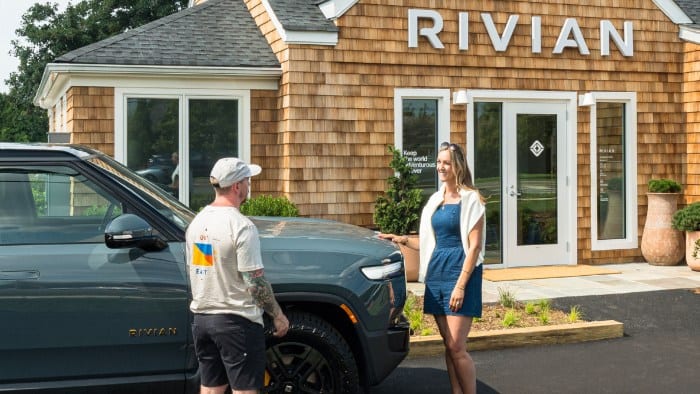

Cantor Fitzgerald is modeling 18,228 Rivian deliveries for the third quarter — a number that quietly makes the fourth quarter the biggest bet in the company’s history.
Analyst Andres Sheppard held his Neutral rating and 12-month price target of $19 in a note sent Friday morning, first obtained by the Wall Street research note archive PriceTarget.
The note came less than 24 hours after Rivian narrowed its adjusted EBITDA loss to $379 million and beat the Street on nearly every line. The EV maker did not unveil how many R2 vehicles it produced or delivered between April and June.
Cantor models 67,511 deliveries for the full year — inside Rivian‘s 65,000-to-70,000 guidance, raised on 2 July — but with 22,559 delivered in the first half and roughly 18,228 penciled in for the third quarter, the model leaves about 26,700 vehicles for the final three months.
Deliveries include the R1S and R1T flagship models, but also the recently launched R2 and the commercial vans co-developed with Amazon EDV 500 and 700.
The figures would be roughly 70% above Rivian‘s best quarter on record, the 15,564 vehicles of the third quarter of 2023, and nearly 90% above the strongest quarter of the past two years.
The shape matches what management itself described.
Chief operations officer Javier Varela said on Thursday’s call that the second R2 shift, due by the end of September, will contribute no material volume until the fourth quarter.
The third quarter will mostly run on a single shift plus the R1 and van lines, and the year’s fate compresses into a fourth-quarter ramp that has to work the first time.
“On the call, management disclosed that initial conversion rate from reservations for its R2 Performance vehicle (highest-priced trim) had been “meaningfully higher” than expectations, and included “a significant number of first-time EV owners,” which we find encouraging,” Sheppard wrote. “Management is targeting positive gross profit margin (on a per-unit basis) for R2 by the end of FY26.”
As of publication time, Rivian shares were trading 3.09% higher during Friday’s pre-market session at $17.35
The Beat Cantor Is Looking Past
The note catalogs how far the quarter cleared consensus.
Revenue of $1.658 billion beat Cantor’s $1.592 billion estimate and the Visible Alpha consensus of roughly $1.537 billion.
Gross profit of $179 million came in nearly three times the $63.9 million consensus — and even stripped of regulatory credits, the firm puts gross margin at 4.6% against a 4.2% consensus.
The adjusted EBITDA loss of $379 million compared with a consensus near $557 million, the net loss of $837 million beat the roughly $986 million expected, and free cash flow of negative $849 million landed within $3 million of Cantor’s own estimate.
Sheppard wrote that the firm remains on the sidelines awaiting “a better entry point and granularity on the company’s monetization plans for autonomy.”
In its model, Cantor cut full-year capital expenditure to $1.75 billion to match the lowered guidance while nudging operating expenses up to $4.302 billion, and derives the $19 target from a ten-year discounted cash flow.
Upcoming Catalysts
The note’s catalyst list doubles as a second-half calendar: a third-quarter pre-announcement in October, the RAP1 chip launch and point-to-point autonomy rollout in the second half, Rivian Assistant arriving on the R2, the Standard trim in the first half of 2027, eyes-off autonomy in 2027 and Level 4 robotaxi capability in 2028.
One entry sits oddly against Thursday’s call.
Cantor listed the R2 Premium trim as a second-half-2026 launch, the timeline Rivian communicated at the March debut — but chief executive RJ Scaringe said twice on the call that the other trims, mid-spec included, arrive “as we look at the early part of 2027.”
Vans, Uber and the Liquidity Staircase
The note also lays out the capital sequence in one staircase: pro forma liquidity of roughly $7.2 billion today including the July raise; about $8.4 billion targeted for 2026 once the $1 billion Volkswagen loan arrives in October and Uber’s $250 million equity investment closes.
The figures also include the up-to-$4.5 billion Department of Energy (DOE) loan drawn by mid-2027; up to $700 million in further milestone-linked Uber investments through 2031 and a final $460 million Volkswagen tranche by 2028.
In total, the number lands at Cantor’s about $14.1 billion of total targeted capital — the “over $14 billion” management cited on the call.