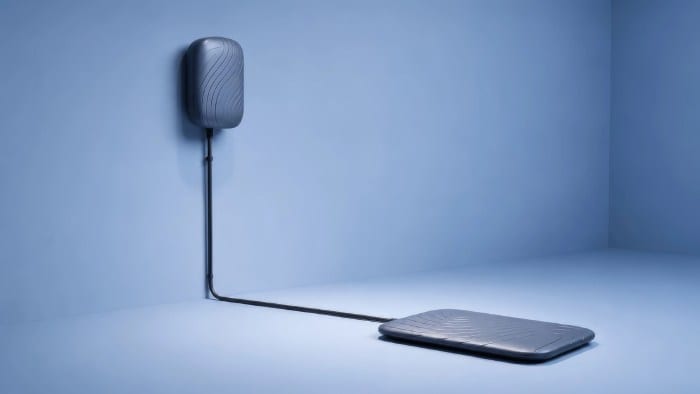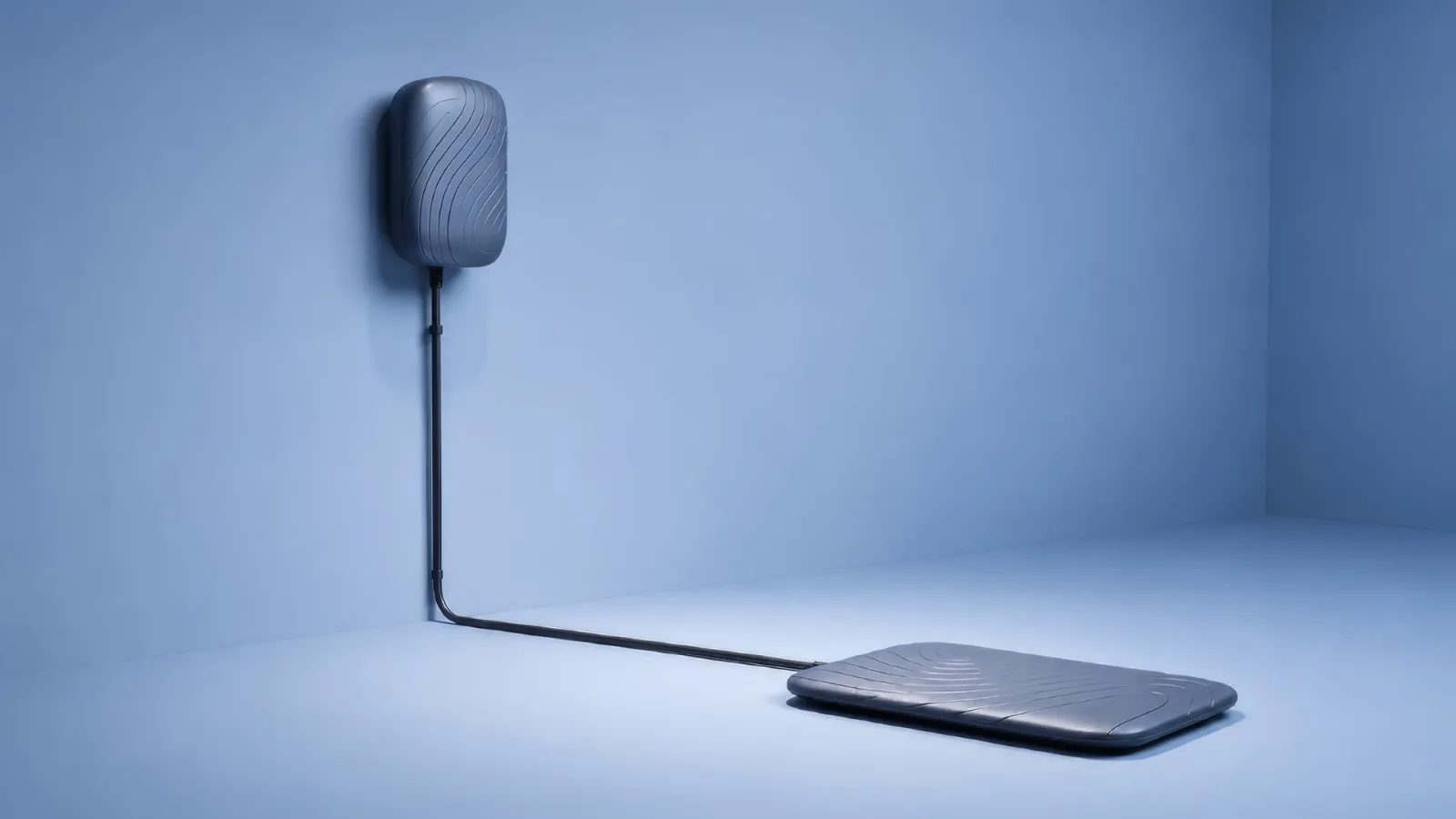

Electreon Wireless has begun showing Lite DOT, its wireless charging system for passenger cars and light commercial vehicles, at IAA Transportation in Hannover — the Israeli company’s first product aimed squarely at private parking spaces and small fleet depots rather than highways or transit routes.
Lite DOT delivers up to 11 kW of charging power through an above-ground pad and wall-mounted control unit, matching the standard output of most private home chargers.
No cable, no plug and no excavation are required.
Charging begins automatically once the vehicle parks over the pad and the system identifies it.
Electreon described the product as the first in a new category: modular wireless charging designed for installation on existing parking infrastructure without civil works.
The company gave no price, no availability date and no launch market, and named no customer.
Lite DOT uses the same magnetic-induction technology Electreon deploys in its existing commercial products. A charging pad sits on the surface of a parking space.
A wall unit mounts on a garage wall or an outdoor pole, and a mobile application called Electreon Flow manages the session.
A vehicle-specific receiver coil, supplied by Electreon or by an automaker partner, completes the circuit from underneath the car.
The system operates in temperatures from −30 °C to +50 °C (−22 °F to +122 °F) and functions in rain and snow, with both indoor and outdoor installation being supported.
“The future of electric mobility is wireless, and it will soon be available in every parking space,” Oren Ezer, Electreon’s chairman and CEO, said in a statement.
Fleet Operators in Focus
Electreon positioned Lite DOT primarily as a fleet tool.
Cables remain one of the most maintenance-intensive components of conventional EV charging infrastructure, the company said, citing frequent plugging and unplugging, exposure to weather and dirt, and damage from vehicles running over connectors.
“Fleet operators need flexible and scalable charging concepts that can be easily installed at their sites and parking facilities and integrated seamlessly into day-to-day operations,” Andreas Wendt, managing director of Electreon Germany, said.
Lite DOT also supports autonomous vehicles, a use case where cable-free charging is not a convenience but a functional requirement.
Vehicles without human operators cannot plug themselves in, which leaves wireless pads or robotic conductive connectors as the options for depot-scale autonomous fleets.
The Efficiency Cost
Wireless transfer loses energy a cable does not, and Electreon has published no efficiency figure for Lite DOT.
Its own bus depot at Rosh HaAyin in Israel, which the company calls the world’s first 24/7 wireless charging depot, reports 89.3% efficiency alongside 99% uptime and about 60 km of added range per bus a day across 23 buses.
For a depot charging overnight on industrial tariffs, roughly a tenth of the energy is a fair price for taking cables out of the operation. For a private owner paying retail, it is a standing surcharge on every kilowatt-hour.
Crowded Field
Wireless EV charging has moved from laboratory demonstrations to production vehicles and commercial fleets in the space of two years.
Porsche began production of the electric Cayenne earlier this year with an optional 11 kW wireless charging floor plate — the first factory-integrated system from a major automaker.
The Cayenne lowers its air suspension to close the gap between its underbody receiver and the ground pad, and Porsche claims efficiency of approximately 90%.
The 50 kg floor plate plugs into a domestic socket and needs professional installation, and Porsche says 75% of charging happens at home, which is the market it is aiming at.
Tesla demonstrated wireless charging at 25 kW during the October 2024 Cybercab reveal and claimed efficiency above 90%.
The Cybercab, which entered service in Austin on September 3, was originally presented without a charge port and designed to charge inductively.
Production vehicles were found to carry a concealed NACS port, and Tesla’s second Austin robotaxi charging site filed with 24 plug-in stalls and no wireless pads.
Wireless pad deployment timelines remain unannounced.
Tesla secured an FCC waiver in February 2026 for ultra-wideband radios on a fixed outdoor ground pad, clearing a regulatory path for centimeter-level vehicle positioning over charging coils.
Porsche uses the same ultra-wideband alignment but needed no waiver, because its system is for private use.
Genesis offers an 11 kW wireless option on the GV60 in South Korea.
WiTricity licenses resonant-coupling technology used by several tier-one suppliers.
Oak Ridge National Laboratory has demonstrated systems at hundreds of kilowatts in controlled settings.
Electreon differs from most competitors in scope.
Beyond Lite DOT, the company sells LINE for dynamic in-road charging while driving, DASH for opportunity charging at stops and Ultra DOT for high-power heavy-duty charging.
Live projects span more than 20 deployments across Europe, Asia and North America, including what Electreon calls the world’s first wireless charging highway segment and a 24/7 wireless bus depot.
Electreon closed its acquisition of InductEV, a Pennsylvania-based provider of high-power stationary wireless charging for heavy-duty transit and freight, in March.
The deal brought the combined patent portfolio to approximately 400 granted and pending patents covering wireless energy transfer.
InductEV’s systems serve commercial fleets in North America and Europe and carry Build America Buy America compliance, preserving eligibility for US federal funding programs.
Market Context
European EV registrations grew approximately 33.7% in the first six half of 2026, according to data from E-Mobility Europe.
More than 1.24 million fully electric cars were registered across the continent in the period. ACEA data put the EU-only fully electric vehicle (BEV) market share at 20.7% through June, up from 15.6% a year earlier.
Globally, the International Energy Agency projected in its 2025 Global EV Outlook that electric cars could account for more than 40% of new car sales by 2030 under current policy settings.
The same report estimated approximately 150 million charging points would need to be added between 2025 and 2030 to support that growth, with about two-thirds of those being home chargers.
SAE J2954
SAE J2954 is the industry standard governing wireless power transfer for light-duty EVs.
Published by SAE International, it defines operating frequency, power classes from 3.7 kW to 22 kW, minimum efficiency thresholds and safety requirements including foreign-object detection.
Broad adoption would allow any equipped vehicle to charge on any compliant pad — the wireless equivalent of a universal plug.
Wireless charging does not compete with high-power DC fast charging for long-distance travel.
Its value lies in eliminating plug handling and cable wear during routine parking — at home, at depots and at fleet facilities — and in enabling automated charging for vehicles that operate without a driver.
How quickly the technology moves beyond premium options and autonomous fleets into the broader market will depend on three things: convergence around J2954, the cost of adding a receiver coil to every new vehicle and who foots the bill for ground-side infrastructure.
IAA Transportation runs in Hannover through September 20.