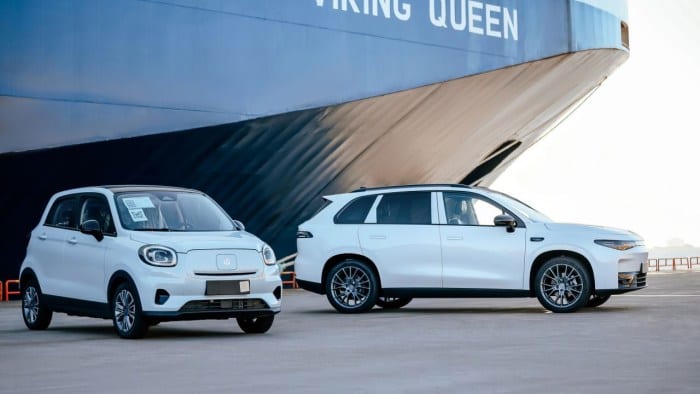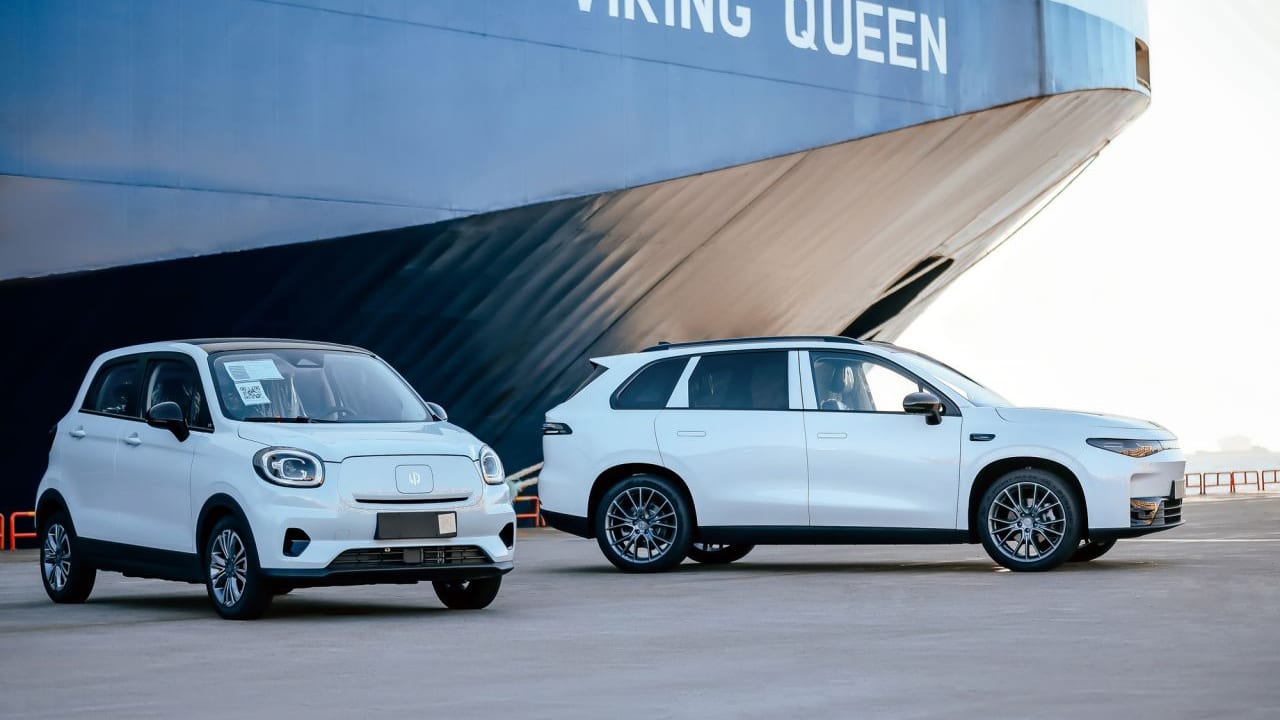

Leapmotor will begin building vehicles in Spain next month, and British buyers will keep taking vehicles shipped from China, as the United Kingdom does not tax them.
Damien Dally, who runs Leapmotor in Britain, told Auto Express that Spanish output has to go to the European markets that impose duties, since those are where local production changes the economics.
The European Union charges up to 35.3% on imported EVs from some Chinese manufacturers on top of a standard 10% import duty while Britain charges nothing.
Leapmotor’s own rate is likely below the 35.3% maximum, which applies to manufacturers that did not cooperate with the European Commission’s investigation. Neither Stellantis nor Leapmotor has published the rate its cars pay.
“That’s not to say that we will never get cars from Spain or Europe,” Dally said, “because they can quickly react in the same way as they’ve done.”
The Plant
The B10, a 4.52-metre electric SUV and Leapmotor’s best-selling model in Britain, will be the first car built at the Figueruelas plant near Zaragoza, which Stellantis runs and where the Peugeot 208 and Lancia Ypsilon are made.
Stellantis chief executive Antonio Filosa confirmed the site at the group’s results presentation in March, saying production would begin in the second half of this year. Leapmotor’s global quality director Ding Yongfei had set out the plan in December.
“We will produce the B10 and, by 2027, the B05, the A10, and the A05,” he said. “In total, four models at the Stellantis Figueruelas plant.”
Initial volume is 40,000 cars a year. Leapmotor registered 48,261 across Europe in the first half alone.
The Spanish operation is a complete-knock-down assembly plant rather than a full manufacturing site, which matters for how much of each car counts as European.
Supply is being localised alongside it.
Leapmotor International opened a battery assembly workshop in June at Mallén, about 50 kilometres from the car plant, which will supply around 65,000 modules a year with room for 100,000. It starts with lithium iron phosphate packs for the B platform in Pro and ProMax versions, is built to handle other chemistries, and employs Spanish workers trained at a battery facility in China.
The building covers 19,000 square metres on a 34,000-square-metre site.
Lieder Automotive, a joint venture between China’s Duoli Technology and the Basque supplier Fagor Ederlan, began building B10 chassis at a former Fagor plant in Borja in July.
Stellantis said in May that a transfer of ownership to Leapmotor International’s Spanish subsidiary was under discussion.
Why Now
Tariffs are not the only reason.
Giacalone said the cost of shipping space from China has risen 150%, which he attributed to the Iraq war and other tensions.
Freight data broadly supports the scale if not the cause. The Drewry World Container Index stood at $2,107 for a 40-foot container in late January. By June, rates from Chinese ports to northern Europe were frequently above $5,000, a rise of about 137%, after carriers imposed general increases and continued routing around the Cape of Good Hope rather than through the Red Sea.
“Bringing a car over from China has started to become expensive, so rightfully, we started planning our European operations a couple of years ago, and we are now about to start,” he said.
He set two conditions for building in Europe. The first was quality matching Chinese production, given spare capacity at the Stellantis plant. The second was speed.
“When in China you develop a car and start production in just 18 to 20 months, you don’t want to change your way of working,” he said. “You don’t want to open a plant somewhere and then all of a sudden your SOP time, because of the supplier network, becomes 36 months. You totally lose your competitive advantage.”
He said Leapmotor has built a tier-one supplier base in Europe capable of working to Chinese specifications, which he expects to speed up future models.
What Britain Gets Instead
Leapmotor arrived in Britain in spring 2025 and has grown fast. It registered 4,273 vehicles in 2025 and had passed 11,000 since launch by June, when it took 2,150 registrations in a single month for 1% of the new car market and 3% of the electric market.
It has outsold Fiat in Britain this year and is close to Lexus.
Across Europe, registrations rose 526.7% in the first half to 48,261, which made it the fastest-growing brand in the European Union and put it ahead of Alfa Romeo, Lexus, Honda and Porsche.
Leapmotor delivered 67,052 vehicles outside China in 2025 and has about 900 sales and service outlets across 40 countries, more than 800 of them in Europe. It reported its first annual profit for that year, 540 million yuan on revenue of 64.73 billion, and says its overseas business is already profitable.
Those British vehicles will keep coming from China.