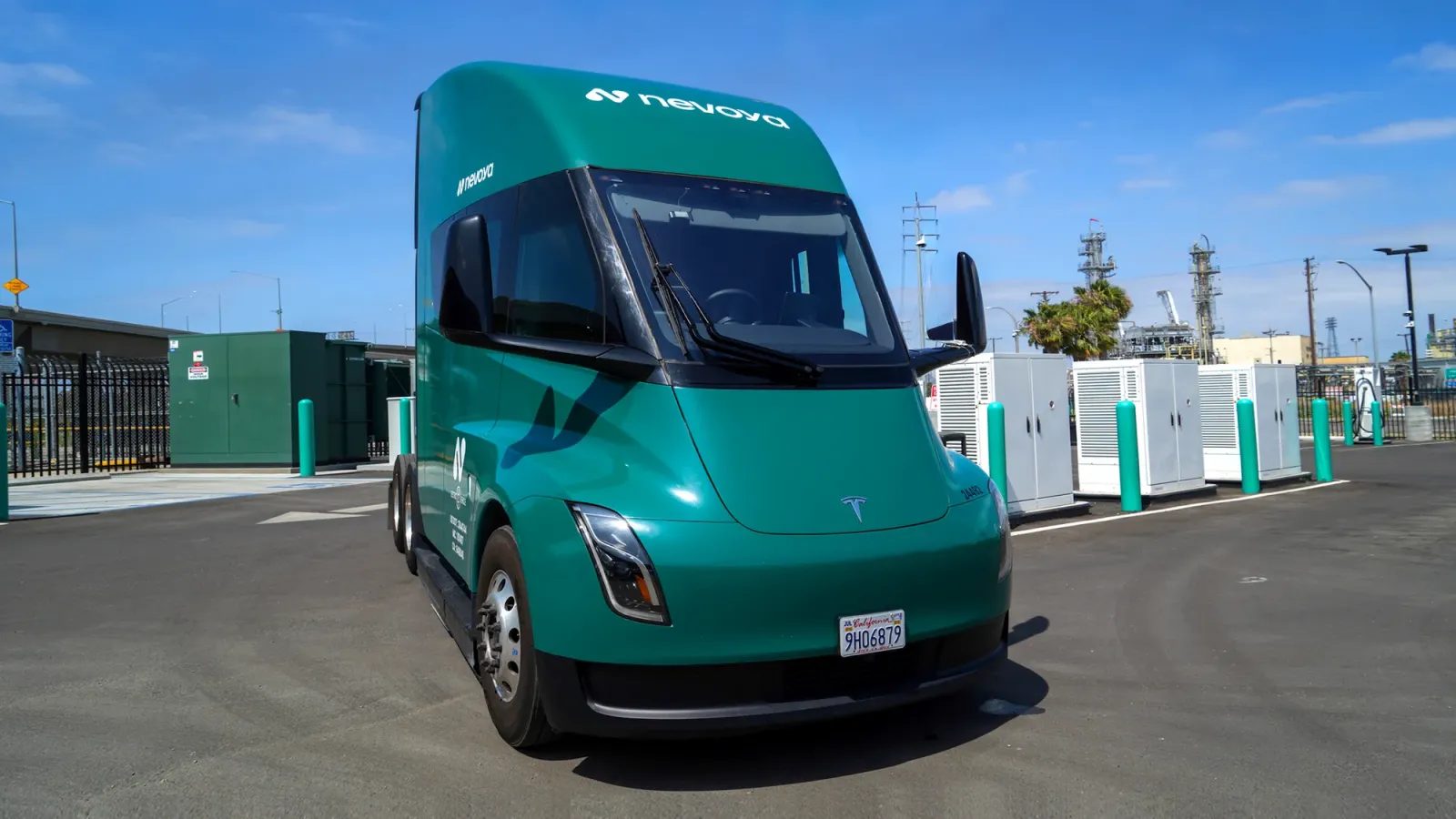

Google is underwriting 25 electric semi trucks and charging infrastructure on a new all-electric freight corridor between Houston and Dallas through the purchase of emissions certificates.
The company will not own or operate any of the vehicles.
Instead, it will receive environmental attribute certificates (EAC), paper credits representing the emissions avoided by running electric rather than diesel, and retire them against its own supply chain footprint.
Jenna Stauffer, Google’s Head of Strategic Priorities for Climate Operations, published the announcement on Tuesday.
The deal expands a project already underway.
In January 2026, the Center for Green Market Activation (GMA) and Smart Freight Centre announced that carrier Nevoya would deploy about 40 Class 8 battery-electric trucks on the same Houston–Dallas route, backed by multiyear offtake agreements from Amazon, Meta, eBay, Etsy and Green Worldwide Shipping.
Google’s 25 trucks bring the total to 63 — what GMA calls the largest known deployment of Class 8 battery zero-emission trucks in Texas.
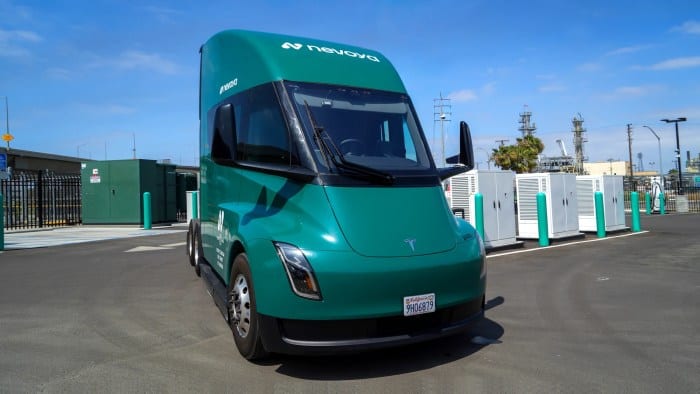
The blog post includes an image that shows a Tesla Semi in Nevoya’s teal livery on California plates, but neither Google, Nevoya nor GMA names a truck manufacturer in the September announcement. The make and model of the 25 additional trucks has not been disclosed.
Nevoya is one of the few carriers already running the Semi. California payment records showed Tesla had collected on five Semis as of March, all delivered to Nevoya Transportation LLC in July 2025, and The Wall Street Journal listed Nevoya among the first paying Semi fleets alongside PepsiCo, DHL, ArcBest and RoadOne.
The truck in Google’s photograph is one of those.
Combined, the 63 trucks are expected to travel approximately 11 million miles per year and reduce an estimated 92,000 metric tons of carbon dioxide equivalent emissions over the life of the contracts, according to Google’s blog post.
The January tranche was described as “roughly 40” trucks, so on Google’s count of 63 it was 38 or the two figures overlap. Neither party has reconciled them.
The Trucks
Nevoya, a Southern California all-electric carrier based in Colton, east of Los Angeles, runs Freightliner eCascadia day cab trucks. The initial trucks announced in January were identified by Electrek, from Nevoya’s own photographs, as what “appears to be” eCascadias**, 116-inch day cabs with battery packs up to 438 kWh and a fully loaded range of about 220 miles, charged at Greenlane fast-charging sites along the corridor. Neither Nevoya nor GMA has named the make.**
Nevoya also operates Volvo VNR Electric trucks and, as of mid-2025, had placed orders with Tesla and Volvo for future deliveries.
Freightliner offers the eCascadia in 230-mile single-drive and 220-mile tandem-drive long-range versions on the 438 kWh pack, and shorter-range configurations.
On a Houston–Dallas run of about 240 miles by road, the eCascadia operates at the edge of its loaded range while the Semi’s 325- and 500-mile ratings leave margin for a same-day turn, which is one reason the unnamed 25 are the tranche most likely to include Semis. That is inference, not disclosure.
Nevoya uses its proprietary AI-powered transportation management system to optimize routes, charging and fleet utilization, and claims to have achieved cost parity with diesel operations.
Class 8 Electric Trucks
Google’s deal lands as Class 8 electric truck momentum accelerates — driven overwhelmingly by the Tesla Semi.
Tesla has set a Semi factory opening event at its Sparks, Nevada plant for September 24, five months after the first truck came off the high-volume production line.
The 1.7-million-square-foot factory is designed for 50,000 trucks per year.
Tesla’s first Semi came off the high-volume line at its Sparks, Nevada factory on April 29.
Chief executive Elon Musk said on the second-quarter earnings call that mass production had started.
Orders have stacked up rapidly.
Einride signed a 500-truck deal in August, the largest publicly announced order for the truck, with deployment beginning in September across California, Texas, New Jersey, Illinois and Georgia on Amazon freight.
WattEV placed a 370-truck order in May worth approximately $100 million, with the first 50 units scheduled for delivery still this year.
A California freight firm ordered 40 in May, DHL has ordered beyond what it called a handful of trucks, and Paper Transport began evaluating the Semi on Chicago dedicated runs in July.
In California’s Clean Truck and Bus Voucher programme, the Tesla Semi accounted for 965 of 1,067 applications between January 2025 and February 2026.
Daimler, PACCAR and Volvo together received fewer than 100.
Production Semis are offered in a 325-mile standard range at about $260,000 and a 500-mile long range at about $290,000, both at 82,000 lb gross combination weight.
Tesla is also preparing to unveil European specifications and launch details at IAA Transportation in Hanover, running September 15 to 20.
Yet the broader Class 8 zero-emission market remains small.
GMA program associate Stacey McCluskey noted in January that zero-emission freight truck sales had peaked at less than half a percent of the market and had since dropped to nearly nothing, with fewer than 200 units sold in the first half of 2025 — an 80% decline from the same period a year earlier.
Pooled Demand
GMA designed the procurement to address that gap.
By pooling corporate EAC purchases from Google, Amazon, Meta and others, the program creates enough guaranteed revenue for Nevoya to justify deploying trucks and building charging infrastructure on routes that might not otherwise pencil out.
Kim Carnahan, GMA’s Chief Executive, said in January that the organization had proven a replicable model to get zero-emission trucks on the road.
Google framed the approach in terms familiar from its aviation deals: pooling EAC procurement with other companies sends a stronger demand signal, which helps grow the market for technologies like zero-emission freight.
Nevoya has not disclosed whether its additional 23 trucks — beyond the 40 eCascadias announced in January — will be Freightliner, Tesla Semi or another platform.
How The Model Works
None of the participating companies need to ship their own freight on the trucks.
The structure uses a book-and-claim system: Nevoya operates the electric fleet, an independent accredited auditor verifies the emissions reductions, and the environmental attributes are tracked through a registry and sold to corporate buyers.
Charging for the fleet is backed by Green-e Renewable Energy Certificates.
Corporate buyers purchase the attributes to meet their climate targets even when their own packages travel on different vehicles.
GMA describes the approach as decoupling the environmental benefit of zero-emission trucking from its physical delivery, allowing attributes to be sold and tracked separately.