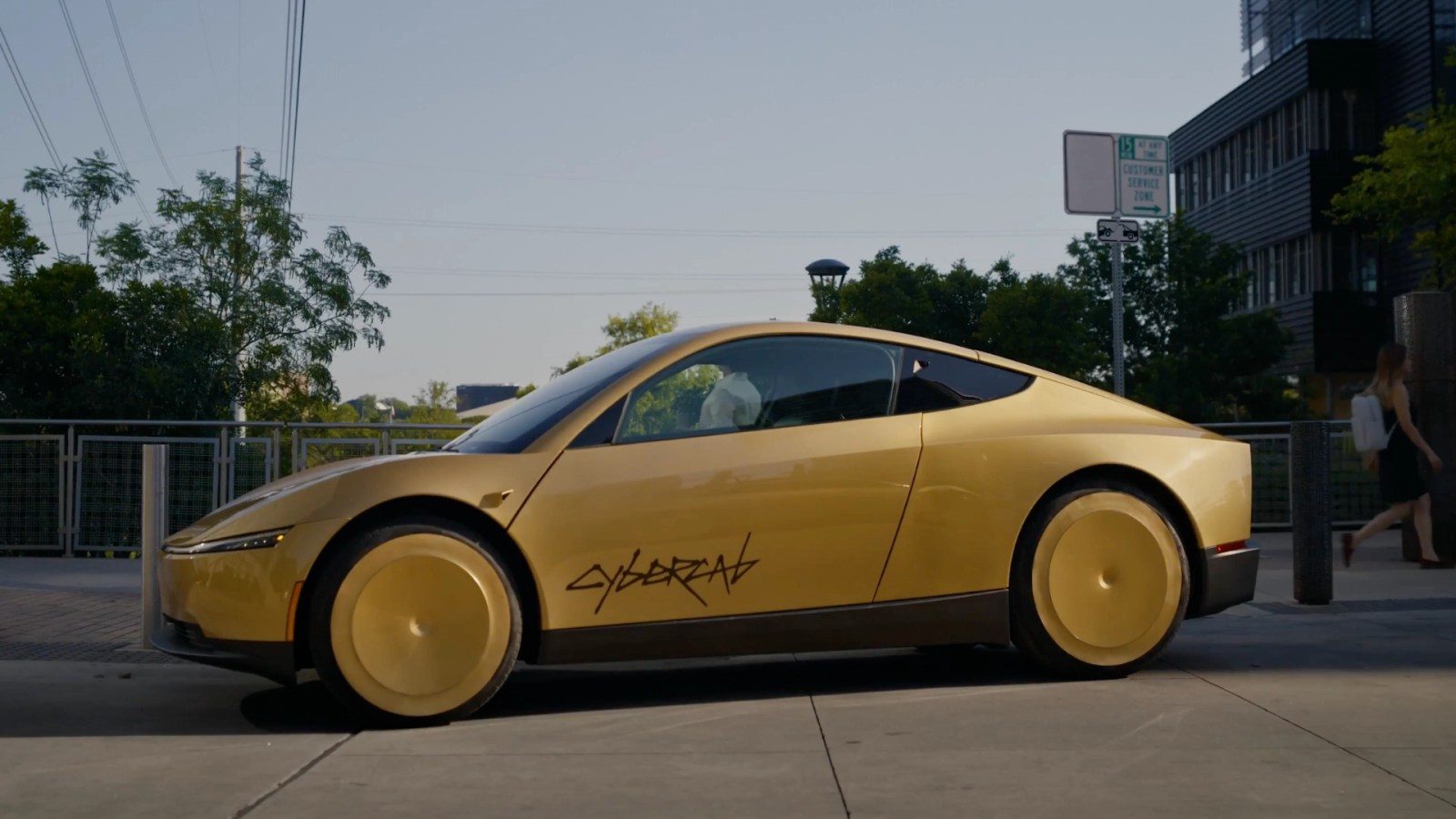

Tesla held a private launch event for the Cybercab on Thursday afternoon at ACL Live in downtown Austin, giving invited guests the first rides in its purpose-built two-seat autonomous vehicle.
Public rides in geofenced areas of the city open Friday at 6 p.m. ET.
The closed-door gathering started around 5:45 p.m, with no official Tesla livestream.
Attendees had been selected through a Robotaxi ride sweepstakes and direct invitations.
Several attendees recorded and shared the 15-minute long keynote and said that 250 Tesla employees were at the event.
Tesla AI VP Ashok Elluswamy and other executives spoke at the event, with CEO Elon Musk participating through posted comments rather than appearing in person.
Cybercab Enters the Robotaxi Fleet
Rides began immediately for event attendees in limited parts of Austin through the existing Robotaxi app.
Tesla updated the app to let riders choose between a Cybercab or a Model Y hours before the event took place.
Broader public access follows Friday at 6 p.m. ET, the company announced at the event and reiterated in a post on X from its Robotaxi account.
Tesla described the rollout as open to the entire public within the geofenced zones, though availability remains constrained by a small initial fleet.
Approximately 45 Cybercabs are registered in Texas as part of a broader autonomous fleet of about 420 vehicles, according to state filings.
JPMorgan noted last month that Tesla was deliberately holding back Model Y additions to its Robotaxi fleet in anticipation of Cybercab deployment.
Tesla described the launch as a quiet milestone after nearly two years of development since the October 2024 ‘We, Robot’ concept reveal at Warner Bros. Studios in Los Angeles.
One Million Unsupervised Miles
Elluswamy announced at the event that Tesla’s Robotaxi fleet has reached 1 million unsupervised autonomous miles — a sharp increase from the 380,000 miles disclosed at the second-quarter earnings call on July 22.
The jump of 620,000 miles in about six weeks suggests a significant acceleration in fleet activity ahead of the Cybercab deployment.
Executives outlined plans for dynamic pricing that rises with demand, framing the service as offering “a first-class experience at coach price.”
Long-term operating cost targets remain around $0.20 per mile, with passenger-facing fares potentially reaching $0.30 to $0.40 per mile including taxes.
No exact current fare structure or launch date for paid rides was disclosed.
The Robotaxi app now includes age restrictions barring children under 13 from Cybercab rides, along with updated terms of service.
Tesla also opened a public interest form for companies wanting to buy Cybercab fleets, operate mobility hubs or provide infrastructure — a shift from earlier visions centered on individual owner-operators adding personal vehicles to the network.
24/7 Service Within a Month
In a separate post on X hours after the event, Elluswamy responded to known Tesla enthusiast ‘Whole Mars Catalog’ who requested round-the-clock Cybercab availability by writing that 24/7 service would arrive within about a month.
“Next month or so. the next tech to merge on the v15 plan will enable it,” the executive wrote.
He attributed the expansion to the next technology track merging into the FSD v15 development plan.
The Robotaxi fleet already runs early builds of FSD v15, as Elluswamy confirmed during the July earnings call.
FSD v15 represents an architectural leap over the current consumer release, FSD v14.3.x, expanding the neural network from approximately one billion parameters to about ten billion — a tenfold increase.
Elluswamy has said seven parallel improvement tracks make up v15, with about 40% already merged and running on the fleet.
A broader consumer rollout is not expected before late 2026 or early 2027.
Dedicated Robotaxi Superchargers
Max de Zegher, Tesla’s Director of Charging for North America, posted a breakdown of the fleet’s charging strategy on X.
“We’re using public Superchargers where we can, especially at night when utilization is low,” he wrote, adding that they’re “also building dedicated Robotaxi Superchargers: back-to-back sessions, low-cost real estate close to demand, low capex.”
Cybercabs are currently plugged in manually, de Zegher wrote, adding that automated charging is planned for a later stage. On public Superchargers, cars carrying passengers take priority; Robotaxis are dispatched to charge when stalls are available.
Tesla’s charging app now shows Cybercab as a vehicle type in Supercharger site maps.
De Zegher framed cost discipline as critical to scaling the fleet, writing that “every penny matters for Robotaxi scale, including charging.”
NHTSA Evaluating the Rollout
A spokesperson of the US National Highway Traffic Safety Administration told Reuters the agency is evaluating the Texas rollout and is in contact with Tesla.
They have not specified which aspects of the deployment are under scrutiny.
The Cybercab lacks a steering wheel, pedals and conventional mirrors — features that federal safety standards typically require.
Federal regulations also limit the number of vehicles any manufacturer can sell without those controls, though manufacturers can deploy an unlimited number for testing, a distinction that could constrain Tesla’s ability to collect fares at scale.
Tesla does not hold permits to operate a driverless ride-hailing service or test fully autonomous vehicles without safety drivers in California, a key market for any national expansion.
Asia Display Tour Announced
Hours after the Austin event, Tesla’s Asia account posted on X that the “Cybercab will be on display in Asia this month! Come experience the future of autonomy in Hong Kong, Tokyo, Beijing & Shanghai.”
Tesla stated the displays are for showcasing design and technology only, with no sales or commercial Robotaxi operations planned in China.
Exact dates and venues have not been released.
The tour follows a prior Cybercab appearance at the China International Import Expo in Shanghai in November 2025 and a European display tour in late 2024.
China’s domestic robotaxi operators, including Baidu’s Apollo Go and Pony AI, already run commercial driverless services in multiple Chinese cities.