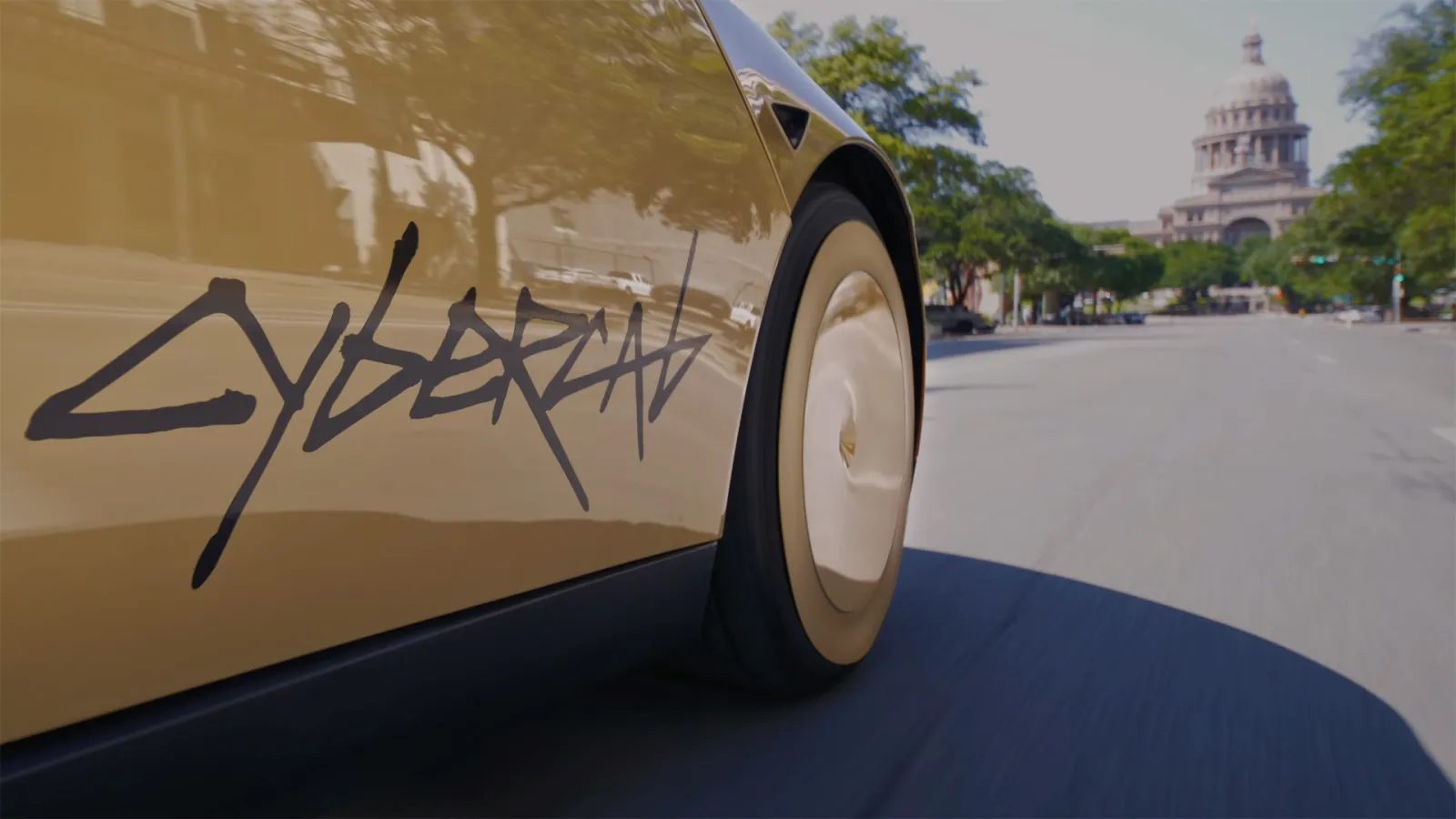

Site plans for a Tesla Supercharger station at 2323 Ridgepoint Drive, the company’s Austin-Ridgepoint gallery and service centre in northeast Austin, point to a second dedicated charging site for its robotaxi fleet, though neither the drawings nor the city’s permit record says so on its face.
Construction drawings issued for review on June 18 and sealed on August 17 call for 24 V4 Supercharger posts, a 2,500-kVA transformer and a 4,000-amp switchboard, and no wireless charging pads.
User ‘MarcoRPi1’ on X, the permit tracker who found Tesla’s first Austin fleet hub and its Arizona filings, first published the site plans on Monday and noted the absence of inductive charging, describing the project as “the 2nd Austin Robotaxi-only Supercharging station.”
The robotaxi reading rests on three things. The drawing file path printed on every sheet names Tesla’s project folder “2323 Ridgepoint Dr – Robotaxi.”
The design has no customer amenity of any kind and adds two wireless access points on light poles of the type Tesla specifies for fleet communication. And the site sits behind a Tesla facility rather than at a retail centre.
Against that, the City of Austin permit record describes the work only as a “New Tesla Supercharger electric vehicle charging station at existing Tesla Sales location,” and Superchargers at Tesla service centres are ordinarily open to the public. Tesla has not said which this is.
Austin permit records show the application was filed June 24 under case number 2026-081324, project name “2323 Ridgepoint Drive Bldg EV1,” described as a new Supercharger electric-vehicle charging station at an existing Tesla sales location requiring “a 2500 kVA transformer to serve 4000 A switchboard for 24 chargers.”
GPD Group, a professional engineering corporation based in Akron, Ohio, that prepares Tesla’s charging-site drawings, produced the set.
The building, which Tesla leased in 2022 for sales, delivery and service, is owned by BLUSV II TX Ridgepoint Drive LLC.
Smaller than St. Elmo
Ridgepoint is a fraction of the robotaxi hub Tesla disclosed last month at 405 E. St. Elmo Road in south Austin.
Permit filings for that site, also spotted by MarcoRPi1, show 48 V4 Supercharger posts in a first phase and references to two additional V4 cabinets capable of supporting up to 80 wireless chargers in a second phase — all on an 82,107-square-foot lot with motorized gates, bollards, 11 light poles, a carwash and a rain garden.
The service description explicitly references “robocar” operations.
Ridgepoint’s scope is more modest.
Civil site plans show the Supercharger equipment occupying an area of about 2,600 to 2,800 square feet of disturbance on the existing property.
A parking stall analysis on the drawings indicates the project will repurpose 29 to 32 existing stalls to make room for the 24 DC fast-charging posts, resulting in a net loss of five to eight parking spaces.
Equipment listed in the plans includes V4 Supercharger posts, Supercharger cabinets, a utility transformer with meter, a switchboard, deterrent and removable bollards, mini EV flex bollards, and light poles.
Proposed pavement markings match existing striping in color, and notes reference Austin Energy’s existing electric manhole and a proposed 36-inch pull box traffic cover.
No carwash, no lounge, no retail and no wireless charging infrastructure appear on any of the four sheets reviewed.
No Wireless Pads
Wireless charging has become a flashpoint in Tesla’s Cybercab infrastructure buildout.
CEO Elon Musk told the audience at the October 2024 ‘We, Robot’ event that the Cybercab would have no plug and would charge inductively.
Production vehicles delivered this month tell a different story: riders and reviewers discovered a concealed NACS port on the rear bumper, and Kyle Conner of the Out of Spec channel confirmed on September 4 that the vehicle lacks an onboard AC charger entirely, making it dependent on DC fast charging until Tesla deploys wireless pads at scale.
Cybercabs are currently plugged in manually and that automated charging is planned for a later stage.
Public Superchargers carrying passengers take priority; robotaxis are dispatched to charge when stalls become available.
St. Elmo’s phase-two reference to 80 wireless chargers was the first time inductive pads appeared in a Tesla construction filing.
Ridgepoint contains no such reference, suggesting the site is designed purely for conventional plug-in fleet charging.
The Federal Communications Commission granted Tesla a waiver in February for a low-power ultra-wideband transceiver that centers a vehicle over a charging pad, using Bluetooth for initial approach and beginning power transfer once aligned.
Tesla demonstrated wireless charging at 25 kW in a clip posted days after the 2024 event and claimed efficiency above 90%.
Deployment timelines remain unannounced.
Charging Buildout Widens
Ridgepoint is the second Austin site and one of at least four dedicated robotaxi charging facilities Tesla has filed for.
Beyond the two Austin sites, the company filed in April for private, fleet-only Supercharger stations in Chandler and Mesa, Arizona, with 56 V4 stalls each, on South Roosevelt Avenue in Chandler and at 5349 East Main Street in Mesa, both found by ‘MarcoRPi1’.
Tesla has also said it plans hubs in San Antonio, Irving, Texas, and Las Vegas. Reports of a 56-stall site at 245 W. Josephine St. in San Antonio and a Cybercab operations hub at 6170 Mohawk St. in Las Vegas with a carwash and fleet building have circulated and are not confirmed here.
None of the Arizona filings reference wireless charging equipment.
Tesla scrapped an earlier plan for a 150-vehicle robo-charging site at 825 Sansome St. in San Francisco in February, pulling the permit application on the day of a planning commission hearing after pushback from the Teamsters union.
Fleet Context
Tesla began public Cybercab rides in Austin on September 4, the day after a private launch event at its campus.
Texas DMV records currently show 49 Cybercabs registered under Tesla Robotaxi, LLC, alongside 269 Model Y vehicles, giving the company a total autonomous fleet of about 318 vehicles in the state.
Ashok Elluswamy, Tesla’s VP of AI Software, said at the event that the fleet had crossed one million unsupervised autonomous miles, up from 380,000 disclosed at the second-quarter earnings call on July 22.
The first Cybercab left the Giga Texas line on February 17 and volume production began in April.
Tesla lists installed annual capacity above 125,000 units.
Last week, the National Highway Traffic Safety Administration opened an audit query into Tesla’s self-certification of a vehicle with no steering wheel, pedals or mirrors against federal safety standards that assume all three.
In Nevada, the state Transportation Authority approved permits in late August clearing Tesla for up to 5,000 robotaxis in Clark County over 12 months, though the company’s Cybercab chief engineer told regulators Tesla expects to field around 2,500 within the year.
Waymo received clearance for up to 1,000 in the same round of approvals.
The Tesla Robotaxi service currently operates in six U.S. cities: Austin, Dallas and Houston in Texas, and Miami, Orlando and Tampa in Florida.
Tesla expanded its Austin service area three days before the Cybercab launch.
Operating hours run daily from 6 a.m. to 10 p.m.
A Ridgepoint Supercharger dedicated to the fleet would give Tesla two charging depots in Austin — one on each side of the city — as production scales and vehicles fan out across the metro area.