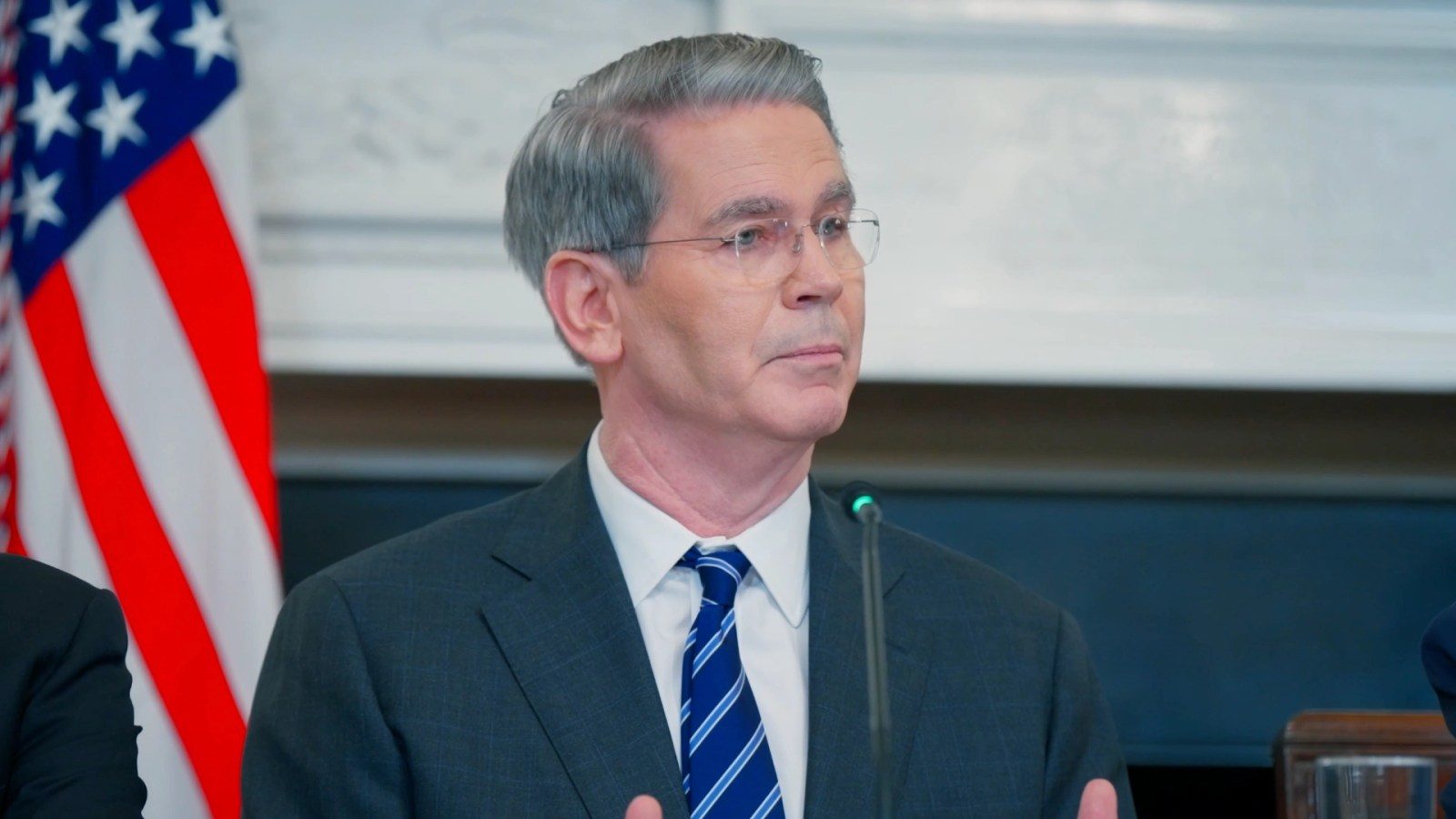

US Treasury Secretary Scott Bessent singled out BYD as a symbol of Chinese industrial subsidization during a speech at the Charlotte Economics Club on Wednesday, reprising a claim he first made five months ago.
The comments were made just a day after the G20 finance ministers meeting was held in the same state — and three weeks before Chinese President Xi Jinping is expected at the White House.
“Anyone here ever seen a BYD car,” Bessent told the audience in North Carolina. “It is the best $70,000 car that $35,000 can buy — it is heavily subsidized.”
Bessent made nearly identical remarks in an April 13 interview with Semafor, when he described BYD vehicles owned by his neighbors at his country home.
“I will tell you, it is the best $75,000 car that $35,000 can buy. It is clearly highly subsidized,” he said at the time, while cautioning that Chinese automakers should not be among the sectors allowed to build factories in the United States.
The figure he assigned to the car’s implied pre-subsidy value dropped from $75,000 in April to $70,000 in September; Bessent offered no methodology for either estimate.
G20 Collapse
The Charlotte speech came a day after the G20 finance ministers meeting in Asheville, North Carolina, ended without a joint communique.
Bessent, who hosted the two-day gathering on August 31 and September 1, publicly blamed China for blocking the statement.
According to Bloomberg, the central sticking point was the inclusion of the phrase “non-market” in a sentence addressing trade imbalances — a term Chinese officials viewed as a veiled attack on state-owned enterprises.
China proposed alternative wording and received private backing from some delegations, but failed to reach consensus with the US side.
The final chair’s statement issued by the Treasury included a line calling on countries to “eliminate non-market policies and practices that exacerbate imbalances.”
Bessent used the Charlotte event to press a broader critique of Beijing’s economic model, arguing that China suppresses domestic demand and relies on exports for growth.
He estimated that about 4% of China’s GDP is directed toward industrial subsidies, though he did not cite a source for the figure.
China posted a record trade surplus of $1.2 trillion in 2025 — a 20% increase from the prior year — while the US trade deficit with China stood at roughly $200 billion, according to Bureau of Economic Analysis data.
Claim Vs Research
Bessent’s characterization of BYD as a heavily subsidized producer contrasts with independent analysis of the cost gap between the Chinese automaker and Western competitors.
A February report by Rhodium Group found that direct government grants to BYD translate into roughly $292 per vehicle, accounting for approximately 5% of the automaker’s estimated $4,700 per-unit cost advantage over Tesla.
The remaining 95% stems from structural factors: deeper vertical integration, greater manufacturing scale, and lower labor and engineering costs.
BYD produces roughly 80% of its core components in-house, including motors, inverters, and battery management systems.
Rhodium estimated that in-house production alone saves BYD approximately $2,369 in supplier markups per unit on its Seal sedan compared with Tesla’s Model 3.
Bessent’s suggestion that the gap between list price and true value reaches $35,000 far exceeds the subsidy-linked cost advantage identified in the report.
State support is nonetheless substantial in absolute terms.
BYD disclosed in its 2025 annual report that it received 12.47 billion yuan ($1.85 billion) in government subsidies related to daily operations — a 19.8% increase from the prior year and equivalent to 38.2% of net profit.
Subsidies accounted for 35% of net income in 2025, up from 26% in 2024, according to Rhodium’s analysis of the company’s filings.
China Pushes Back
Beijing has rejected characterizations of its industrial policies as unfair.
Beijing’s Commerce Ministry released a white paper on July 28 titled “China’s Position on the So-called Excess Capacity Issue,” arguing that capacity shifts are a natural feature of market economies and that the US and European Union operate their own subsidy programs for industries including EVs and AI.
The paper called accusations of unfair competition and non-market practices a case of “double standards.”
People’s Bank of China Governor Pan Gongsheng, who led the Chinese delegation in Asheville alongside Vice Finance Minister Liao Min, attributed worsening global imbalances to rising protectionism and policy unpredictability.
Pan urged deficit nations to narrow fiscal shortfalls and lift savings rates, while calling on surplus countries to boost consumption and investment.
US Market Sealed
Chinese-made EVs face an effective tariff rate exceeding 110% at the US border.
The duties combine the 100% duty imposed under the Biden administration in 2024, a 25% tariff on all imported vehicles and auto parts introduced by Trump in April 2025, and a 10% global tariff under Section 122 of the Trade Act of 1974.
No Chinese-made passenger EV is currently sold in the United States.
Senators Bernie Moreno and Elissa Slotkin introduced the Connected Vehicle Security Act of 2026 in April, which would ban the import, manufacture, sale, and operation of vehicles and connected components linked to China or other designated adversaries.
North American Divide
While Washington layers restrictions on Chinese vehicles, Canada has moved in a sharply different direction — and the resulting North American divide on Chinese EVs is deepening alongside a worsening US-Canada trade dispute.
Ottawa signed a deal with Beijing in January allowing up to 49,000 Chinese-built EVs into the country annually at a 6.1% tariff rate, replacing the 100% surtax imposed in late 2024.
The quota is set to rise to 70,000 vehicles by 2030.
BYD recently added a “Coming Soon” page to its Canadian website and posted eleven management roles in the country.
Canada’s import quota reached 61.5% utilization as of August 21, with around 15,000 of 24,500 first-window permits claimed.
Tesla has also exploited the opening, launching a Shanghai-built Model 3 in Canada on May 1 at C$39,490 to take advantage of the 6.1% rate — far below the 25% national-security tariff applied to US-built vehicles entering Canada.
The China-EV quota opened just as US-Canada trade talks collapsed.
US-Canada Trade Collapse
Negotiations broke down on August 21 after US negotiators introduced demands that Prime Minister Mark Carney said would have limited Canada’s ability to strike trade agreements with other countries — a condition widely interpreted as aimed at the Canada-China arrangement.
Washington imposed 50% tariffs on roughly $20 billion of Canadian goods on August 22, with Canada announcing dollar-for-dollar retaliatory tariffs on US imports from September 8.
Trump posted on Truth Social that tariffs on all Canadian cars, trucks, auto parts, and steel would rise to 50% on January 1, 2027.
Summit Approaches
Bessent’s repeated focus on BYD comes as both sides prepare for Xi’s expected arrival in Washington around September 24 — a visit Trump has publicly confirmed but Beijing has not formally announced.
The US Treasury Secretary said this week that artificial intelligence will be on the agenda.
Bessent played a leading role in the economic and trade discussions surrounding Trump’s May 14–15 visit to Beijing and is expected to play a central role in upcoming US-China talks.