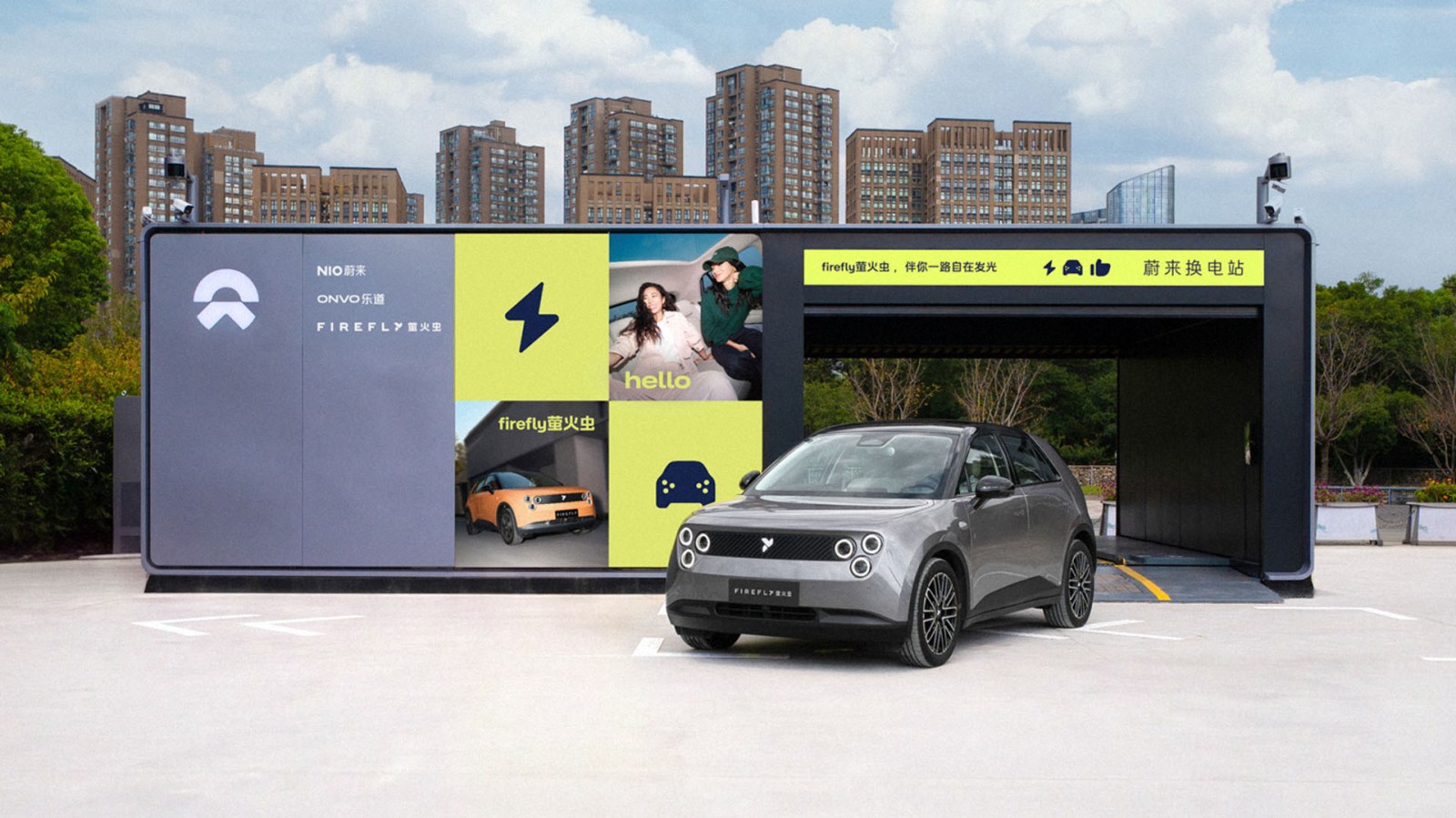
Chinese EV maker Nio handed over the first 36 charging and battery swap stations built with Optics Valley Transportation Group on Wednesday and disclosed that the transfer leaves every existing swap station asset in Wuhan held by state-owned partners.
Wuhan is where Nio‘s battery swap and charging unit, ‘Nio Power, ‘ is headquartered.
The company published the detail in its own app, at a ceremony that also marked three years of operation for the Optics Valley Skyrail swap station.
The Model Has a Name Now
Nio described the arrangement in its own words as state-capital partner holds the asset, Nio operates it.
Optics Valley Transportation Group owns the 36 stations. Nio Power runs them, supplying the technology and the operating expertise.
The company called the delivery an industrial cooperation template and a significant step in extending the ownership model across Hubei and nationwide, saying the structure was gradually rolling out across the country.
The scale of that rollout is larger than previously disclosed.
Nio Power said it has now worked with more than 40 local state-capital platforms and financial institution partners across 25 provinces and regions, jointly building and operating more than 800 swap stations.
The figure represents about a fifth of the company’s Chinese swap network, and a fourfold increase on the figure Nio gave for the end of 2025, when it counted close to 200 charging and swap stations built with 35 partners.
Qu Yu, Nio‘s Chief Financial Officer and the head of Nio Power, attended in person, alongside Nio Power VP Guo Chenggang and Shao Ting, general manager of the company’s Wuhan operation.
Why the Ownership Shift Matters
Nio has committed to adding more than 1,000 battery swap stations in China this year, a target founder and Chief Executive William Li has reiterated repeatedly.
The company added 679 stations in 2024 and 681 in 2025. It ended last year with 3,676 and stood at 4,017 as of Wednesday — about 341 in seven and a half months, against a target implying roughly 83 a month.
Nio has slowed its own construction over the past two years to control capital spending, which makes the partner channel the only route to the number.
The Wuhan handover is the second partner delivery in eight days.
On August 5, Zhongan Energy and Nio Power completed delivery of 90 stations, following an initial 50 in December 2025 and a June agreement to build 500 within a year across the Yangtze River Delta, Beijing-Tianjin-Hebei, the Greater Bay Area and northwest China.
Zhongan is not an arm’s-length counterparty as Nio was among the investors that established it in January 2024, according to a company filing.
The Wuhan relationship has its own financial history.
Nio Power Investment (Hubei) received a 1.5 billion yuan strategic investment in May 2024 from a fund backed by Wuhan Optics Valley Industrial Investment, the East Lake High-Tech Zone’s state investment platform, alongside a second-phase headquarters agreement with the city.
A Long Presence in Optics Valley
Nio Energy has been registered in Optics Valley since May 2017.
Li announced the unit’s new headquarters at the Optics Valley Digital Economy Industrial Park in August 2024, alongside a manufacturing centre of about 20,000 square metres. The 100th station rolled off that line on December 5, 2024, with stated maximum capacity of 1,500 stations a year.
Nio built Hubei’s first swap station in Wuhan in November 2018. The province held 60 by August 2023 and 89 by August 2024.
Wuhan is also where battery asset company Weineng was established in August 2020, the month Nio launched its battery-as-a-service rental model — the mechanism that separates battery ownership from the vehicle, and the conceptual ancestor of separating station ownership from station operation.
The Network Status
Nio put its nationwide total at 9,198 facilities, which include 4,017 swap stations, 5,181 charging stations and 29,875 charging piles.
Cumulative swaps have passed 120 million last weekend, and combined charging and swap services have reached 200 million.
The company says it has invested more than 20 billion yuan in the technology and infrastructure.
The 4,000th swap station opened in Quanzhou, Fujian last week — the first fifth-generation unit, and the first able to serve all three of the company’s brands including Firefly, whose 42.1 kWh pack fourth-generation stations cannot handle.
Therollout has slipped repeatedly, from a trial before Christmas 2025 to the first quarter of 2026, then the second, then July or August for mass deployment.
About 450 of this year’s stations are expected in the fourth quarter alone.
In Europe, EV reported exclusively that Nio closed a station in Denmark late last year, the first such closure in the Old Continent.
The Competitive Clock
CATL’s Choco Swap network did not exist at the start of 2025.
Its subsidiary confirmed 1,020 stations across 45 cities on December 30, then raised its end-2026 target from 2,500 to more than 3,000 across 140 cities.
Including its Qiji Energy heavy-truck stations, CATL has said the combined total will exceed 4,000 in China by the end of this year — approaching the size of a network Nio has been building since its first station opened in Shenzhen in 2018.
The swap business is not yet independently profitable.
Meanwhile the eight automakers that signed swap alliance agreements with Nio from November 2023 — including Changan, Geely, Chery, JAC, Lotus, GAC and FAW — had still not launched a compatible vehicle as of May, more than two years after the first deal.