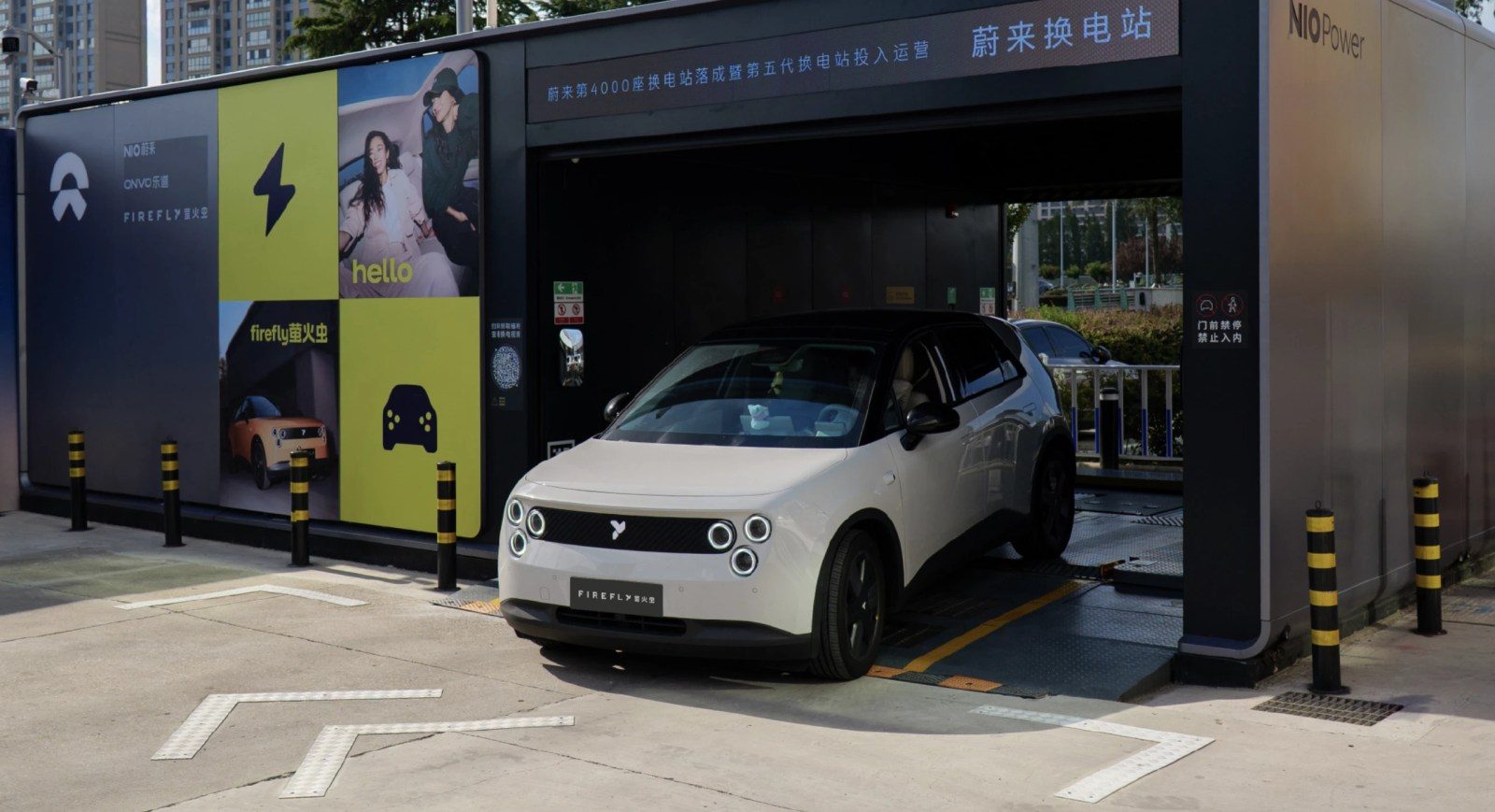

Nio Inc.‘s sub-brand Firefly began rolling out Aster 2.0.0 on Friday — the brand’s sixth major software release and its first full version bump since the operating system launched alongside the vehicle in April 2025.
The update spans intelligent assisted driving, the smart cabin, the ‘Lumo’ voice companion, and the overall vehicle experience.
Firefly described the release on Weibo as having four major areas “comprehensively upgraded, unlocking an even more effortless driving experience!”
Vehicles must be running Aster 1.4.0 or above to be eligible. The upgrade is being pushed in staged batches, and delivery timing may vary.
Smart Cabin and Parking
The smart cabin received the bulk of the update.
New additions include AI-powered wallpaper generation, an immersive full-screen desktop with dynamic ambience-ring backgrounds, left/right desktop mirroring, a screen-off mode for parked resting, an intersection info imaging function that displays forward-view camera footage at zebra-crossing intersections.
Additionally, it was added a commute mode that auto-launches navigation at set times based on daily habits.
On parking, the update upgrades the vision-fusion assisted parking system to support directional selection, allowing the driver to choose head-in or tail-in entry after selecting a parking space.
Close-range vehicle summon and remote parking-out have also been optimized with improved account synchronization, ensuring personal settings load correctly after the vehicle is summoned.
Assisted Driving
The driver-assistance section of Aster 2.0.0 is narrow relative to the scope of the wider update, containing one new feature and two incremental upgrades.
The sole new addition is an intelligent lighting reminder.
When enabled at night or in low-light conditions, the system automatically toggles between high and low beams when the vehicle is preparing to overtake while lane-centering assist (Pilot) or Navigate on Pilot (NOP) is active.
The feature targets scenarios where a vehicle ahead is straddling lane markings or a large vehicle is obstructing the lane, alerting it to an approaching car from behind.
Nio‘s main brand has rolled out more advanced intelligent lighting features as hardware additions.
The 2026 refresh of the ET5, ET5T, ES6, and EC6 introduced smart matrix headlights with LiDAR-assisted beam control as standard equipment.
Firefly‘s beam-toggle reminder, by contrast, is delivered entirely via software using the vehicle’s existing headlight hardware.
The feature arrives against a shifting regulatory backdrop for ADAS-related exterior signaling in China.
Regulators have barred the use of blue exterior indicator lights — the so-called “little blue lights” that signal when a driver-assistance system is active — on newly certified passenger vehicles since late July.
The ban stems from mandatory standard GB 4785, which permits only white, red, yellow, and amber for exterior vehicle lighting, while blue is reserved for emergency vehicles.
Firefly‘s own refreshed model, launched in April, added the blue indicator as a hardware feature, predating the enforcement action.
Broader mandatory standards covering L2 combined driver assistance — including GB 47955-2026, effective 2027 — focus on driver monitoring, hand-over alerts, and risk mitigation rather than conventional exterior signaling.
Practical, rule-compliant features such as the beam-toggle overtaking reminder in Aster 2.0.0 remain unaffected and continue to appear in new software updates from multiple automakers.
Lumo Updates
The ‘Lumo’ voice companion received four new capability categories. Query functionality now supports searching for charging stations along a route.
Toggle controls allow ‘Lumo’ to activate camping mode, screen-off mode, mute, and mic-free karaoke by voice.
Launch commands can open the dashcam interface, Sentry Mode video, Flux Media, Youku, Yunting, and light-language themes.
Media control has been expanded to play QQ Music daily playlists and NIO Radio programs by voice, with improved song-search logic.
Core voice capabilities were also upgraded, with optimized zone-specific recognition that improves command accuracy and reduces cross-zone wake-up interference.
Overall Vehicle Experience
On the ecosystem side, Firefly added mic-free karaoke powered by its in-car 14-speaker system, the WeSing app with more than 10 million licensed backing tracks, a built-in web browser, Flux Media streaming, Youku Video, and Yunting radio with access to over 1,500 stations nationwide.
Other additions include upgraded nap mode stability for sessions exceeding four hours, expanded light-language themes with new welcome, farewell, and parking signatures, improved app remote control that preserves seat ventilation and steering wheel heating settings after unlock, and a new privacy toggle for the in-cabin driver monitoring camera.
When the driver awareness function is turned off, fatigue and distraction alerts are disabled — except in assisted-driving modes or other scenarios where monitoring is legally required.
Prior Updates
Aster 2.0.0 continues the rapid release cadence Firefly has maintained since launch. Version 1.1.0 in August 2025 added dashcam functionality and blind-spot camera views.
Version 1.2.0 in September introduced rear collision warning and optimized rain driving.
Aster 1.3.0 in early 2026 brought battery preheating and multi-language support.
Version 1.4.0 in April added mistaken-acceleration suppression, an emergency rescue service, and significant expansions to Lumo.
Version 1.5.0 in May integrated battery swap station parking assist and delivered the previously announced free motor power upgrade from 105 kW to 120 kW.
Bigger Battery Ahead
Separately, Firefly brand chief Daniel Jin said at a user event tied to Nio‘s fifth-generation battery swap stations last week that a higher-capacity battery version of the Firefly EV is confirmed.
Jin said the larger pack is targeted for launch before Spring Festival 2027 — which falls in mid-February — and could arrive as early as the end of this year, according to local media reports.
The current model ships with a 42.1 kWh lithium iron phosphate pack supplied by Sunwoda, delivering 318 km of WLTP range.