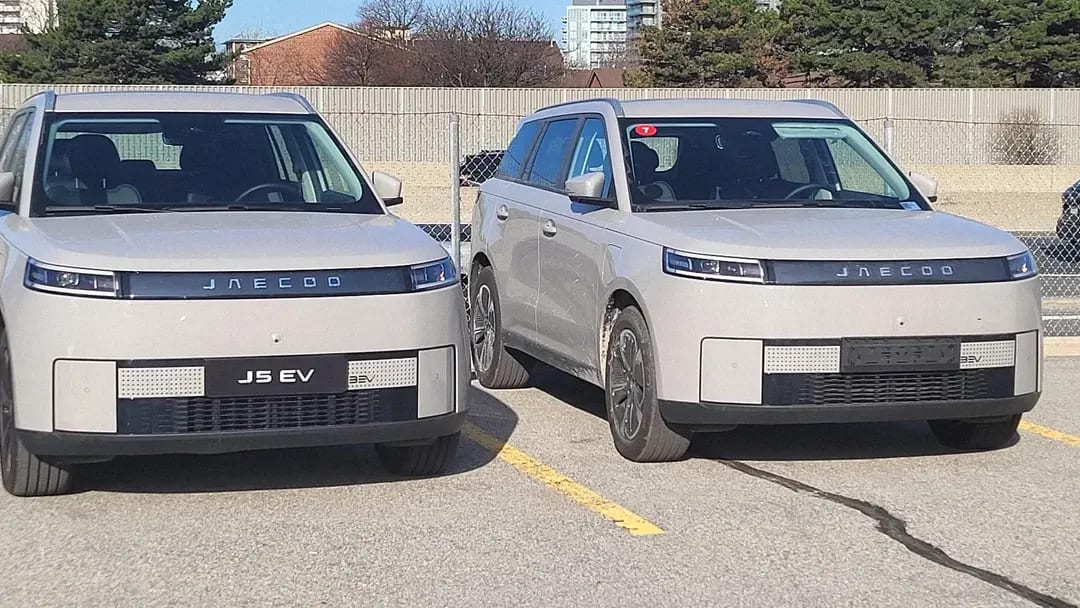

China’s Chery has shipped the first vehicles to Canada, according to pictures shared on social media this week showing several J5 from the sub-brand Omoda & Jaecoo parked in Toronto.
Reddit user ‘keredkill’ shared images on Thursday of four vehicles — two from each brand — parked near Toronto’s Don Valley Parkway.
“I just saw 4 car in a parking lot with the make JAECOO and OMODA,” the user wrote.
They noted that the Omoda-branded vehicles had their logos partially concealed, as though the company was trying to hide the brand identity.
“I had to type guess the brand lol,” they added.
The vehicles displayed license plates bearing the brand names and models.
It is not confirmed whether they are officially registered in Canada, leaving their legal status for road use unclear.
Omoda & Jaecoo is Chery‘s export-focused brand, designed exclusively for overseas markets.
Chery was China’s largest car exporter last year, with over 1.2 million vehicles shipped overseas.
Through Omoda & Jaecoo, Chery already sells vehicles across Europe, South America, the Middle East, and Southeast Asia.
The images mark the first time that Chery‘s vehicles were spotted in Canada.
The Wuhu-headquartered giant is preparing to enter the country this year — alongside companies such as BYD and Geely, after Ottawa and Beijing struck a trade deal that lowered the tariff on Chinese EVs to just 6.1%.
Canadian Preparations
Chery has been the most active Chinese automaker in laying the groundwork for a Canadian launch.
The company began approaching Canadian staff as early as January.
Recruiters approached auto industry professionals on LinkedIn about roles covering vehicle engineering, electrical architecture, intelligent driving, and regulatory certification — with some messages specifically referencing the Omoda & Jaecoo sub-brand.
Chery has filed trademark applications in Canada for several sub-brands: Exeed, iCar, Lepas, Luxeed, and Omoda & Jaecoo.
In March, the company issued its first official statement on a potential Canadian entry, confirming it is “closely studying” the market and “evaluating partnerships with local stakeholders.”
Advisory firm DSMA, which is brokering discussions between Chinese manufacturers and Canadian dealer groups, said in March that BYD, Chery, and Geely are all targeting Canadian market entry by the end of 2026, with months of certification work still ahead.
Canada-China EV Deal
The sighting comes nearly four months after Canada opened its market to Chinese-built EVs under a new quota system.
In January, Prime Minister Mark Carney and Chinese President Xi Jinping agreed to allow up to 49,000 Chinese-made EVs into Canada annually at a 6.1% most-favored-nation tariff — replacing the 100% surtax imposed in October 2024.
Under the framework, the first 24,500 vehicles can enter between March 1 and August 31 on a first-come, first-served basis, with a second allocation covering September through February 2027.
The quota is set to rise to approximately 70,000 units per year by 2030.
Canada’s Industry Minister Mélanie Joly disclosed in late January that she met with Chery executives during Carney’s state visit to Beijing.
More recently, Trade Minister Maninder Sidhu met with BYD, XPeng, and GAC in Guangzhou as Ottawa continues to court Chinese automakers.
Chinese-built vehicles entering Canada under the quota are not eligible for the country’s C$5,000 federal EV rebate — also announced earlier this year — which is restricted to models produced domestically or in free-trade partner countries.
Political Opposition
The prospect of Chinese EVs entering Canada has drawn sharp opposition from industry groups, opposition politicians, and provincial leaders.
This week, CVMA President Brian Kingston warned that Chinese automakers benefit from “weak or non-existent labour rights” that suppress wages and distort competition.
He told the House of Commons that the 49,000-vehicle quota is “equivalent to 30% of the total number of EVs sold in Canada last year.”
The lobby group, which represents Ford, GM, and Stellantis in Canada, has also backed the Conservative Party’s proposal to scrap the Chinese EV quota entirely.
Kingston had also called forced labor allegations against BYD at factory sites in Brazil and Hungary “deeply concerning,” saying they reinforced the case against Chinese automakers’ entry into Canada.
Security Concerns
Data security has also emerged as a flashpoint.
A recent survey found that while most Canadian consumers are open to Chinese EVs, some raised concerns about vehicle data collection — echoing warnings from Ontario Premier Doug Ford, who has labelled the incoming vehicles “spy vehicles.”
Conservative leader Pierre Poilievre has pledged to ban Chinese-connected software from vehicles sold in Canada.
The measure would align with a US rule that took effect in March 2025, prohibiting connected vehicles with hardware and software linked to China or Russia.
The Conservative auto pact proposal, which also called for a tariff-free deal with the US and aligning Canada’s China tariffs with Washington’s, was rejected in the House of Commons last month after all other parties voted against it.