
Polestar registered approximately 3,665 vehicles across its 16 European markets in May, according to data compiled by EV based on national registration agencies and the EU-EVs data platform.
Twelve of the brand’s 16 European markets posted year-over-year growth in May, led by Iceland, France and Austria — as the brand continues expanding to new countries in the Old Continent.
In May, only Belgium and Luxembourg, Switzerland, Ireland and the Netherlands recorded declines.
European production is only expected to begin with the Polestar 7 SUV, through Volvo’s manufacturing footprint.
The Geely-backed brand’s monthly volumes continue to fluctuate based on manufacturing and shipping cycles, as production is split among China, the United States and South Korea.
Polestar sold over 10,500 EVs in Europe during the first quarter, a slight increase from the 9,478 units registered in the same period of 2025.
With April and May figures combined, the brand’s year-to-date European total now exceeds an estimated 17,000 units.
United Kingdom and Ireland
The United Kingdom was once again Polestar‘s largest European market in May, with 1,305 registrations — an 11% increase year over year.
The monthly result represents a rise from April’s 1,076 registrations, consistent with the pattern seen in May 2025, when UK volumes also climbed sequentially following a post-quarter dip.
The UK was Polestar’s best-performing European market in both 2024 and 2025.
Last year, the brand registered 16,959 EVs in the country, doubling the prior year’s figure.
With May data, the year-to-date total reaches approximately 6,532 units, comfortably ahead of the pace required to match 2025’s full-year performance.
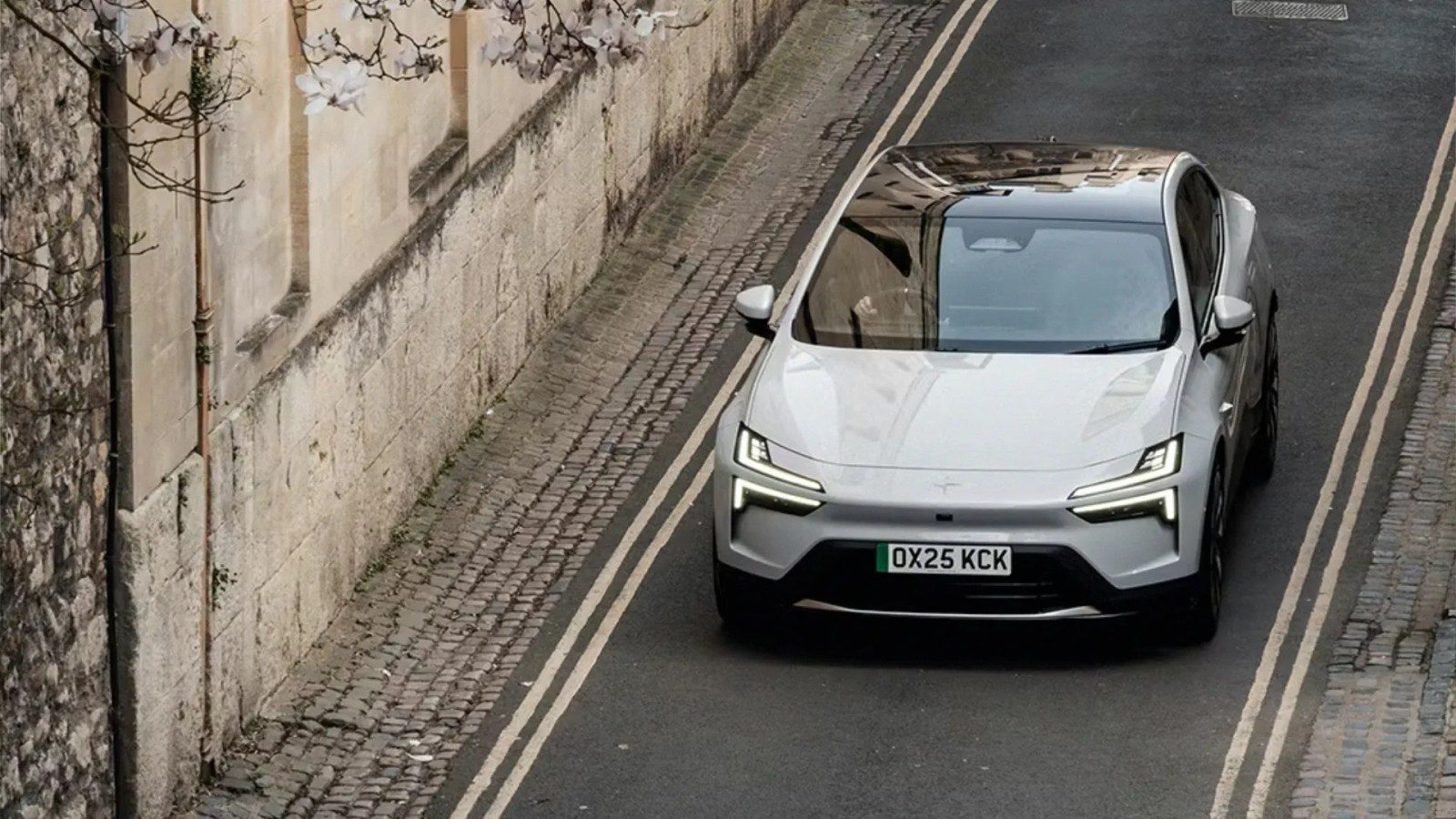
The brand’s UK portfolio includes the Polestar 2 sedan, the Polestar 3 and 4 SUVs, and the Polestar 5 grand tourer.
The UK was the first market to receive the upgraded Polestar 3, which introduced an 800-volt electrical architecture, peak DC charging of up to 350 kW, and an eightfold increase in processing power.
In Ireland, eight vehicles were registered in May — a decline from the 14 units recorded in April.
Year-over-year, registrations fell 11%.
The country had registered 165 Polestar vehicles in the full year of 2025, and first-quarter registrations had already nearly matched that annual total.
Northern Countries
Sweden was Polestar‘s second-largest European market in May, with 629 registrations — a 3% increase year over year and a sequential rise from April’s 570 units.
The brand is headquartered in Gothenburg and sold 1,670 vehicles in Sweden during the first quarter.
Year-to-date, Polestar has registered approximately 2,869 EVs in the Swedish market.
Last year, the company registered 7,594 vehicles in Sweden, a 28% increase from 2024.
At the current pace, the brand appears to be tracking broadly in line with the prior year’s trajectory in its home market.
Polestar recently opened orders in Sweden for the revamped Polestar 3 and Polestar 4, with the upgraded Polestar 3 starting at 924,000 SEK and the Polestar 4 coupé from 619,000 SEK.
Norway posted 349 Polestar registrations in May, a 31% increase year over year and a notable rebound from April’s 223 units.
The May figure marks a sharp turnaround after a difficult start to the year.
First-quarter registrations had fallen to 516 units from 583 a year earlier, as reduced EV incentives continued to weigh on demand across the broader Norwegian market.
Year-to-date, Polestar‘s total in Norway stands at approximately 1,088 units.
In Denmark, Polestar registered 250 vehicles in May, a 26% increase year over year and up from 216 units in April.
The brand’s year-to-date total in Denmark has now reached approximately 899 units.
Finland posted 113 registrations, a 20% increase year over year, while Iceland recorded 15 units — a 200% surge, though from a base of just five vehicles in May 2025.
In total, the five Nordic markets accounted for approximately 1,356 units in May, or roughly 37% of the brand’s estimated European total for the month — the same share as in April.
Central Europe
In Germany — Europe’s largest auto market — Polestar registered 292 vehicles in May, a 22% increase year over year and a rebound from the 17% decline recorded in April.
The May result pulls Polestar‘s year-to-date total in Germany to approximately 1,826 units, roughly 31% above the comparable period in 2025.
The rebound coincides with the opening of Germany’s new EV purchase incentive scheme.
The federal government’s BAFA application portal went live in May, allowing private buyers to apply for subsidies of €3,000 to €6,000 depending on household income and number of children.
The programme is retroactive to January 1, meaning tens of thousands of EVs already delivered this year became eligible as soon as the portal opened.
Polestar is also running a parallel promotion in the market, offering a €2,000 Vorteilsprämie on the Polestar 4 for orders placed by June 30 — on top of the federal subsidy.
The Netherlands posted 124 registrations in May, an 8% decline year over year but a sequential improvement from April’s 114 units.
The Dutch market has been a weak spot for the brand in 2026, with scaled-back incentives continuing to weigh on EV demand more broadly.
Year-to-date, Polestar‘s Dutch registrations stand at approximately 437 units.
Belgium and Luxembourg — tracked together under the Benelux grouping — recorded 170 registrations in May, a 27% decline year over year.
France recorded 37 registrations in May, a 164% increase year over year, though from a very low base.
The brand entered the French market in mid-2025 and had registered 210 vehicles by year-end.
April had been an unusually strong month for France at 148 units; the May drop to 37 suggests volatility consistent with a market still in its early ramp-up phase.
Year-to-date, Polestar‘s French total has reached approximately 334 vehicles.
Austria registered 98 units, a 69% increase year over year and a sharp rebound from April’s 38 units. Switzerland posted 106 registrations, a 19% decline year over year.
Southern Europe
Polestar‘s three Southern European markets — Portugal, Spain and Italy — continued to grow in May, albeit from low volumes.
Portugal registered 48 units, a 78% increase year over year but a sequential decline from April’s 58 units.
Spain posted 69 registrations, a 19% year-over-year increase, broadly in line with the 67 units recorded in April.
Italy saw 52 registrations, a 63% surge year over year, matching April’s monthly volume exactly.
The three Southern European markets combined for 169 May registrations — roughly 4.6% of the brand’s European total, broadly in line with April’s 6% share.
European Expansion
The May results arrive as Polestar continues to widen its European footprint.
Earlier this month, the brand announced its entry into Estonia, Latvia and Lithuania, raising its European presence to 31 markets through a partnership with Volvax Baltic.
A dedicated Polestar Space is set to open in Tallinn this month, with locations in Riga and Vilnius to follow in the second half of the year.
Chief Commercial Officer Scott Dicken framed the Baltic entry as part of a retail strategy built around test-drive-focused showrooms rather than high-volume discounting.
The company operated 230 retail locations globally at the end of the first quarter, up roughly 50% from a year earlier, and is targeting 250 by year-end.
Europe accounted for 78% of Polestar‘s total retail sales in the first quarter of 2026.
Model Offensive and Outlook
The upgraded versions of the Polestar 3 SUV and the Polestar 4 coupé have been rolled out across several key European markets and Canada.
The Polestar 3’s most significant change is the introduction of an 800-volt electrical architecture, which cuts the 10-to-80% charging time to 22 minutes and increases peak DC charging rates to 350 kW.
The Polestar 5 grand tourer — the brand’s first model built on its in-house Polestar Performance Architecture — debuted at the IAA Auto Show last September and is expected to begin customer deliveries this summer.
Polestar is guiding for low double-digit volume growth in 2026 — implying roughly 66,000 to 69,000 deliveries globally.
The company delivered approximately 60,119 vehicles in 2025, of which over 46,000 were registered in Europe, accounting for roughly 77% of the total.
The product push comes amid continued financial headwinds.
Polestar‘s first-quarter gross margin swung to negative 3.2%, down from positive 10.3% a year earlier, with revenue essentially flat at $633 million despite the 7% volume increase.
The company has raised $1 billion in new equity since December and secured a $600 million loan from parent Geely to shore up its balance sheet.