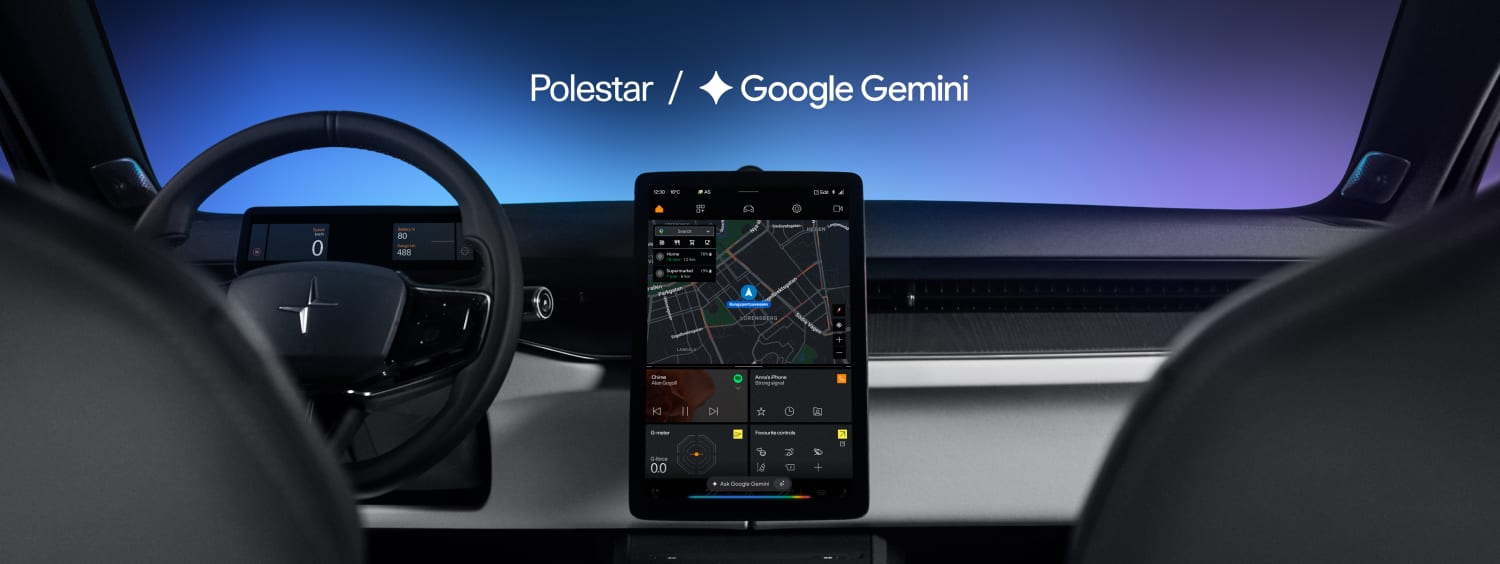

Polestar began rolling out Google Gemini in its EVs on Thursday, marking the first deployment of the AI model in the Geely-owned premium brand’s lineup.
The Gothenburg-headquartered EV maker said the over-the-air update started being rolled out for Polestar models with Google built-in, located in the United States, with the vehicle’s language set to US English.
Additional languages and regions will follow, the company said, while adding that Gemini will allow its customers to have “free-flowing conversation” with their vehicles.
The update applies to all the mass produced Polestar models.
Both companies had announced late last year in Finland that Gemini would be implemented across the lineup through a future update, with the Polestar 5 grand tourer hosting the public demonstration.
Eligible drivers will see a pop-up on their centre display prompting them to opt in to Google Gemini or decline.
Over time, Gemini will fully replace Google Assistant in Polestar vehicles, the brand led by Michael Lohscheller said.
From Commands to Conversations
Polestar said the integration introduces contextual understanding and multi-turn dialogue, allowing drivers to issue more complex, conversational queries than the command-based interaction Google Assistant required.
“Google Gemini represents a fundamental shift for Polestar drivers and how they interact with their vehicles,” Hans Bleckert, Connected Car Manager at Polestar, said in a statement.
“And this is only the beginning. With Gemini, we enter a new period of possibilities with the focus on creating better user experiences,” Bleckert added.
The previous Google Assistant experience required distinct commands, such as “Hey Google, navigate to a supermarket.”
With Gemini, drivers can now issue conversational queries, such as “Hey Google, let’s find a supermarket on the way home, and let Joe know I am on my way,” the company said.
Drivers no longer need to memorise specific phrasing or restart a query if they forget a detail, Polestar said, with the advanced AI model interpreting follow-up questions and complex intent.
Gemini Live and Translation
The update also brings Gemini Live to the car, which is activated by saying “Hey Google, let’s talk.”
The hands-free conversation tool can help brainstorm gift ideas, dinner recipes, and shopping lists, Polestar said.
The capabilities of large language models also break down language barriers, with the system integrating translation directly into messaging.
Drivers can dictate a text in English and ask Gemini to translate it into Swedish — or any supported language — before sending it.
A Partnership Spanning 8 Years
The Gemini rollout is the latest milestone in a Google partnership that began in early 2018, when Polestar first announced that the Polestar 2 would use Android Automotive OS.
Unveiled in February 2019, the Polestar 2 began integrating Google’s in-car software in July 2020 — including Android Automotive OS, Google Maps, Google Assistant, and Google Play Store — making it the first vehicle in the world to launch with native Android Automotive OS.
At CES 2024, both companies showcased new automotive features for Polestar‘s models, including Route Send-to-Car and Google Chrome in-car.
Building on Live Lane Guidance
The Gemini rollout follows another Google-developed feature Polestar deployed in the United States and Sweden in late February.
The company began rolling out Google Maps live lane guidance on the Polestar 4 in those two markets, becoming the first automaker to integrate the feature directly into the driver display of its vehicles.
The system uses AI-powered real-time analysis from the car’s forward-facing camera to understand which lane the vehicle is in, guiding drivers through complex highways and interchanges with visual and audio cues.
Polestar 4 owners in the United States and Sweden need software version 4.2.9 or 4.2.10 to access the feature, with more markets to follow.
The Geely brand has built its software roadmap around its Google partnership rather than developing proprietary infotainment, distinguishing it from Tesla and from rival Chinese EV makers that typically build their own systems.