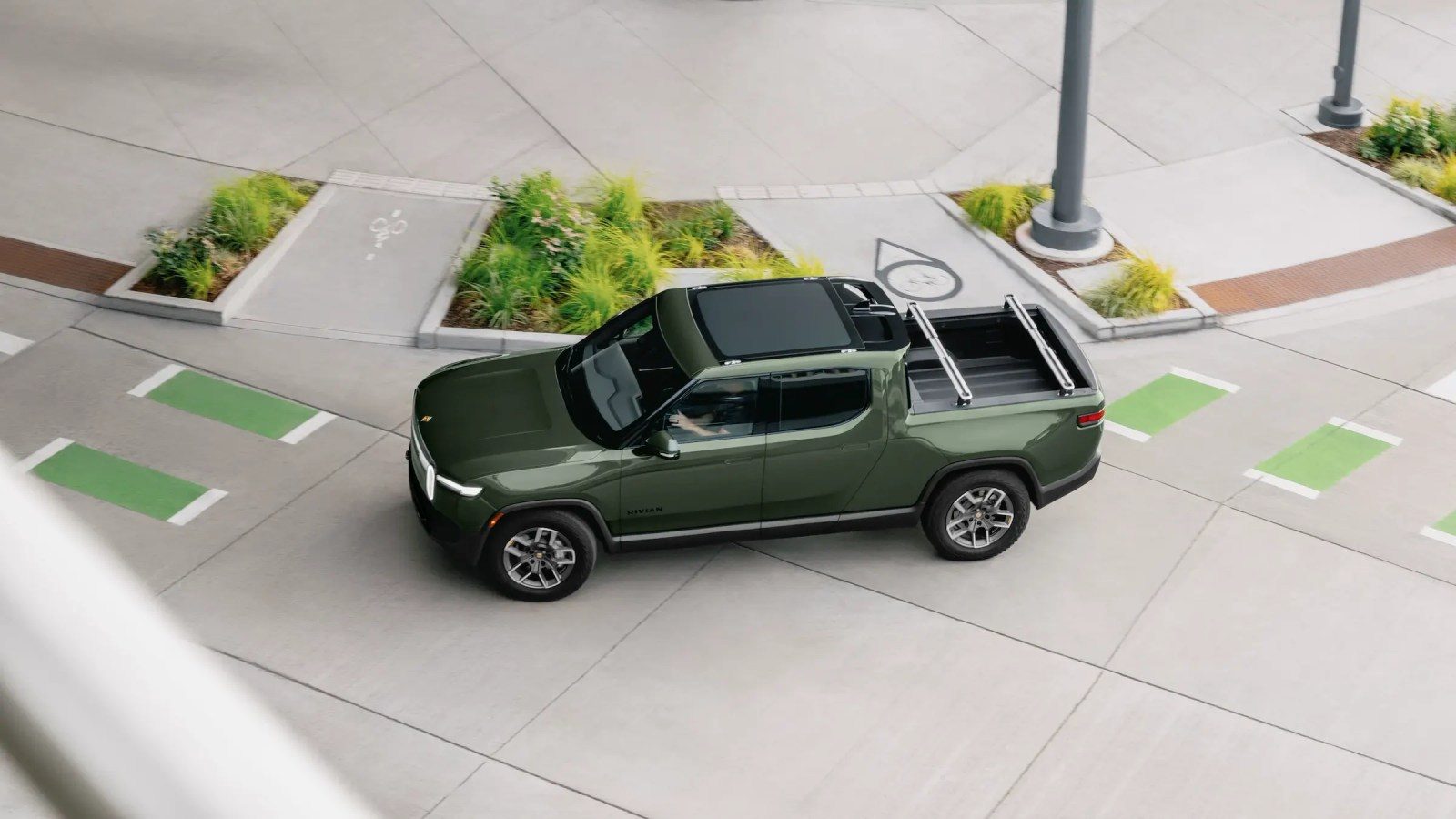

Rivian has cut prices across its R1 inventory again, a move that points to an imminent switch to the 2027 model year for its pickup and SUV.
The latest reductions arrived on Monday, posting inventory listings that showed in-stock 2026 R1S SUVs with $500 off and R1T pickups with $2,000 off, and steeper cuts higher up the range.
Rivian owner and X user Chris Hilbert first reported on the latest cuts on Monday morning.
The current incentives sit atop other promotions — including a $3,000 lease bonus on select trims and low-rate financing (as low as 1.99% APR) on 2026 models.
Additionally, Monday’s cuts follow Rivian’s discontinuation of the entry-level Dual Motor Standard trim in late June. The change increased the R1S starting price to $83,990 for the new base Dual Large configuration.
What’s Discounted
The markdowns apply only to built, in-stock 2026 units — not custom orders — and deepen sharply on the priciest configurations.
On the SUV, three Dual-motor R1S builds on the Large battery, from $83,490 to $94,940, are each $500 off, while the 850-hp Tri is $1,000 off at $116,190. The steepest cuts, both $5,000, land on the two flagships: the 1,025-hp R1S Quad at $122,490 and a 410-mile Max-battery R1S Dual at $102,990.
Every R1T in the batch is a flat $2,000 off — five Dual-motor pickups from $84,990 to $96,940, spanning the Large and Max battery packs and 289 to 370 miles of range. Broader listings have shown pickup reductions running as high as $3,000 on Tri-motor trims. All are new 2026 models, not demo or pre-owned stock, with delivery quoted in two to three weeks.
That the discount tracks price rather than applying evenly is telling: the cheapest R1S is barely touched, while the halo Quad and the long-range Dual — the hardest builds to shift — carry ten times the cut.
A Familiar Playbook
The timing and scope echo how Rivian has handled past model-year changes.
The company cleared 2023 and 2024 R1 stock with discounts of up to $6,000 in mid-2024, as it shifted to the Gen 2 lineup sold as the 2025 model year.
The 2026 model year launched on July 8 last year, meaning a 2027 update could be days away.
Rivian has not announced the 2027 model year as of Monday morning.
The 2026 update brought standard NACS charging ports, small motor-efficiency gains and price rises of up to $1,090, rather than a wholesale redesign.
What a 2027 Update Might Bring
Rivian has detailed its third-generation (Gen 3) autonomy hardware suite, which includes a front long-range LiDAR sensor, the custom Rivian Autonomy Processor 1 (RAP1), the new Autonomy Compute Module 3 (ACM3), and significantly higher compute power (approximately 4x prior generations in key metrics, with the ability to process 5 billion pixels per second).
The company is prioritizing this upgrade for the more affordable R2, with production vehicles expected to begin receiving the Gen 3 hardware in late 2026 or early 2027.
Early R2 units (including Launch Edition models) will ship with an enhanced Gen 2 sensor suite (cameras and radars only) and have no retrofit path to Gen 3 hardware.
The EV maker has not provided a timeline for bringing the Gen 3 suite to the R1 lineup while software continues to be among Rivian‘s main priorities.
Chief software officer Wassym Bensaid has said RivianOS 2.0 — the unified stack that ends the need to run parallel software platforms and underpins Rivian‘s $5.8 billion software joint venture with Volkswagen Group — will reach R1 vehicles later this year after debuting on the R2. .
Soft Demand in the Background
The discounting lands as R1 sales soften.
Combined R1S and R1T deliveries fell about 6.3% year on year in the second quarter, according to Cox Automotive‘s figures, with the R1T down 30.4% and the R1S roughly flat.
Full-year R1 deliveries slid about 15.1% in 2025, a drop Rivian has partly blamed on buyers holding out for the cheaper R2, whose orders opened on June 9.