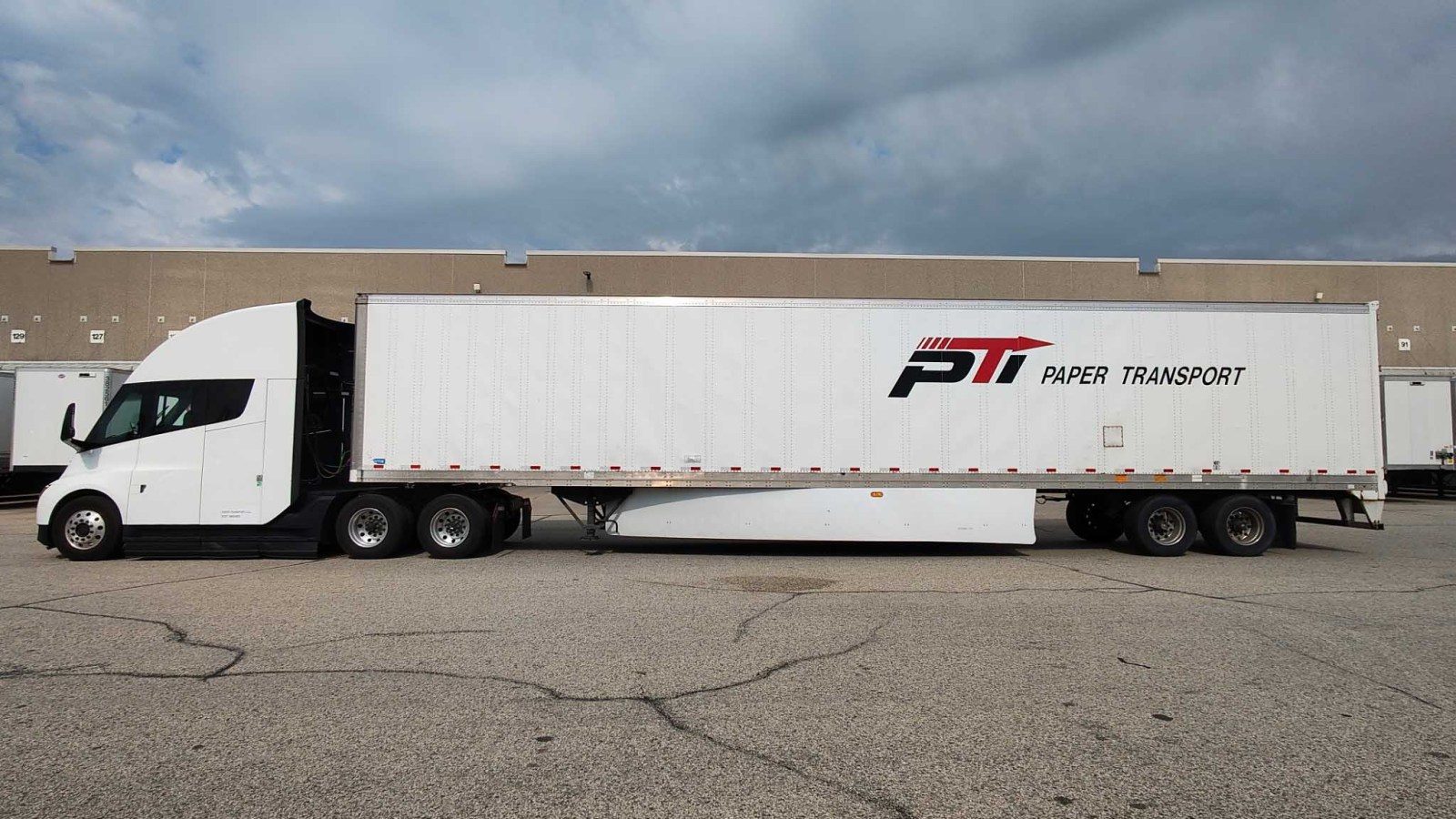

Paper Transport said on Monday it has partnered with Tesla to evaluate the Tesla Semi Long Range in dedicated freight operations in the Chicago market.
The De Pere, Wisconsin-based carrier is testing the truck within its dedicated operating model, where fixed routes and consistent mileage offer a controlled setting to measure how the electric tractor performs against the cost and reliability its shippers require.
The announcement extends the roster of fleets putting the Tesla Semi to work as the company ramps volume production.
Paper Transport’s evaluation will see the Semi model in the freight-dense corridors around Chicago rather than the California ports and lanes that have anchored most previous deployments.
The Evaluation
Paper Transport framed the trial as consistent with a consultative approach in which it helps customers pick the transportation method that fits each network.
The carrier is running the Long Range configuration, the version rated for up to 500 miles on a single charge, within lanes where predictable routing and steady daily mileage suit a battery-electric tractor.
Bryan Ellen, the company’s VP of Maintenance, said Paper Transport is “bullish” on the fit between its dedicated model and the efficiency of the fully electric Class 8 truck, and expects the relationship with Tesla to grow.
The company has not disclosed how many trucks are involved, the length of the evaluation or whether it carries an option to purchase, framing the arrangement as an assessment rather than a fleet order.
Founded in 1990, Paper Transport is a dedicated and intermodal truckload carrier that ranks among Transport Topics’ top 100 for-hire fleets and top 20 intermodal providers, operating roughly 950 drivers from its Wisconsin base and terminals across the Midwest and South.
The dedicated model it is using for the trial matters technically, because fixed customer routes with known distances and return-to-base scheduling remove much of the range and charging uncertainty that complicates electric trucks in irregular, long-haul work.
Where It Fits in the Semi Rollout
The evaluation lands as Tesla moves the Semi from a long pilot into volume production, having built the first truck on its high-volume line in late April at a dedicated factory next to Gigafactory Nevada.
The Long Range Semi is rated for up to 500 miles, 82,000 pounds of gross combination weight and 1.7 kilowatt-hours per mile, with 800 kilowatts of drive power and charging that can recover up to 70% of its range in about 30 minutes.
A California Air Resources Board (CARB) filing confirmed the Long Range carries an 822 kilowatt-hour pack with nickel-cobalt-manganese-aluminium cells, and that its roughly 23,000-pound tare weight leaves about 45,000 pounds of payload in a typical dry-van setup, competitive with a diesel tractor.
Paper Transport joins a widening group of operators that includes the 370-truck order from charging-and-freight company WattEV, the largest single electric-truck deal in California history, alongside port-drayage buyers through Forum Mobility and testing by DHL, Saia and ArcBest.
The Chicago focus is notable because most early Semi activity has clustered in California, where a $200,000 state voucher has driven more than 1,000 orders, making a Midwest dedicated evaluation a test of the truck’s economics outside the most incentive-rich market.
Incentives are spreading beyond California, with Oregon, Washington and a planned clean-ports program at East Coast harbors offering rebates of up to $175,000 or more per electric Class 8 truck.
The interest is spreading through new channels as well, with Tesla having partnered with Uber Freight to deploy Semis through a program designed to lower upfront costs and route trucks around available charging, one of several efforts to ease fleets past the adoption barriers of price and infrastructure.
Early operators have reported the truck meeting its billing, with DHL running a Semi in Central California at about 100 miles a day and charging roughly once a week, and confirming an order beyond a handful of units for delivery this year.
Tesla itself has said it will be the first to deploy the Semi at scale in its own logistics, and program director Dan Priestley has argued the truck is ready for commercial use, telling an industry audience that “the product is ready” and that Teslahas “ample demand.”
The Broader Backdrop
Real-world data from earlier fleets has underpinned the interest, with Tesla reporting its test fleet has covered more than 13.5 million miles at about 95% uptime and pilot operators logging efficiency between 1.6 and 1.7 kilowatt-hours per mile under heavy loads.
The company has priced the Long Range Semi near $290,000 and the Standard Range version near $260,000, below the roughly $435,000 average for a zero-emission Class 8 truck under California’s incentive program, though the figures sit well above the estimates Tesla floated at the 2017 unveiling.