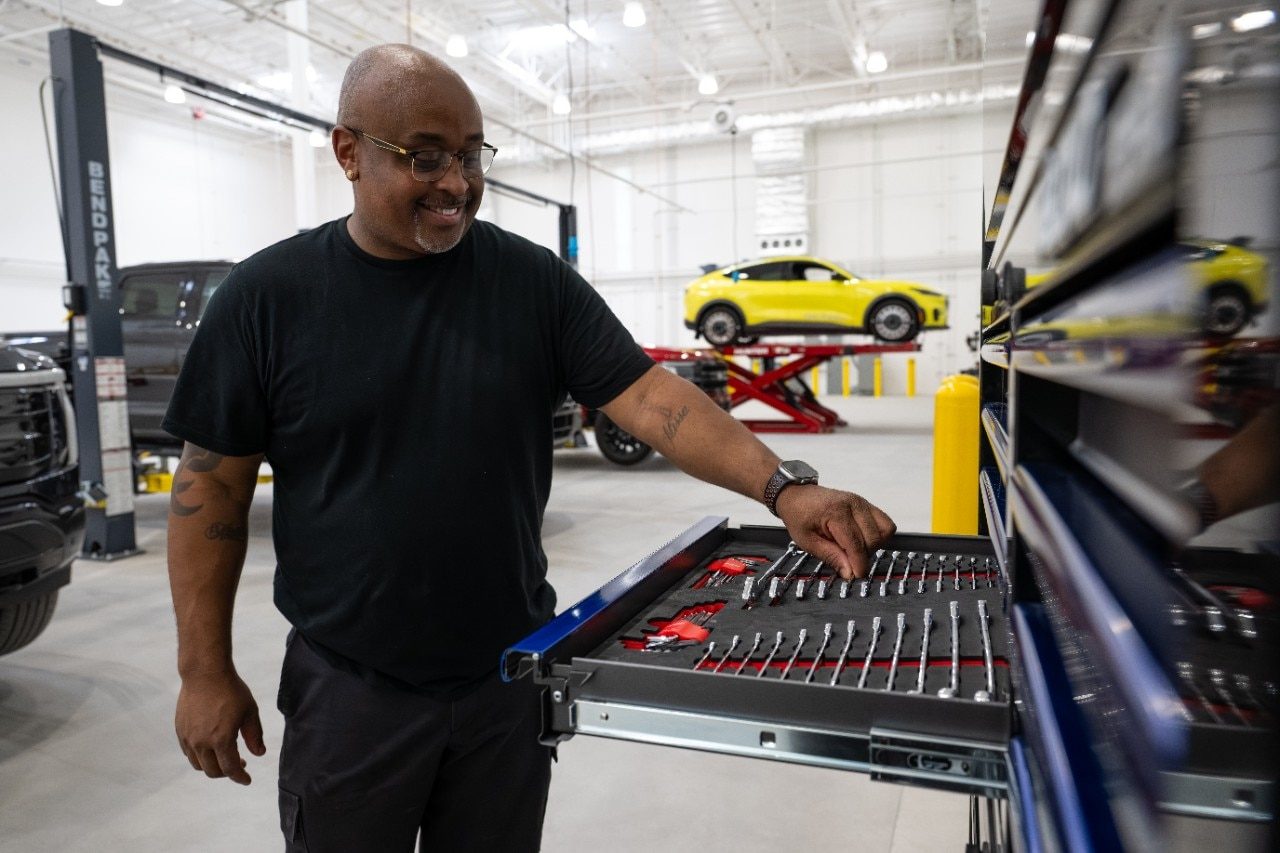

Ford Motor Company invited media to tour its Electric Vehicle Development Center in Long Beach, California, offering the first inside look at the 350-person hub where its next-generation, affordable EVs are being designed and tested.
The facility is central to the automaker’s Universal Electric Vehicle (UEV) platform — a clean-sheet architecture that will underpin a midsize electric pickup truck priced around $30,000, with production set to begin at the Louisville Assembly Plant in 2027.
The Long Beach campus began as a confidential project around 2022, staffed by a small team assembled by Alan Clarke, a former Tesla executive with 12 years of experience who now serves as VP of Advanced Development Projects.
The group drew talent from US EV makers Rivian and Lucid Motors, as well as aerospace firms, operating with limited oversight and a mandate to rethink how Ford designs and builds electric vehicles.
What was once a single 120,000-square-foot building has grown into a two-building, 270,000-square-foot campus across from Long Beach airport, with a 150,000-square-foot testing and validation facility also being built out.
Ford says the roughly 350 employees on-site work alongside designers, engineers, battery specialists, and supply chain staff — all under one roof.
In an interview with CNBC at the facility, Clarke framed the team’s work as a response to an industry in flux.
“Agility is key,” he said, noting that Ford has been “able to pivot around all the different market conditions. The EV industry has had massive headwinds, and so we’ve had to adjust.”
Clarke remains confident that the UEV platform can hold its own against Chinese competitors, while acknowledging the uneven playing field.
“We only win with speed, and we have to play by the rules here,” he told CNBC. “We’re pretty confident that we’re going to be competitive … and we won’t win, ultimately, unless we get down to the prices that American consumers are willing to pay for EVs like this.”
Platform Gains
Ford says the UEV platform delivers 20% fewer parts, 25% fewer fasteners, and 50% fewer cooling hoses and connections compared to previous products.
Assembly of the midsize truck is expected to be 15% faster than Louisville Assembly Plant’s prior output, using 40% fewer workstations.
The company has also adopted a 48-volt electrical architecture — a system Tesla first commercialized in the Cybertruck — which Ford says reduces wiring by over 4,000 feet and cuts 22 pounds from the harness compared to its first-generation electric SUV.
Large aluminum “unicastings” condense over 146 parts into two structural components.
The platform is designed to underpin multiple future vehicles beyond the launch truck.
According to Clarke, the team has been focused on a single platform and a single product to start. However, the architecture needs to be replicable across multiple factories worldwide.
Ford expects the platform to eventually anchor a family of EVs spanning compact vehicles to full-size vans.
Battery Lab
Battery cost is the core challenge — Ford estimates the pack accounts for roughly 40% of an EV’s total cost.
The Long Beach facility includes battery labs where cells and packs are tested to failure, torn down, rebuilt, and re-tested without leaving the campus.
The campus also houses a 22,000-square-foot design studio with seven milling towers, 3D printers, a trim shop, and a full-size five-axis gantry machine.
Ford says full-size prototypes can be fabricated in as little as 30 minutes for smaller components and a few days for full-scale models — compared to a typical three-month turnaround when outsourced.
Financial Context
The EVDC opening comes at a turbulent moment for Ford‘s EV ambitions.
The company took $19.5 billion in charges in December after restructuring its EV strategy, canceling three planned electric models — including a full-size truck and two commercial vans — and permanently discontinuing the F-150 Lightning.
The ‘Model e’ EV unit recorded $4.8 billion in losses in 2025 and is not expected to reach profitability until 2029.
At the same time, US EV sales have collapsed since the federal tax credit expired in September, with Ford‘s registrations more than halving in the past months.
The company restructured its EV and manufacturing operations last month under Chief Operations Officer Kumar Galhotra, announcing the departure of chief EV executive Doug Field.
CEO Jim Farley has described the UEV project as a “Model T moment” for Ford, while framing the broader competitive landscape in existential terms.
He said last week that the skunkworks team’s breakthroughs are now being integrated back into Ford‘s mainstream products and processes.
The company is investing approximately $5 billion in the UEV program, including a $2 billion upgrade to Louisville Assembly Plant. The company has delayed the platform’s European rollout while it tests the architecture domestically first.