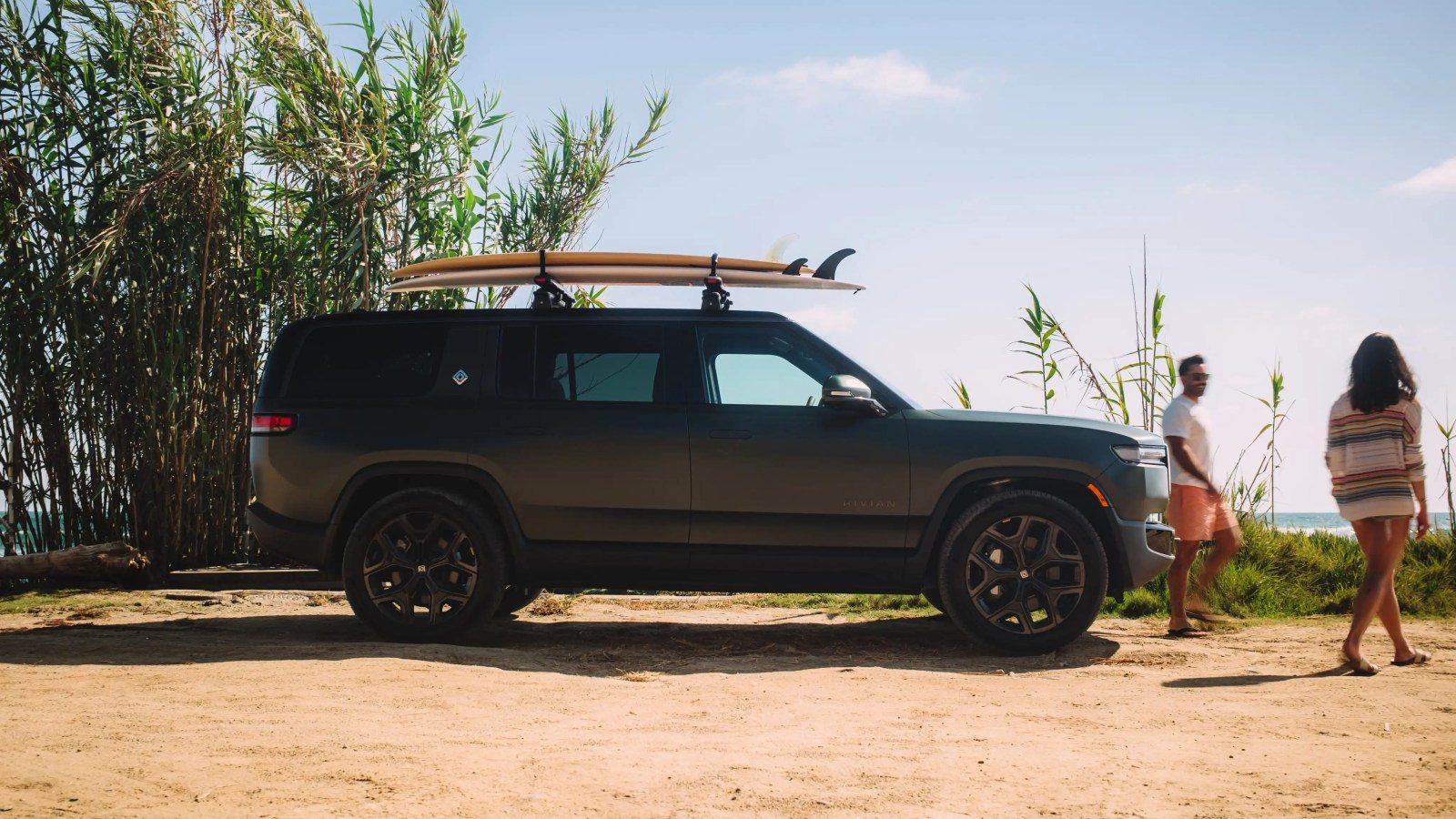

Rivian registered 3,970 EVs in California during the first half of 2026, a 28.3% decline from 5,540 units in the same period a year earlier, according to data published by the California New Car Dealers Association (CNCDA).
The drop made the Irvine-headquartered EV maker the second-worst-performing brand among California’s top 30 sellers by year-over-year change, trailing only Dodge at -30.5%.
A total of 1,759 Rivian vehicles were sold in the second quarter, down 34% from 2,668 in Q2 2025, marking a steeper decline than the first quarter.
The CNCDA revised the EV maker’s Q1 2026 California registrations upward to 2,211 from the 1,841 units originally reported in the Q1 Auto Outlook, reducing the first-quarter year-over-year decline to 23% from the previously published 36%.
The report noted that historical figures had been updated since the previous release.
Under the revised figures, the pace of decline accelerated between the two quarters rather than moderating — a trajectory that underscores the demand erosion facing Rivian‘s R1 lineup in its home state heading into the R2 ramp.
The company’s share of California’s ZEV market slipped to 2.9% in the first half, down from 3.0% a year earlier.
R1S Sales
Rivian‘s R1S SUV ranked 25th among California’s top 25 selling hybrid, ZEV and plug-in hybrid (PHEV) models in the first half, logging 3,092 registrations.
The figure implies that just 878 of Rivian’s 3,970 total California ZEV registrations came from the R1T pickup, the electric delivery van (EDV) and any early R2 units that may have been registered before the end of June.
Customer deliveries of the R2 began on June 9, limiting the model’s contribution to the half-year total to roughly three weeks of handovers.
Rivian has projected 5,000 R2 deliveries in California alone for 2026, according to an EPA certification filing, out of a company-wide R2 target of 20,000 to 25,000 units.
Reaching that California figure now rests entirely on the second half.
Rivian raised its full-year delivery guidance to 65,000 to 70,000 vehicles after second-quarter deliveries of 12,194 units came in above consensus.
Hitting the midpoint of the raised target would require roughly 45,000 deliveries across Q3 and Q4, more than double the approximately 22,500 shipped in the first half.
Broader Market
California’s overall ZEV market contracted sharply in the first half.
Total new zero-emission vehicle registrations fell 24.8% year over year to 137,430 from 182,802, as the expiration of the federal $7,500 EV tax credit at the end of September 2025 weighed on demand across the board.
Rivian‘s 28.3% decline outpaced that market-wide contraction by 3.5 percentage points.
Only five of the 30 largest brands in California posted year-over-year registration gains in the first half.
Lucid led the list with a 22.7% jump, followed by Volvo at a 14.2% increase and Chrysler at 9.2%. Genesis and Toyota also registered slight gains while every other brand declined.
Lucid’s California growth reflected the ramp of the Gravity SUV against a year-earlier baseline in which the Saudi-backed EV maker was delivering almost exclusively the Air sedan.
Volvo has just commenced deliveries of its EX60 mid-size SUV in Europe — a rival to the Rivian R2, and for which orders opened two months ago in the US.
The Sweden-headquartered, Geely-owned automaker has received special clearance to continue selling its vehicles in the US — unlike its sister brand Polestar, which has been barred under the Connected Vehicle Rule from model year 2027.
Among EV-focused automakers, Tesla fell 6.5% but grew its ZEV market share to 56.7% from 45.6% a year earlier, a gain of 11.1 percentage points, as competing brands lost volume more rapidly.
Tesla‘s Model Y remained the best-selling ZEV in California by a wide margin, with 54,327 registrations through June.
The Model 3 followed at 16,643 units; the Hyundai Ioniq 5 was the top non-Tesla ZEV at 7,628 registrations, followed by the Toyota bZ4X at 5,262.
The Elon Musk-led company will report its second-quarter earnings this Wednesday, July 22.
At the other end of the spectrum, legacy brands with limited or declining EV lineups posted some of the steepest drops.
Buick fell 28.0%, Lincoln declined 27.8% and Jeep slid 26.6%. Rivian‘s -28.3% placed the company closer to that legacy cohort than to its pure-play EV peers.
California’s ZEV Landscape Shifts
Separately, the California Energy Commission (CEC) announced that Californians purchased 86,857 new ZEVs during the second quarter, representing 19.1% of new car sales — an increase of 3.3 percentage points from the first quarter.
Electric vehicles accounted for 16.6% of new car sales in the state, compared with 5.8% nationally, according to Cox Automotive.
The CEC described the quarter as the highest EV share recorded without federal tax credits, coming in only 2.5 percentage points below the same quarter a year ago, when the $7,500 incentive was still in effect.
Battery-electric vehicles held a 15.9% share of all California powertrain registrations through June, while hybrids commanded 22.1%, plug-in hybrids took 2.3% and gasoline vehicles accounted for 57.6%.
Combined share for BEVs, PHEVs, hybrids and fuel-cell vehicles reached 40.3% in the first half, down from 43.8% in 2025 but sharply above the 11.6% recorded in 2018.
Governor Gavin Newsom’s rebate program — a $3,500 rebate for first-time EV buyers — takes effect next month, restoring direct consumer subsidies in the nation’s largest auto market for the first time since the federal credit expired.
Thirteen automakers have signed on to participate.