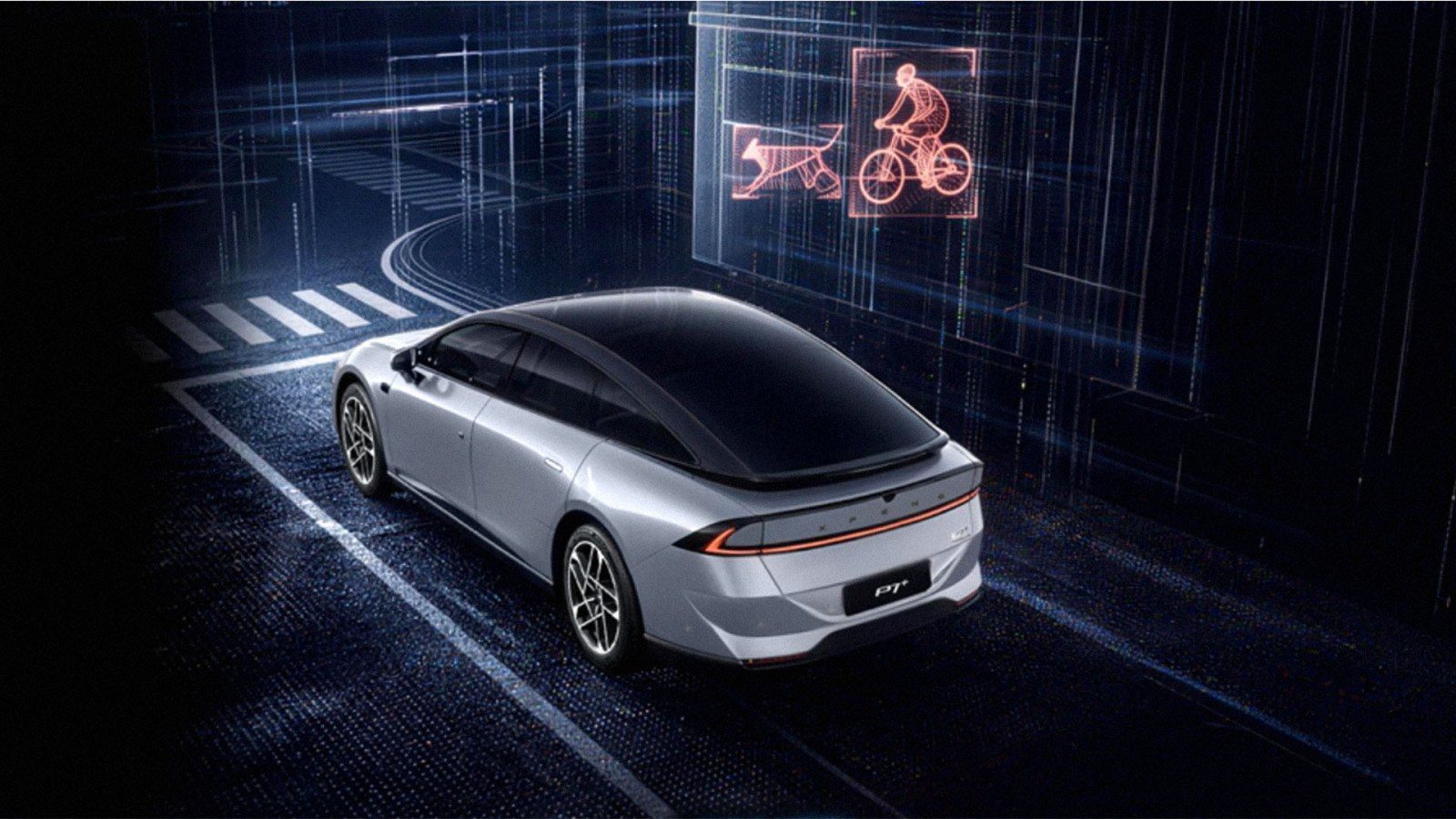

XPeng released the first model upgrade to its second-generation assisted driving system on Thursday, in an event called ‘All-New VLA 2.0 Experience Day.’
The carmaker claims a twentyfold improvement in what it calls comprehensive safety capability, a 3.5-fold increase in parameters, responses 300% faster, and an architecture that remembers 30 seconds of what a vehicle has passed while predicting six seconds of what is coming.
The VLA 2.0 system was unveiled at XPeng’s AI Day in November 2025, opened to pioneer users a month later, rolled out to Ultra models in the first quarter of this year and pushed as a public over-the-air update in March.
Global delivery of VLA 2.0 begins in 2027, with Volkswagen as the inaugural launch partner in China and Australia among the first overseas markets.
Understanding Through Time
XPeng presented its physical world foundation model as moving from three-dimensional space to four-dimensional spacetime, and divided the system into three parts by tense.
The past is handled by Infini-VLA, a long-sequence architecture that builds a memory of the preceding 30 seconds and folds it into driving decisions.
The present is handled by streaming inference, described as streaming autoregressive reasoning.
The future is handled by two components: X-Foresight, a predictive world model that anticipates the next six seconds and simulates the behaviour of surrounding road users, and Flow Matching, which generates multiple candidate future scenarios so the system can select among them.
The company also introduced what it calls an MoT hybrid architecture, allocating capability by task so that urban driving, campus roads and parking are handled by specialised experts rather than one undifferentiated model — an approach it says reduces interference between scenarios and makes switching between them more stable.
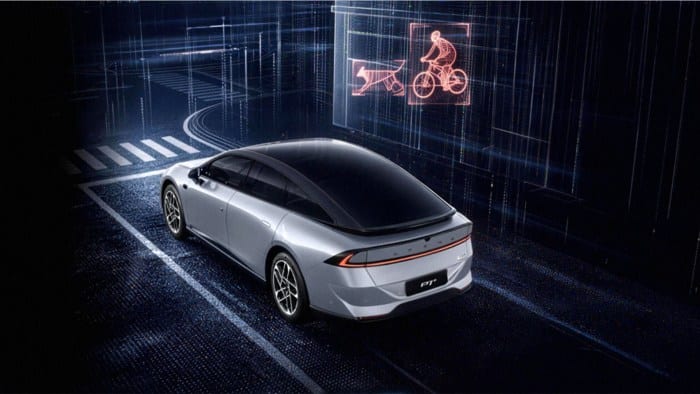
The stated targets are the situations that defeat conventional systems: sudden braking ahead, unexpected pedestrian movement and cut-ins.
What the Twentyfold Figure Measures
The largest number of the day is also the softest.
The twentyfold claim is presented on stage as a multi-dimensional comprehensive safety capability improvement, aggregated across six named dimensions: risk identification, trajectory planning, handling of extreme conditions, response latency, future projection, and generalisation combined with robustness.
That is a composite of six separate measures, and XPeng published neither the individual figures nor the method by which they were combined.
The Third Chip Goes Live
The second announcement of the event concerns silicon that customers already own.
XPeng said the third of its Turing chips is now live and will run an in-vehicle system it calls Master Agent, handling instructions by voice: pulling over, parking nearby, imprecise navigation requests and complex planning.
The company summarised it as “One brain runs the car. One voice controls it.”
That chip was sold to customers nine months ago.
XPeng opened reservations in late November for a hardware upgrade adding a third Turing chip to the G7 Ultra and the new P7, as EV reported at the time.
The company described it then as involving only the cockpit chip, a large-scale model controller, and said it would be installed under the front passenger-side floor carpet without dismantling the vehicle.
Owners have therefore been carrying 750 TOPS of additional in-cabin compute, fitted beneath the passenger footwell, waiting for software to use it. Thursday is when the software arrived.
Robotaxi vehicles carry four chips for roughly 3,000 TOPS, operating without LiDAR or high-definition maps. The Mona L03, launched across 65 markets, carries three, as do the next P7 and the IRON humanoid robot.
What Is Actually New
VLA 2.0 itself is not new, and the framing matters.
Against the perception-planning-control pipeline it replaced, XPeng has previously claimed a reduction in hard-braking events of roughly 99% and efficiency gains near 23%.
Volkswagen has separately nominated the Turing chip for its own vehicles.
The company has committed VLA 2.0 only to vehicles with the triple-Turing architecture and has not promised backward compatibility for older overseas hardware.
Second-quarter results missed consensus and the shares fell. Third-quarter guidance of 115,000 to 121,000 vehicles leaves the annual target of 550,000 to 600,000 needing a record fourth quarter.
The call was dominated by physical AI rather than vehicles, and the emphasis has a financial dimension: the robotics unit raised more than $900 million at a $6.3 billion valuation. The social post announcing 6.3.0 closed with the company’s ticker.