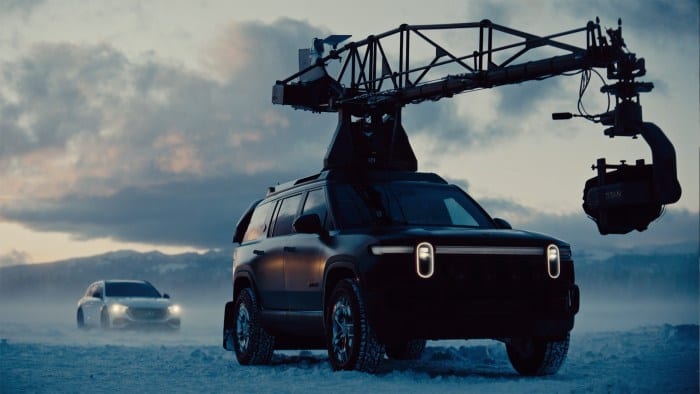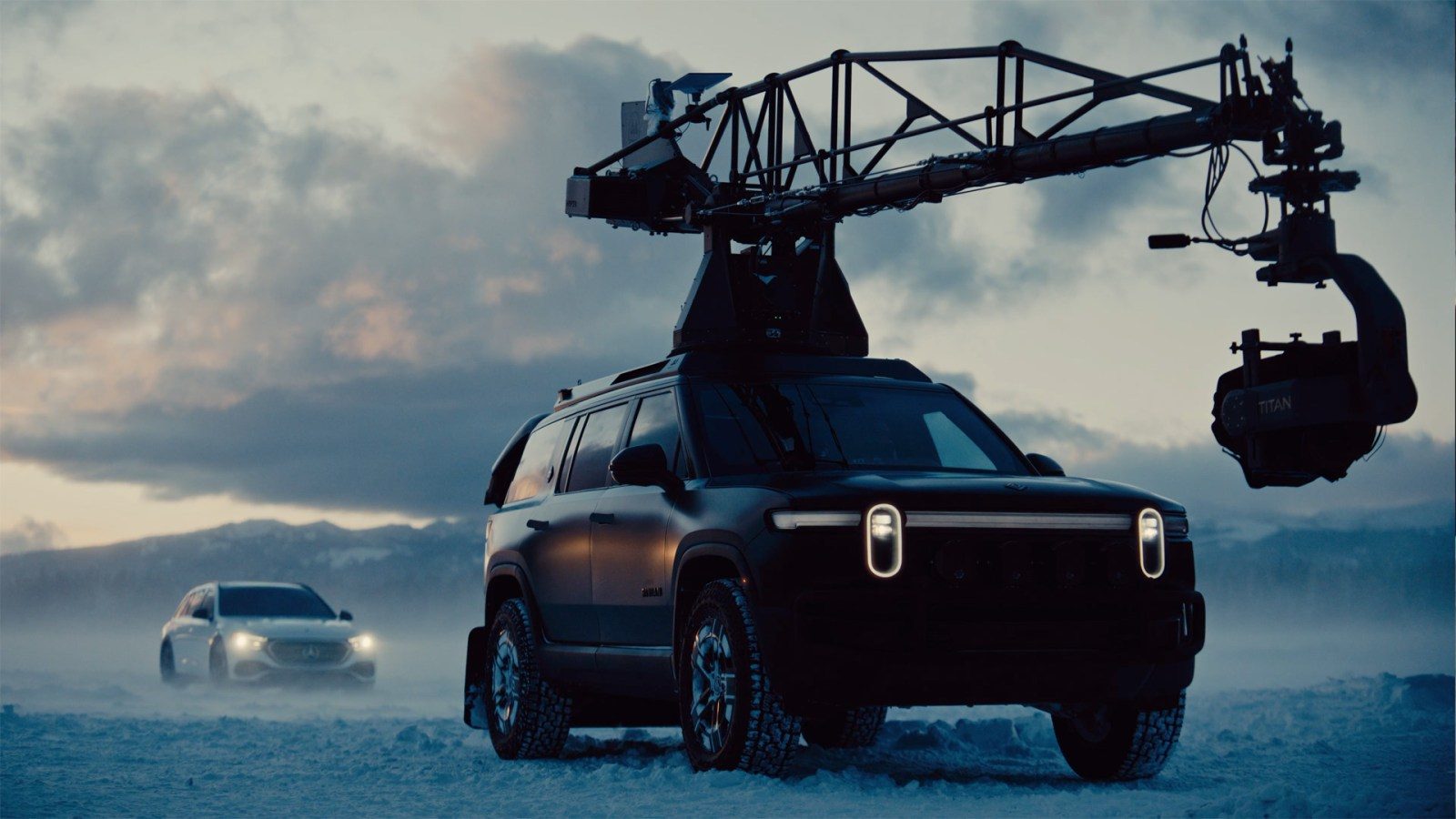

A production Rivian R1S carrying a gyro-stabilised camera crane can rotate through unlimited 360-degree revolutions in 5.5 seconds while travelling at more than 100 miles per hour.
The vehicle is the work of Motion State, a Pacific Northwest production company, built in partnership with Rivian over about a year. Motion State describes it as the first factory-built arm car.
A short documentary on the project, directed by Amber Koniniec and Colby Brickwell, was released last month.
Motion State owns and operates the vehicle, listing it alongside a Ford Raptor Roush and a Porsche Cayenne Turbo in a fleet it describes as the most advanced arm cars in the Pacific Northwest.
Productions rent it, including Rivian‘s own.
Rivian published a video in October 2025 describing the vehicle as a custom R1S camera car built in partnership with Motion State.
What an Arm Car Is
An arm car is a camera vehicle fitted with a remote, gyro-stabilized crane arm, used above all for filming other vehicles in motion.
The system that defined the category is Filmotechnic’s Autorobot—long nicknamed the Russian Arm, designed and built in Ukraine—which much of the industry began calling the U-Crane after Russia’s 2022 invasion.
The economics are unusual. Productions rent these vehicles rather than own them, and the crane rather than the car is the expensive part.
The vehicles are typically wrapped matte black to keep them from reflecting into the footage they capture, and are trailered to location rather than driven.
Motion State publishes two separate specification sets, and the headline figures belong to the crane rather than the vehicle.
The crane is a Motocrane Hyper. Beyond the 360-degree rotation figure, the arm lifts through its full range, minus 35 to plus 35 degrees, in under two seconds.
The Vehicle
The R1S underneath is a dual-motor car, rated by Motion State at 650 horsepower with regenerative braking, and electronically limited to 110 miles per hour. It is not the 1,025-horsepower quad-motor version.
Adaptive air suspension and all-terrain tyres give 14.9 inches of adjustable ground clearance.
The cabin seats six: precision driver, arm operator, director of photography, first assistant camera, director, and client or photographer, with hands-free open-mic communication between the crew and the driver.
Two details reveal what the vehicle is actually optimised for.
The second is the frunk. Motion State built a custom drone station into the front trunk, with a video monitor mounted inside the hood streaming a live feed from the aircraft, so the same crew can switch from ground tracking to aerial work within minutes rather than deploying a second unit.
Motion State describes the platform as delivering “silent power, instant torque, and precise control” across varied terrain, and says it custom-engineered the vehicle’s design and interior layout around production workflow.
The documentary shows some hardware changes such as a front brush guard carrying four auxiliary lights, a roof structure supporting the crane base, and the matte black finish across the body.
Why an EV as Base Vehicle
The case for an electric arm car is largely about what it does not produce.
A camera vehicle running an internal-combustion engine generates noise on set, vibration through the chassis into the stabilised head, and exhaust into the frame.
An electric platform removes all three, and instant torque suits the acceleration profile of a vehicle that must match a hero car’s speed precisely from a standing start.
The build uses the 650-horsepower dual-motor.
Rivian’s Own Performance Group
The project sits alongside a formalisation of Rivian‘s internal performance work.
In late February the company gave a public name to a skunkworks team that had operated since its earliest days, calling it the Rivian Adventure Department, or RAD. The announcement was timed to the FAT Ice Race in Big Sky, Montana.
Chief Design Officer Jeff Hammoud said RAD gives an official name to an impulse he described as the company’s DNA rather than one team’s remit, and that the department’s purpose is to keep pushing the boundaries of adventure.
RAD’s stated mission is to find the next level of what the vehicles can do and bridge between the extremes and the features that reach customers’ driveways.
The team has taken vehicles to 14,000 feet at Pikes Peak, into deserts in California and Nevada, and onto ice in Montana.
An R1T won the 4×4 class of the Rebelle Rally in 2023 — the first fully electric vehicle to win the event, driven by two Rivian engineers — and set a production electric truck record at Pikes Peak the same year before beating it in 2024.
The RAD Tuner, available on quad-motor R1 models, exposes ten variables to the driver — including front-to-rear torque split, damping, roll stiffness and brake assistance — with saved presets.
The feature sits behind a price barrier of about $122,000 for a quad-motor R1.
It Does Not Only Film Rivians
One frame in the documentary shows the arm car working on snow at dusk, boom extended, tracking a white Mercedes-Benz.
That is the commercial logic of the vehicle. Motion State rents it to productions, and its arm car page lists the R1S alongside a Ford Raptor Roush and a Porsche Cayenne Turbo as three platforms a client can book.
The Work It Has Done
The arm car has shot Rivian‘s own advertising more than once.
Production credits published by the company place it on a Rivian campaign around the turn of the year. A second shoot, for a Rivian voice assistant commercial, was documented in June.