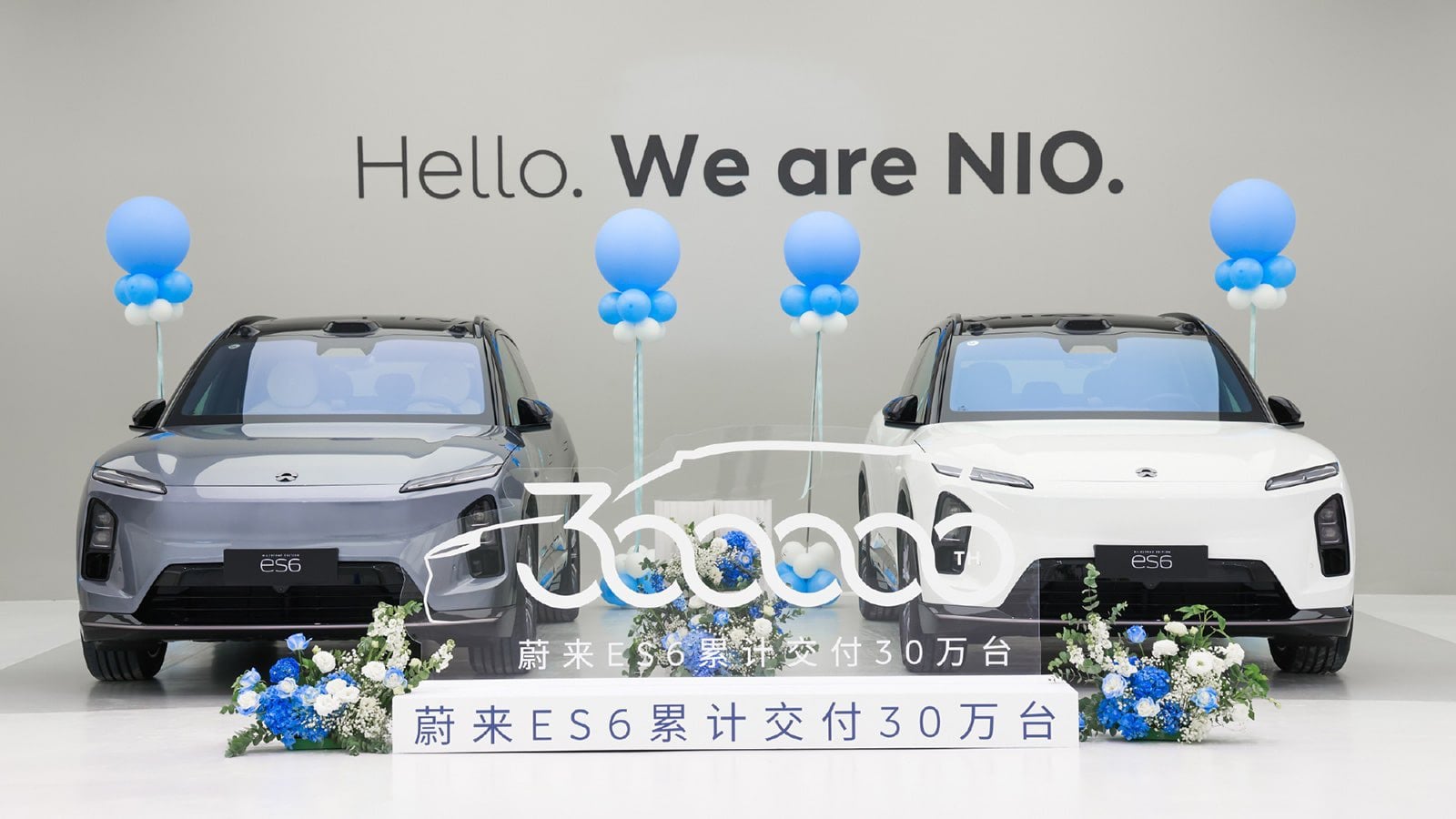

Nio will keep launching sport utility vehicles (SUVs) through next year, with the third generation of its ES6 now announced for the third quarter of 2027.
As it prepares to launch a revamped station wagon model, the premium brand will also launch a revamped five-seat SUV next year.
Co-founder and president Qin Lihong first set that window at the company’s Spring Festival user event, telling attendees the mid-size SUV ES6 would “probably be the most popular model in our third-generation lineup” when it arrives, because “as a mid-size SUV, it has the widest appeal.”
Deliveries of the ES6 reached a new 12-month low in July with 860 units registered, according to CPCA data. The ET5 Touring recorded 1,555 deliveries, the lowest since January and the second-worst month since last year.
The third-generation ES6 will be the first of the brand’s four entry-level models to move to the NT3.0 platform, extending a strategy that has reshaped what Nio sells and how much it charges for it for a third consecutive year.
Three Years of SUVs
The pivot began with the third-generation ES8 in late September 2025, and 2026 was built almost entirely around large SUVs.
The ES9 executive flagship launched in May from 498,000 yuan ($74,100) and reached 20,000 deliveries in 73 days.
A five-seat ES8 opened pre-orders on June 28 from 382,800 yuan ($57,000), or 274,800 yuan ($40,900) under Battery as a Service, with deliveries from July 10 — giving the flagship five-, six- and seven-seat configurations and returning it above 10,000 units a month in July.
The Onvo sub-brand added the L80 in the same window.
That five-seat variant answers part of the brief Qin described in February.
Some buyers, he said, and “especially female users,” find the ES8 “a bit too large,” feedback he attributed to friends with smaller families.
Founder and chief executive William Li has framed the whole sequence as a third growth cycle, targeting 40% to 50% annual sales growth driven primarily by large SUVs, after weaker-than-expected demand for the company’s sedans through 2024 and 2025.
What the 2027 Car Inherits
No dimensions, battery capacities or motor outputs have been disclosed.
Qin’s guidance was comparative: the new ES6 will be “similar to our overall third-generation lineup” both technically and in design, with the third-generation ES8 as the reference point.
He noted that the ET9, developed earlier, carries third-generation technology but an exterior not fully aligned with the finished Gen-3 look.
The ES6 is the entry point of a four-model group Nio calls the 5566 series — the ET5 sedan, the ET5 Touring, the ES6 and the EC6.
All four received a model-year update on April 2 that left prices unchanged, adding a driver-assist status lamp, rear ventilation and massage, and an optional zero-gravity driver’s seat.
The ES6 still lists at 338,000 yuan ($50,300), or 268,000 yuan ($39,900) under BaaS.
Those updates were explicitly not the generational change. A full NT3.0 redesign of the series remains a 2027 event, and the ES6 leads it.
One Wording to Watch
Qin’s February commitment was to a quarter. Subsequent company briefings have been looser.
An account of Nio’s Beijing spring exchange event in March places the all-new ES6 in the second half of 2027, and EV‘s own reporting in April carried the same phrasing.
A quarter becoming a half-year is not a delay announcement, and none has been made, but the narrower window has not been publicly restated since February.
The company’s record on this lineup argues for reading the looser version.
The ES7 was discontinued in China in early 2025 without a formal announcement before returning in July badged as a five-seat ES8 rather than a revived nameplate.
Why the Mid-Size Slot Matters
The strategy that has worked at the top of the range has hollowed out the middle.
The ES8 and ES9 delivered 16,603 units in July, 83% of the Nio brand’s 20,008 and 46% of the group’s 35,934.
The four 5566 cars managed 3,300 between them, or 16.5% of brand volume.
ES8 deliveries across the first seven months reached 88,947, more than twenty times the year-earlier figure, and the model led both China’s large SUV segment and the 400,000-yuan price class in the first half.
Qin conceded last September, four months after the mid-2025 updates to the entry series, that those models had not met expectations.
“Objectively, compared to the ES8, our other models face more challenges in the short term, for various reasons,” he said. “We still need to work harder on this.”