
XPeng said on Monday that its robotics business had entered into share purchase agreements with multiple investors, raising more than $900 million at a post-money valuation above $6.3 billion, or about 43 billion yuan.
The company described the round as the largest single private capital raise in China’s embodied AI industry to date.
The transaction has not yet closed.
IDG Capital led the round, with participation from Gaorong Ventures and what XPeng called support from Tencent and Alibaba as strategic investors.
XPeng will retain controlling ownership on closing, and the robotics business will continue to be consolidated into the group’s accounts.
Proceeds will fund hardware and software development, training and iteration of physical AI models, high-quality data generation, the development of end-to-end mass production facilities and international commercial expansion, the company said.
XPeng said the IRON humanoid will enter mass production by the year end, deployed first in its own stores and campuses, with formal sale and delivery in China and overseas markets from 2027.
XPeng Calls It the First Round
XPeng described Monday’s transaction as the robotics business’s first funding round, and said the amount and post-money valuation both set industry records.
Corporate records compiled by CB Insights show XPeng’s robotics arm, Xiaopeng Pengxing, raised a $100 million Series A in July 2022, also led by IDG Capital and with XPeng itself participating.
The characterisation may reflect a restructured entity or a first round of external strategic capital. XPeng has not addressed the earlier round.
What the Valuation Buys
The round roughly doubles the previous benchmark for the sector.
TARS Robotics closed a $455 million pre-A round in April that the company billed as a Chinese record. Unitree raised about $905 million, though through a Shanghai STAR Market listing rather than a private round.
Chinese embodied AI companies raised approximately 43.8 billion yuan, around $6.4 billion, in the first five and a half months of 2026, according to a tally by the Chinese technology outlet QbitAI. XPeng’s single round is equivalent to roughly a seventh of that.
China accounts for more than 43% of global robotics venture investment, according to Crunchbase data, and Beijing has committed a $138 billion state venture fund to artificial intelligence and robotics.
The valuation nonetheless sits far below the American benchmark. Figure AI has been reported at about $39 billion post-money, a figure the company has not confirmed publicly.
Valuation as Compensation
XPeng said the round establishes a clear market valuation for the robotics business and strengthens long-term incentive mechanisms for senior executives and key talent.
A priced round gives the unit a share currency with which to pay people, which matters in a sector where Chinese rivals have been bidding for the same engineers.
The company now describes itself as a leading global physical AI company rather than a carmaker, and lists Turing chips, world foundation models and integrated software and hardware as its architecture.
Founder and chief executive He Xiaopeng said the ambition is for IRON to become “a trusted partner for people and a meaningful part of everyday work and life.”
IDG Capital said the embodied AI industry is at a pivotal juncture, “transitioning from technical breakthroughs to scalable manufacturing and commercial deployment.”
The Robot
XPeng unveiled the first IRON at its AI Day in November 2024.
The robot stood 178 centimetres, weighed 70 kilograms and carried 60 articulated joints, and was subsequently deployed on XPeng’s own production lines, including assembly work on the P7+ sedan.
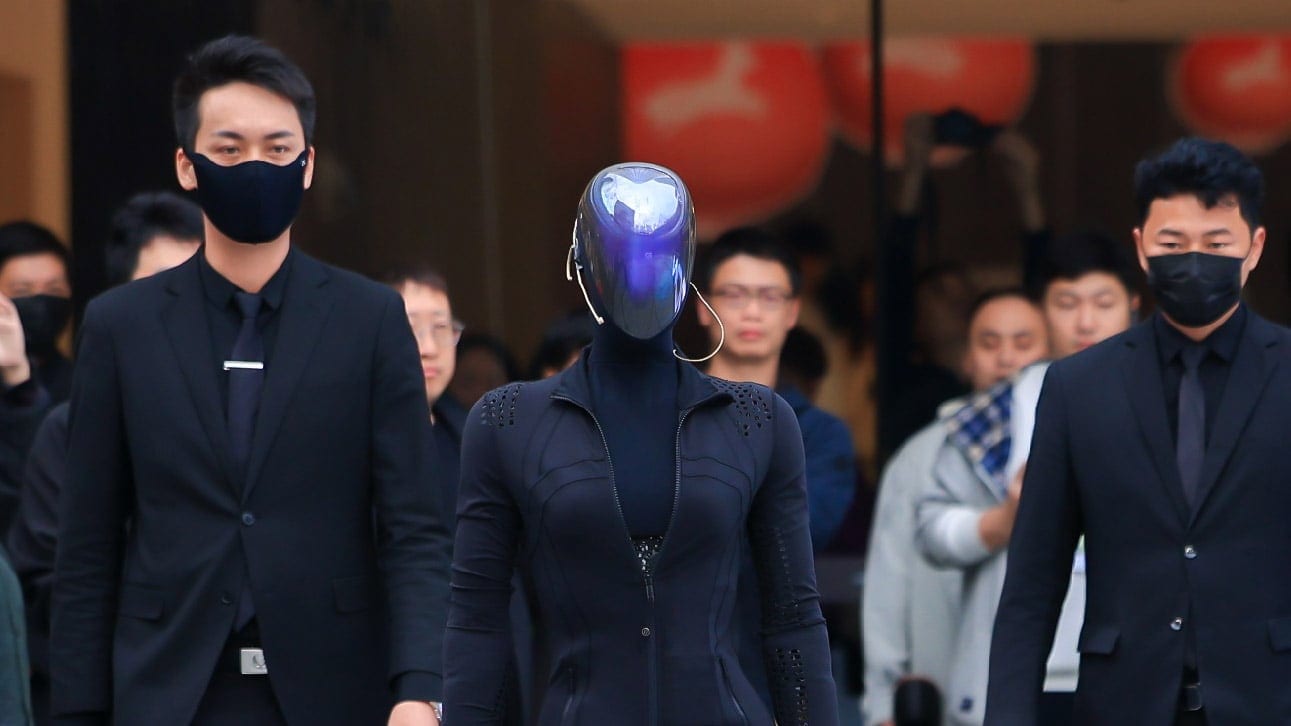
A second generation appeared at the 2025 AI Day on November 5, with a humanoid spine, bionic muscles, flexible skin and a curved display in the head. XPeng added passive degrees of freedom at the toes to soften the gait, and demonstrated the machine walking a catwalk.
XPeng said on Monday that the current IRON has 76 degrees of freedom across the body and 21 in each hand, within a proprietary fully enclosed flexible lattice structure.
Three in-house Turing chips deliver up to 2,250 TOPS of what the company calls effective computing power, enough to run its physical AI foundation model on the robot itself.
XPeng said that removes any need for remote operation and improves both latency and data security.
He Xiaopeng has said the company iterated through seven generations of robots, five of them quadrupeds, before arriving at the current bipedal form.
The catwalk demonstration prompted online claims that the robot was a person in a costume.
XPeng responded by releasing footage of staff cutting away the outer suit and the bionic muscle layer to expose the chassis and actuators beneath.
The Targets
He has set out commercial ambitions well beyond the 2027 delivery date.
He has been reported as saying the retail price could be similar to car prices and that households could afford the robot within five years, with a target of one million units by 2030. XPeng did not repeat those figures on Monday.
He has also discussed long-term investment of up to 100 billion yuan, about $13.8 billion, in the programme.
XPeng took the unit under his direct control in June, elevating IRON to the same strategic priority as the car business.
In an internal letter reported by Reuters at the time, He compared the moment to the eve of XPeng’s first mass-produced vehicle, the G3, eight years earlier.