
XPeng is planning to take its humanoid robot business global in 2027, with an internal goal of surpassing 1,000 units in monthly production by year-end ahead of the global rollout, the Wall Street Journal reported on Wednesday citing people familiar with the matter.
The report confirms a timeline for the company’s intent to sell its ‘Iron’ humanoid robot outside China, extending a domestic mass-production push since breaking ground on a dedicated robotics factory in Guangzhou earlier this year.
According to the report, the Guangzhou-based brand will roll ‘Iron’ out as a retail sales assistant across its Chinese stores starting in the first quarter of 2027, before extending the program to stores overseas later in the year.
The move fits into XPeng’s broader rebrand from EV manufacturer to “physical AI company,” leveraging the AI and autonomous-driving systems from its vehicle lineup to drive Iron’s development.
China Manufacturing Push
The global plan builds on targets XPeng has laid out internally for months.
Founder and CEO He Xiaopeng told nearly 1,000 employees at a mobilization meeting in late May that the humanoid program was entering its final stretch, with commercial units expected to start working as retail-store sales assistants in the first quarter of 2027.
He compared the robotics unit’s current stage to where XPeng‘s car business stood eight years ago, around the time of the G3’s launch and first deliveries in late 2018.
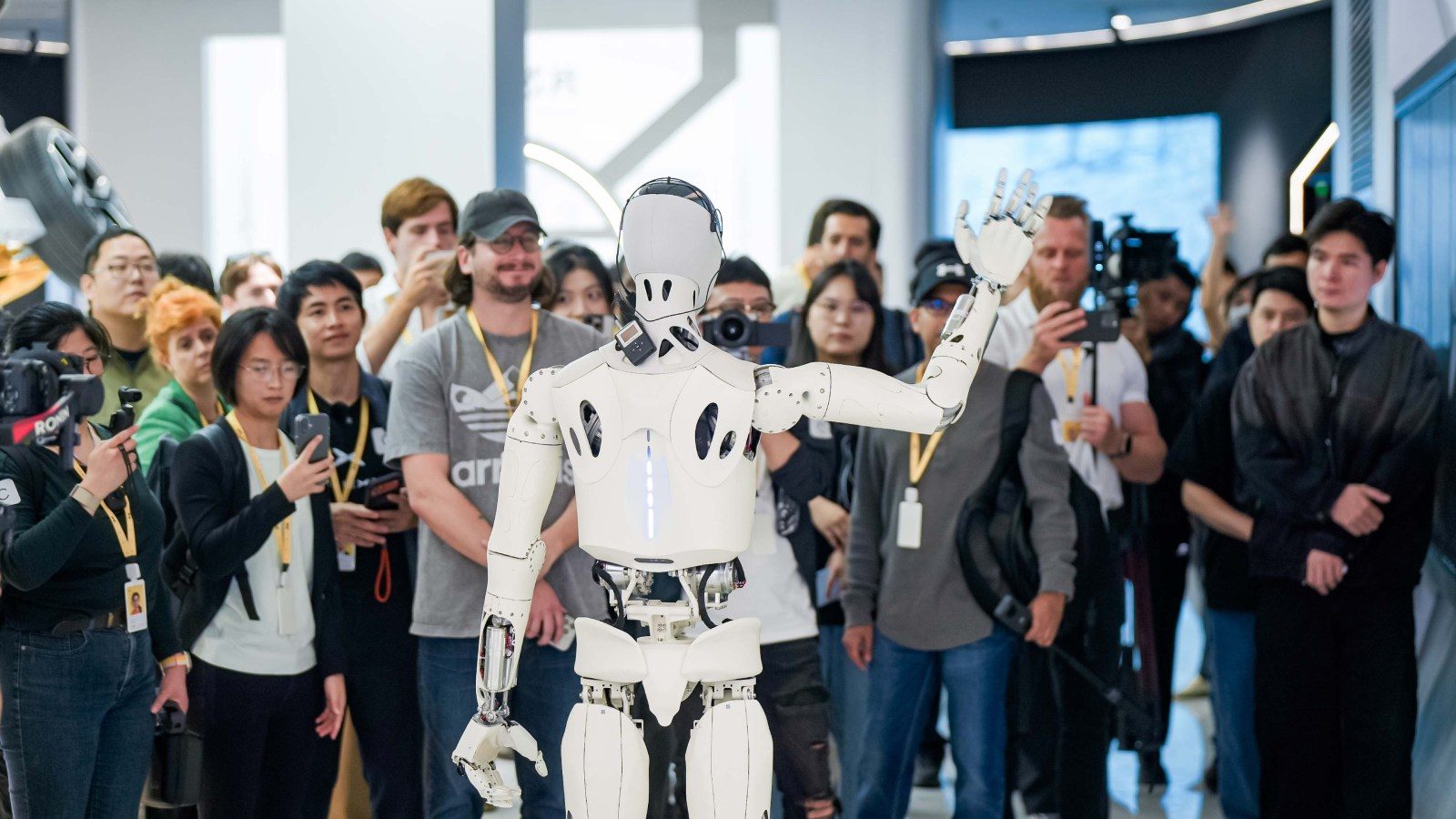
The current-generation ‘Iron’ stands 1.73 meters tall, weighs around 70 kilograms, and packs more than 60 joints and 200 degrees of freedom, along with a humanoid spine, biomimetic muscles, and fully wrapped flexible skin.
He Xiaopeng has said it uses what he calls the industry’s first all-solid-state battery fitted to a humanoid robot, and has repeatedly stressed that XPeng develops every major component in-house — chips, operating system, joints, and dexterous hands.
Manufacturing capacity is centered on a roughly 110,000-square-meter facility in Guangzhou’s Tianhe District, which XPeng has billed as the industry’s first “full-chain” humanoid robot mass-production base.
Autonomy Backdrop
The robotics push shares its technical foundation with XPeng‘s autonomous driving and robotaxi programs.
All three run on the company’s second-generation VLA (vision-language-action) model, which the automaker says cuts response times to under 80 milliseconds by skipping the translation step used in conventional autonomous-driving architectures.
He Xiaopeng has argued that progress in physical AI will likely reach robotics before it reaches self-driving cars, reasoning that robots face lower safety requirements than vehicles, where even small failures can cause frequent accidents.
The founder of the Guangzhou-based company has separately set an August deadline for VLA to comprehensively overtake Tesla‘s Full Self-Driving in China, while conceding FSD still holds an edge in some scenarios and that XPeng is still refining lateral control and extreme U-turn handling.
XPeng‘s autonomy team has also distanced itself from the LiDAR debate, similarly to Tesla, after initially integrating the sensors.
He Xiaopeng has said he feels no pressure to add LiDAR sensors despite rivals increasingly fitting them to vehicles above 150,000 yuan ($22,000), maintaining that a pure vision-based approach remains sufficient.
In China, VLA 2.0 has reached a 50.4% assisted-driving mileage share since its March rollout — what autonomous-driving head Xianming Liu has called the first time smart driving has overtaken human-controlled driving at fleet scale.
Munich Debut
The comapny’s humanoid robot’s international debut arrives just ahead of the global sales push.
XPeng is staging a brand event this Thursday (July 16) in Munich to launch its Mona L03 SUV across seven European markets.
The event will double as the European debut of the ‘Iron’ humanoid, alongside the company’s Land Aircraft Carrier modular flying car, from its Aeroht subsidiary.
XPeng has also been testing its VLA 2.0 assisted driving software with the L03 in Munich ahead of the event, which He Xiaopeng announced on Tuesday will reach Europe in early 2027.
He also tied the software push to XPeng‘s robotaxi ambitions, saying the company hopes to bring its robotaxi fleet to European partners running the same underlying model.
Sales Backdrop
XPeng is working toward a full-year delivery target of 550,000 to 600,000 vehicles, after posting its first-ever quarterly net profit in the fourth quarter of 2025.
Export markets — which have doubled to 60 last year — are key to achieving these targets, as domestic sales continue to falter.
In the first half of 2026, XPeng doubled the share of overseas shipments across its overall deliveries from 9.5% to 19%.
The company invested 9.5 billion yuan ($1.4 billion) in R&D last year, of which 4.5 billion yuan ($700 million) went to AI specifically, and plans to lift AI-related spending to 7 billion yuan in 2026.