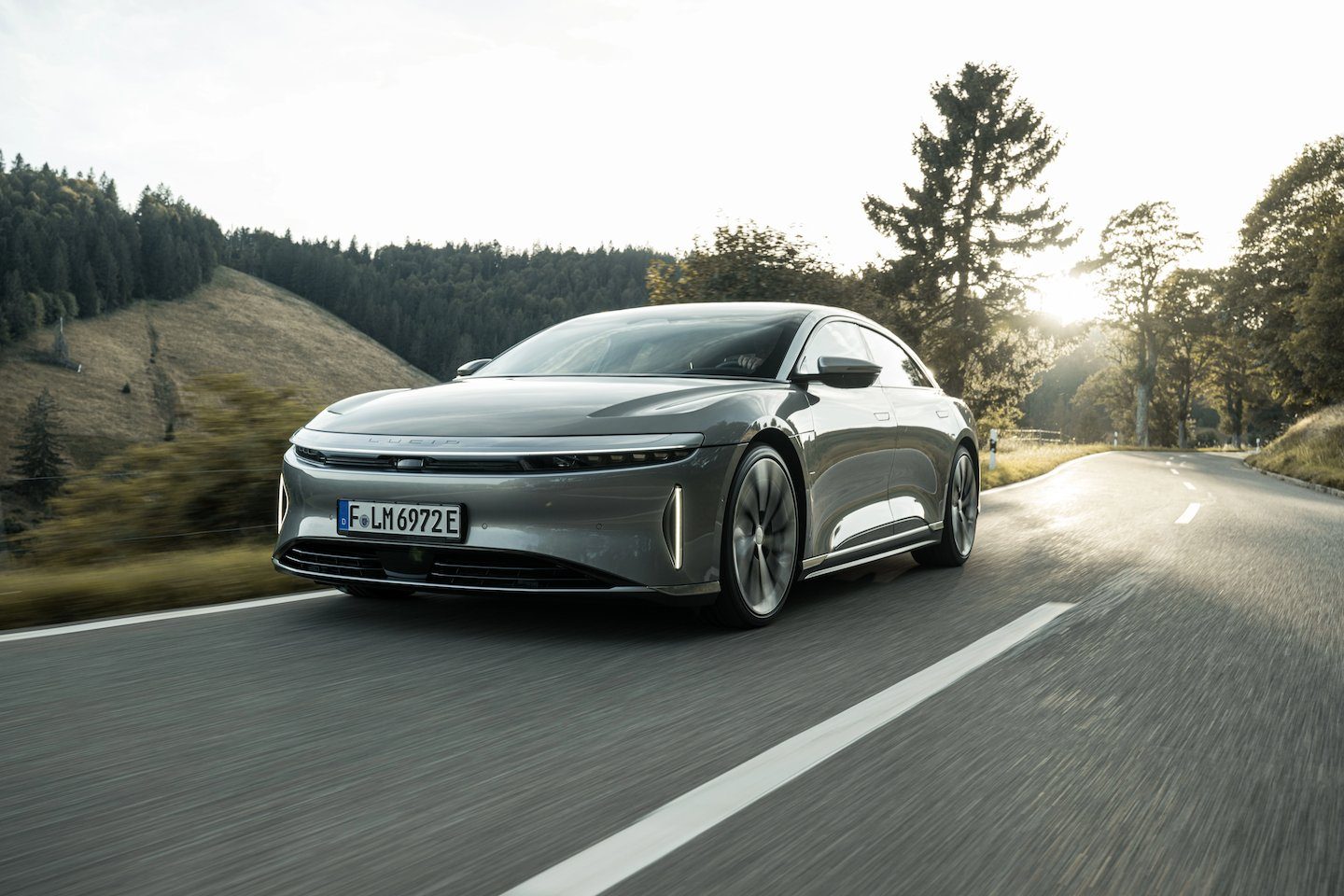

Lucid registered six vehicles in Germany in July, an 87.0% decline from a year earlier, according to data released on Thursday by the Federal Motor Transport Authority (KBA).
The figure brings the company’s seven-month German total to 114 units, down 4.2% from the same period of 2025, and lands two days after Lucid reported second-quarter results showing a $1.03 billion net loss on revenue of $405.3 million.
Germany carries an outsized weight in the company’s European business, accounting for 60% of the region’s registrations in May and 76 of the 118 European units recorded through the first five months.
The backdrop compounds the contrast as German fully electric registrations grew 61.7% in July to 78,609 units, a 29.3% share of a market where the premium segments Lucid targets continued to shrink.
The KBA reported upper-class registrations down 20.2%.
As seen in other European markets such as Norway and Spain, Tesla posted a steep decline in July with only 367 vehicles recorded — a 67% year on year drop.
The Wackenhut Bet
The July print is the first full month since Lucid‘s German distribution overhaul reached its initial operating rhythm.
EV exclusively reported in February that the company had signed the German dealer group Wackenhut as its first European retail partner, a deal concluded at the group’s Baden-Baden location after then-interim chief executive Marc Winterhoff announced an unnamed first European dealer agent on the fourth-quarter earnings call.
The company confirmed the signing in mid-March as it formally launched a hybrid distribution model, with Wackenhut selling and servicing the full lineup from Baden-Baden since March 30 and a second location in Stuttgart slated for this summer.
Wackenhut, the family-owned mobility group headquartered in Nagold in Baden-Württemberg, represents Mercedes, Mercedes-AMG, Aston Martin, Smart and Skoda across 11 locations and employs certified high-voltage technicians.
Under the hybrid model, the company retains brand positioning and pricing while partners handle regional sales and service, alongside Lucid‘s own studios in Munich, Frankfurt, Düsseldorf and Hamburg and a leasing partnership with Kazenmaier.
Roughly ten further German locations sat under letters of intent at the March announcement, and Europe president Lawrence Hamilton has outlined a path from 12 to 15 German cities toward 50 to 60 locations through a shop-in-shop format.
The partnership produced its first marquee moment in May, when Wackenhut handed the first partner-delivered Gravity to chef and television personality Johann Lafer in Baden-Baden, following a European Gravity rollout that had begun quietly and months behind schedule.
Infrastructure Ahead of Demand
The organizational build-out has continued through the sales trough.
Lucid hired a European aftersales lead in May as part of the expansion push, and Winterhoff has said partner selection is built around service capacity rather than sales, targeting roughly four times more service capacity than sales capacity.
Market expansion has followed the same logic: the company entered Belgium in June as part of a plan Winterhoff described as on track for seven or eight new European markets this year, growing from four markets toward as many as 12.
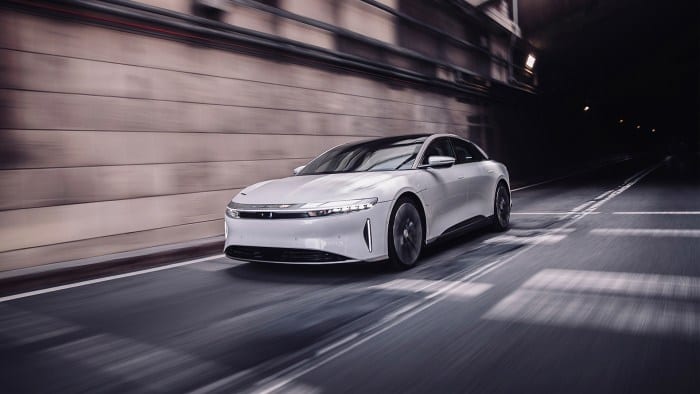
The German lineup spans the Air sedan, priced from €85,900 for the Pure trim to €250,000 for the Sapphire — named 2026 German Performance Car of the Year — and the Gravity SUV from €99,900 for the Touring and €116,900 for the Grand Touring.
A European Pattern of Lows and Resets
July extends a European trajectory that has swung between troughs and tentative recoveries all year.
Lucid recorded just 12 vehicles across Germany, the Netherlands, Norway and Switzerland in February, nearly halving from a year earlier, in the month the Wackenhut deal was signed.
May brought the year’s European high of 35 registrations before the summer months turned down again.
Norway illustrates the reset underway outside Germany.
The company moved to close its Oslo showroom after zero customer sales in 2026, with plans to reopen later in the year at its service and delivery center — the same logic of trading prestige floor space for operational sites now visible in the German dealer pivot.
Winterhoff, who has been recently ousted as exclusively first reported by EV, acknowledged the transition’s pace on the way out, noting that moving from a direct-to-consumer model to an indirect one takes time.
A Number the Q2 Narrative Cannot Ignore
The timing sharpens the question for new chief executive Silvio Napoli, who used his first earnings call on Tuesday to withhold full-year guidance while the company works through an inventory build and a strategic reset.
Lucid produced 4,774 vehicles and delivered 3,953 in the second quarter, with Saudi government purchases — committed at more than 4,000 vehicles annually through 2032 — carrying a record 23.7% of revenue.
Europe’s contribution remains marginal by comparison, and the German July figure suggests the region will not relieve the demand pressure in the near term.
The company’s summer has also been shadowed by the EV exclusive that advisers presented going-private and Chapter 11 options to the board, a report Lucid called “completely false” while confirming its work with AlixPartners under a different scope — an assignment wrapping up at the end of August.
The first is whether the Stuttgart Wackenhut location opens within the promised summer window, with three weeks of the season remaining.
The second is whether the August and September KBA tables show the dealer channel producing registrations the four company-owned studios never sustained — the test the entire European hybrid model was designed to pass.