
XPeng laid out a platform roadmap pointing toward embodied artificial intelligence at the global launch of its Mona L03 on Thursday, charting a path from today’s assisted driving to Level 4 autonomy and an in-house AI foundation model by 2028.
Xianming Liu, who heads XPeng‘s General Intelligence Center, presented the roadmap at the Munich event, hours before the L03 opens for sale in China and Europe simultaneously.
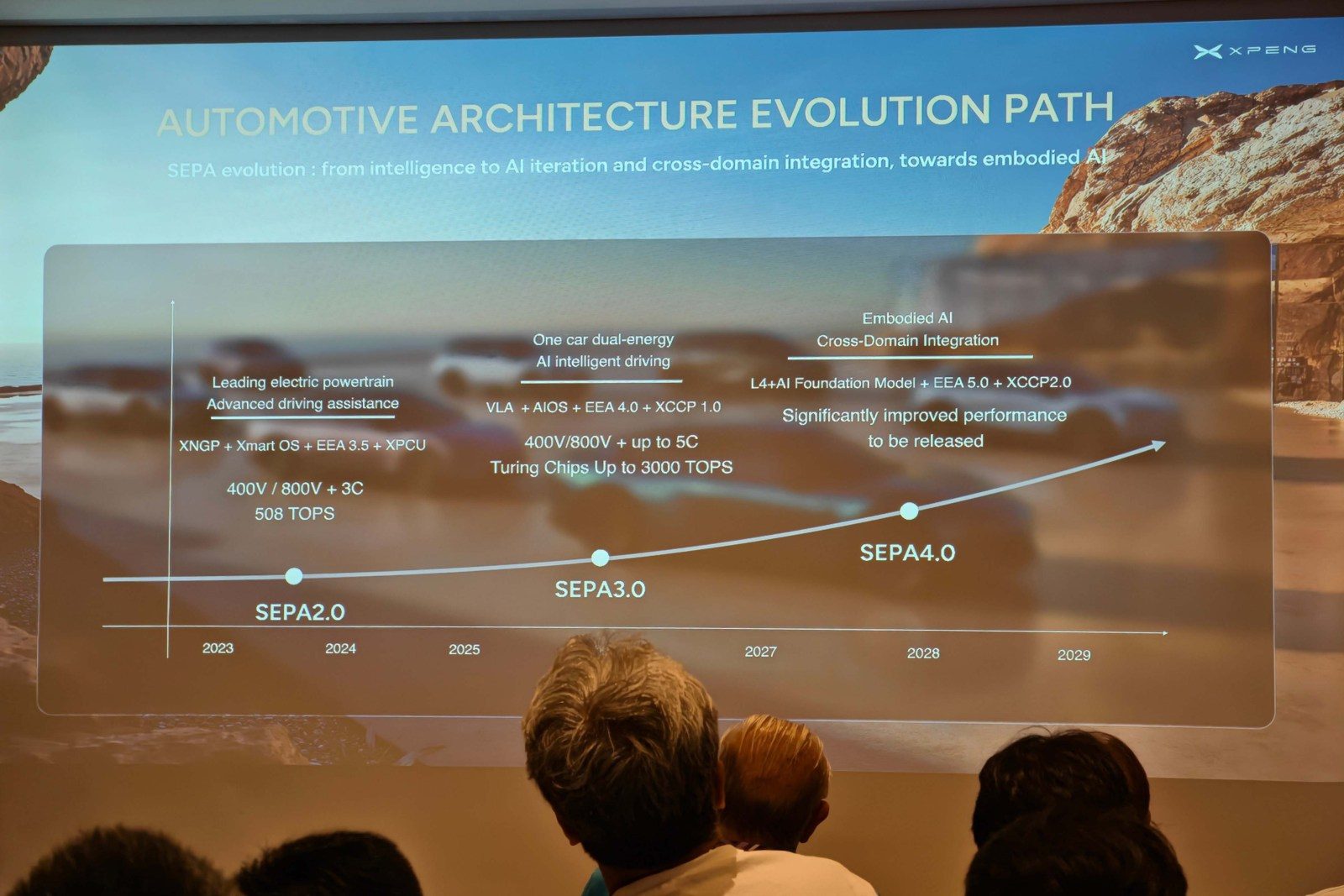
The centerpiece was a single slide plotting three generations of XPeng‘s Smart Electric Platform Architecture, or SEPA, on a steepening curve running from 2023 to 2029.
The chart framed the arc as a move “from intelligence to AI iteration and cross-domain integration, towards embodied AI.”
SEPA is XPeng‘s underlying vehicle platform, the layer that bundles powertrain, electrical architecture, compute and driving software, and serves as the company’s analog to Volkswagen‘s MEB.
The Three-Generation Path
The 2.0 generation pairs what the company calls a leading electric powertrain and advanced driving assistance — its XNGP navigation-guided system, Xmart operating system and a 3.5-generation electrical architecture — with 508 TOPS of compute, 400-volt and 800-volt systems and 3C charging.
SEPA 3.0, the current generation, moves to the Vision-Language-Action (VLA) driving model, a new AI operating system and a fourth-generation electrical architecture, with charging up to 5C and Turing chips rated at up to 3,000 TOPS.
The slide labels SEPA 3.0 a one-car, dual-energy generation, a reference to offering both battery-electric and range-extender powertrains on a single platform.
SEPA 4.0, dated to 2028, is where XPeng places Level 4 autonomy, an AI foundation model and what it calls embodied AI and cross-domain integration, with performance details the company said were still to be released.
The through-line is compute and autonomy rising together, from assisted driving on 508 TOPS to VLA-based driving on 3,000 TOPS, and on to a foundation model meant to span cars, robots and other machines.
The L03 as SEPA 3.0’s Debut
Timing placed the L03 at the center of the pitch.
By presenting the roadmap at the same event, XPeng framed the car not as a standalone product but as the first global embodiment of SEPA 3.0, its VLA-plus-Turing generation.
The L03 is a 4,650-millimeter SUV-coupe on a 2,850-millimeter wheelbase, designed by a global team led by former Ferrari designer JuanMa Lopez.
The model opened pre-sales in China on July 2 from 143,800 yuan ($21,200) and carries both fully electric and range-extender options, in line with the platform’s dual-energy billing.
Every trim ships with XPeng‘s Turing chip and a version of the second-generation VLA system.
The Max trim runs a distilled version of the software on a single Turing chip, while the Ultra tier runs the full system on multiple chips, bringing near-flagship driving hardware into a mass-market price band.
XPeng has road-tested the car’s VLA-based Next Generation Pilot in Munich ahead of the launch.
The company now operates in 28 European countries through nearly 300 retail outlets, having more than doubled its European footprint over the past year.
Deutsche Bank expects the model to average about 12,500 sales a month, a volume XPeng is counting on to sustain a recovery in the second half.
The launch follows XPeng‘s strongest month of 2026, with 40,126 vehicles delivered in June.
Benchmarking Tesla
The roadmap doubles as XPeng‘s answer to Tesla, whose Full Self-Driving system the company has set as its yardstick.
Founder and chief executive He Xiaopeng has said XPeng aims to surpass FSD in China by August 30, after testing the US software in San Francisco, and in May he argued that VLA already outperforms FSD on narrow roads and in the hardest driving situations.
He framed that comparison as complicated, because the full version of FSD has not officially cleared Chinese regulatory approval, leaving drivers there with a limited feature set.
XPeng executives, He Xiaopeng among them, have for years cast Tesla as the top tier of the assisted-driving field, a characterization the company repeated in Munich even as it pointed to conditions where VLA claims an edge.
Both systems follow a camera-only approach that forgoes lidar and high-definition maps, the strategy Tesla has pursued with FSD.
Volkswagen became the first external customer for VLA 2.0 and the Turing chip, the first time a major Western automaker adopted Chinese-developed autonomous-driving software.
Physical AI Beyond the Car
The SEPA 4.0 endpoint reaches past passenger vehicles, the case the roadmap was built to make.
XPeng began producing its first robotaxi this year on its GX platform, fitted with four Turing chips and about 3,000 TOPS of compute, with passenger pilots due in the second half of 2026 and driverless operation targeted for early 2027.
The same VLA architecture is intended to run the company’s humanoid robot and a flying car developed by its in-house unit, the cross-domain integration the 2028 stage describes.
XPeng has earmarked 7 billion yuan for physical-AI research this year and is targeting 1 million sales abroad by 2030.
The company rolled out its second-generation VLA across its Ultra models from March and plans a global rollout of the software in 2027, with multilingual voice control, after the United Nations cleared a first framework for automated driving, a process XPeng took part in by showing its stack to UN delegates.
He Xiaopeng has said the company chose Germany, the country where the car industry took root, for its first formal global launch, casting the L03 as the start of that push rather than its endpoint.