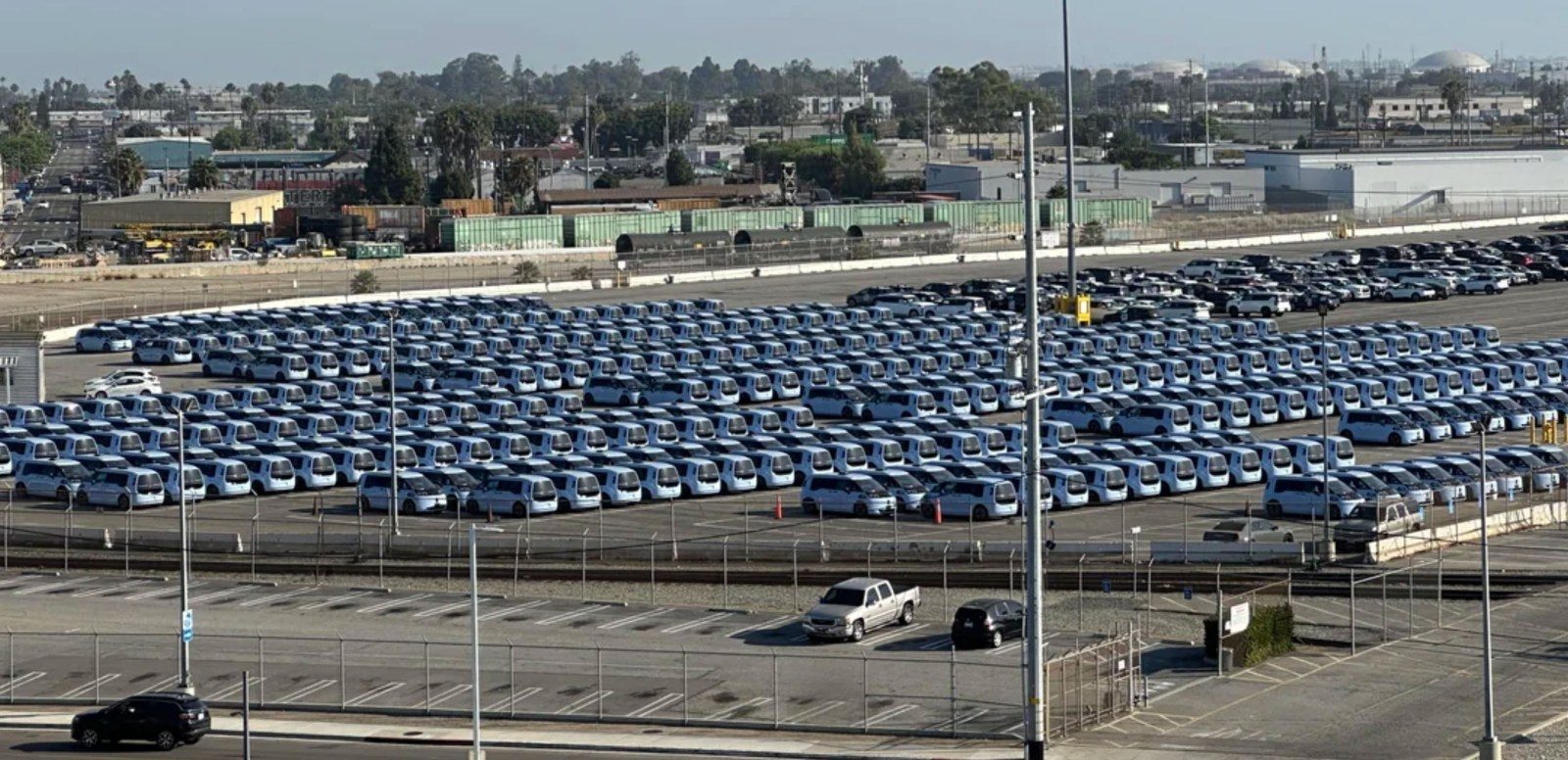

Hundreds of Waymo’s newest robotaxis have been photographed massed in a Southern California port lot without any of the sensors that make them drive themselves — as the company continues expanding its fleet with China-built vehicles.
A user posting as ‘Full_Astern’ posted the photographs on Sunday to the r/waymo forum showing hundreds of pale-blue vans, roofs bare, parked at the Los Angeles Port.
The Ojai is built by Zeekr, the premium marque of China’s Geely Holding Group, on the SEA-M platform at Ningbo, Zhejiang.
The US Commerce Department’s connected-vehicle rule takes effect for model year 2027 and bars vehicle-connectivity and driver-assistance hardware or software sourced from China or Russia.
Waymo’s answer is to import the shells stripped of Chinese connectivity hardware and sensors entirely.
The vehicles are shipped to a facility in Mesa, Arizona, operated with the Canadian giant Magna, where Waymo installs its own US-designed compute and sensor suite: 13 cameras, four lidar units, six radar units, an array of external audio receivers and a 17-megapixel imager.
Waymo’s regulatory framing is that what arrives is not a connected vehicle at all — a rolling chassis, a glider. “Those Chinese vehicles, the Geely vehicles, have no smarts, no connectivity,” Chief Safety Officer Mauricio Peña has said earlier this year.
The company has also said Zeekr receives no access to its autonomous driving technology, sensor data or rider information.
The relationship runs deeper than an off-the-shelf purchase — Waymo and Zeekr announced a partnership in 2021 and co-developed the vehicle on the SEA-M platform over three years — but the hardware and the data stay on the American side.
The Political Risk
None of that has settled the question in Washington.
A bipartisan Senate bill would bar the Zeekr-built chassis by 2027.
Zeekr is a Geely subsidiary, and Geely’s Polestar brand was expelled from the US market in June under related restrictions — the closest available precedent for what could happen to the Ojai.
At a Senate hearing in February, after Waymo’s Chief Safety Officer defended the Geely relationship, Senator Bernie Moreno told him: “You said in your testimony that we’re locked in a race with China, but it seems like you’re getting in bed with China.”
Waymo is importing at 725 vehicles a month into that.
The Volume
More than 3,200 Ojai units have entered the US through the Port of Los Angeles since 2024, with 2,600 arriving in 2026 alone.
Four in five have landed this year and about 600 came across 2024 and 2025 combined.
MoffettNathanson, the New York research firm, tracks the flow by analysing customs receipts.
It counted 725 Ojai vehicles entering the country in July alone and puts Waymo on pace for 5,000 by the end of 2026 — which the firm says would be more than double the current Jaguar fleet.
The tariff on Chinese EVs is substantial, though published figures differ: some accounts stack it at roughly 127.5%, others at about 102.5%.
Estimates of the stripped vehicle’s value cluster near $38,000, but that is inferred — Forbes reported that declared values were not present in the bills of lading it examined, and used the Chinese sticker price as a proxy.
Waymo has published none of it.
The company has not disclosed the Ojai’s purchase price, the cost of its autonomous system, its maintenance cost or its per-ride margin. What it has said is that the vehicle should be cheaper to build, operate and maintain than the Jaguar I-Pace — a car Jaguar discontinued at the end of 2024.
A punitive tariff on a Chinese import still appears to produce a cheaper robotaxi than the British-built alternative.
What Happens in Arizona
The conversion line is running ahead of deployment.
An aerial count of the Mesa site published August 12 by a watcher on the r/waymo forum, ‘jjricks_’, found 953 Ojai units on the lot: 684 fully retrofitted and ready to ship, and 269 still awaiting conversion. That is 72% converted, up from about 500 in early June — a 91% increase in roughly ten weeks.
The count also found 12 finished Hyundai Ioniq 5 robotaxis, the first time Waymo’s second purpose-built vehicle had appeared completed at the site.
Those figures aren’t official and Waymo hasn’t confirmed them.
Set against them, the deployed fleet is small.
Waymo had about 300 Ojai robotaxis in commercial service across the three cities on August 19, a spokesperson told TechCrunch, out of a total fleet of 3,500 to 4,000 vehicles.
The Ojai
The Ojai is the Zeekr RT, renamed at CES in January after the village in the Topatopa Mountains above Los Angeles. Pronounced “oh-hi,” which is what Waymo intends the vehicle to say to riders as they get in.
Spokesman Chris Bonelli’s stated reason for the change was that the American public isn’t familiar with the Zeekr brand.
It’s a four-door minivan, rear-motor and rear-wheel drive, with a 93-kilowatt-hour battery and 268 horsepower.
Boxier than the I-Pace, with a lower step and higher ceiling, and roughly the same footprint. It seats four. Unlike the 2022 concept, it has a steering wheel, designed so it can be removed later.
Waymo began employee rides on the Ojai in February, opened it to selected riders in late May, and made it available to all riders in San Francisco, Los Angeles and Phoenix on August 19.
Passengers can’t request one specifically; they’re matched when one is nearby, and Waymo says riders will be able to choose between the Ojai and the Jaguar once there are enough of the newer cars. Denver, Las Vegas and San Diego follow later this year.
In late July, Waymo added Google’s Gemini assistant and a three-screen interface including a Calm Mode.
The company says Gemini handles cabin controls, trip information and general questions, and doesn’t control the vehicle.
The LA Operation
Waymo launched in Los Angeles in March 2024 across 63 square miles from Santa Monica to Downtown, and opened to the public that November across roughly 80.
Freeway testing began in January 2025 on Interstates 10, 110, 405 and 90.
Freeway rides opened to public riders in November 2025, were paused in late May 2026, and began returning on July 29 starting with Phoenix, with Los Angeles and the Bay Area announced to follow. Surface-street service ran throughout.
Waymo now runs public driverless service in 11 US metros, about 500,000 paid rides a week and roughly 4 million autonomous miles a week, across more than 1,400 square miles of coverage.
It’s targeting 1 million weekly trips by the end of 2026, with Las Vegas, Denver, San Diego and Tampa announced, plus London and Tokyo.