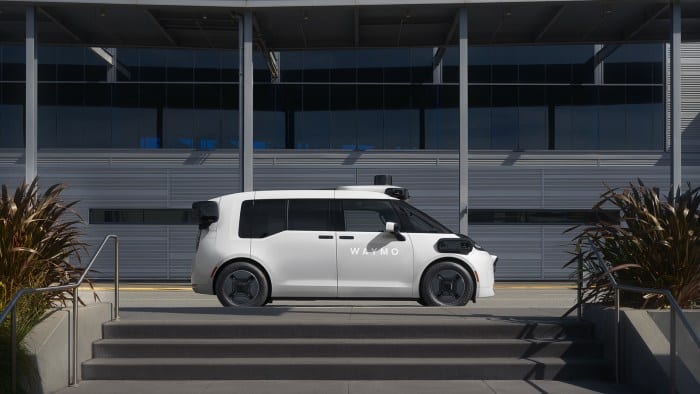
Waymo unveiled a silver version of its Ojai robotaxi with a reworked interior on Tuesday, less than five months after the vehicle entered public service.
The new version adds leatherette seats, carpeted flooring, a wireless phone charger and rear armrests, the company said in a blog post.
The Ojai has gone from employee-only testing to paid service in six US cities in under eight months, and Waymo is building its expansion around a vehicle that is made in China and that a stalled Senate bill could bar from import.
The Ojai is the first vehicle in Waymo’s fleet designed around riders, not adapted from a retail car, and the first to carry the company’s sixth-generation autonomous driving system.
Its base vehicle is built by Zeekr, part of China’s Geely Holding Group, and is shipped to the United States, where Waymo installs its sensors and computer in Mesa, Arizona.
The Silver Version
“We’re adding a new version of the Ojai to our growing fleet,” Waymo said, describing “a silver exterior finish, and curated color and trim updates to the interior”.
Riders will find “soft leatherette seating, matching seatbelts, carpeted flooring, and high-contrast trim accents”, it added.
Waymo listed the wireless phone charger, new seats and rear armrests separately as “functional amenities”.
The Ojai now in service has fabric seats, and a review published by Forbes in August, when the vehicle opened to all riders, said wireless phone charging was already offered alongside wired ports.
Waymo did not explain how the charger in the silver version differs.
The change follows a software update in late July that added Google’s Gemini assistant, in beta, and a redesigned interface across the Ojai’s three screens.
The silver Ojai “is ramping up production at our Mesa, AZ driver integration plant and hitting the road for testing now”, the company said.
It will begin serving rides “in the coming weeks” in San Francisco, Los Angeles and Las Vegas “before scaling to many more cities over time”.
Phoenix, one of the three cities where the Ojai first carried riders, was not named in the first group, and neither were Denver or San Diego.
Waymo did not say whether the silver version replaces the light-blue Ojai now in service or will be built alongside it.
The post made no mention of changes to the sensors, the computer or the base vehicle, and gave no production numbers.
From Zeekr RT to Ojai
Waymo and Zeekr announced their partnership in December 2021, and Waymo showed a concept on Zeekr’s SEA-M platform at an event in Los Angeles in November 2022.
The production vehicle was presented as the Zeekr RT at CES in January 2025, and Waymo renamed it the Ojai at the same show a year later.
Zeekr filed four recalls in February 2025, each covering a single 2025 RT, over the tire-pressure warning light, the occupant weight sensor, seat position and the side curtain airbag, records from the US National Highway Traffic Safety Administration show.
The name comes from a city in the mountains northwest of Los Angeles, and the car greets riders with “Oh hi” and their name.
Waymo Spokesperson Chris Bonelli told TechCrunch in January that the US public was not familiar with the Zeekr brand.
The Rollout
Fully autonomous operations in the Ojai began for employees and their guests on February 12, Waymo Vice President of Engineering Satish Jeyachandran wrote in a company blog post.
Waymo opened the vehicle to select riders in San Francisco, Phoenix and Los Angeles after an announcement on May 28, offering free trips while it gathered feedback.
All riders in those three cities gained access in August, when a company spokesperson said about 300 Ojais were in commercial service and that a rider could be matched with either an Ojai or a Jaguar I-PACE.
Denver and San Diego followed on September 1, when Waymo started paid rides in three new cities, with Tampa served by the I-PACE.
Las Vegas became the sixth Ojai city and Waymo’s 15th market on September 14, starting with what the company described as dozens of vehicles and riders invited on a rolling basis.
Denver is the first of those markets with regular snow, a condition Jeyachandran said the sixth-generation system was designed to handle.
In Texas, where the Ojai has not been announced for public service, state records showed 350 of Waymo’s 1,133 registered vehicles were Ojais as of September 25, although a registration does not confirm that a vehicle is carrying riders.
What Is on the Vehicle
The sixth-generation system uses 13 cameras, four LiDAR units and six radars, together with external audio receivers, according to Waymo’s August 2024 description of the hardware.
That compares with 29 cameras and five LiDAR units on the I-PACE, and Waymo said the new 17-megapixel imager allowed it to use fewer than half as many cameras as before.
The company said the system can detect objects up to 500 meters away.
Inside, Waymo lists a flat floor, a low step, three LED screens, a handle built into the seat, and braille and screen-reader support, and calls the cabin “an oasis on wheels”.
The Ojai seats up to four passengers and, unlike the 2022 concept, keeps a steering wheel and pedals.
Waymo has not published battery, motor or range figures for the vehicle, and those in circulation conflict, with reports citing packs of both 76 kWh and 93 kWh.
Made in China
Waymo announced the Mesa plant, a 239,000-square-foot site operated with Canada’s Magna, in May 2025 and said it would build “tens of thousands” of vehicles a year at full capacity.
Vehicles assigned to Phoenix can pick up their first passengers less than 30 minutes after leaving the factory, the company said at the time.
Waymo has not disclosed how many Ojais it has imported or fitted out.
Customs records compiled by ImportGenius showed more than 3,200 Zeekr vehicles had entered through the Port of Los Angeles since 2024, including more than 2,600 this year, as of early August.
Research firm MoffettNathanson counted about 725 arrivals in July and said Waymo was on pace for 5,000 by the end of 2026.
A count from aerial images posted on Reddit in August put 953 Ojais at the Mesa site, 684 of them fitted with sensors, a figure that has not been confirmed by Waymo, and photographs later that month showed hundreds more arriving at the Los Angeles port without sensors.
Production Cost
Waymo says the sixth-generation hardware costs “significantly” less than its predecessor but has never published a figure for the system or for a finished Ojai.
Outside estimates vary widely, in part because Chinese-built EVs face US import tariffs of more than 100%.
Morgan Stanley has estimated a finished Ojai at about $125,000, against roughly $200,000 for an equipped I-PACE.
Tesla Chief Executive Officer Elon Musk used the $125,000 figure in September to argue that the Cybercab is cheaper.
The China Question
Waymo Chief Safety Officer Mauricio Peña told a Senate hearing in February that the vehicles arrive with “no smarts, no connectivity”, and Republican Senator Bernie Moreno accused the company of getting around restrictions on Chinese vehicles.
A Commerce Department rule issued in January 2025 already restricts Chinese connected-vehicle software from the 2027 model year and hardware from 2030, and Waymo Spokesperson Chris Bonelli said in January this year that the Ojai would not be subject to the restrictions that keep Chinese cars away from US consumers.
The Connected Vehicle Security Act, introduced by Moreno and Democratic Senator Elissa Slotkin on April 29, goes further.
The bill as introduced prohibits “the importation, manufacture, sale, resale, or introduction into interstate commerce” of a connected vehicle from January 1, 2027 if its country of origin is China or it was designed there.
That clause applies regardless of whose software the vehicle runs, and no amended text has been published.
The bill defines a connected vehicle as one that integrates networked hardware and software to communicate wirelessly, and whether an Ojai shipped without Waymo’s equipment meets that definition has not been tested.
“We support the broader aims of the industry and the bill’s authors,” Waymo said in a statement reported at the start of September.
The bill cleared the Senate Commerce Committee in July, but an attempt to pass it by unanimous consent failed on September 30 over a separate ownership clause, and the Senate has left Washington until November.
Waymo’s second sixth-generation platform is the Hyundai Ioniq 5, which Hyundai builds in Georgia under a partnership announced in October 2024, and Jeyachandran’s February post named it alongside the Ojai.
Waymo has not said when the Ioniq 5 will carry public riders or how it will split future volumes between the two vehicles.
State registration data put the fleet at about 4,000 robotaxis in late September, and Co-Chief Executive Officer Dmitri Dolgov said in March that Waymo had reached 500,000 rides a week.