
Waymo has brought its first robotaxis to Munich ahead of a planned 2027 launch, using Jaguar I-PACE SUVs rather than the China-built Ojai minivans it is shipping into the US.
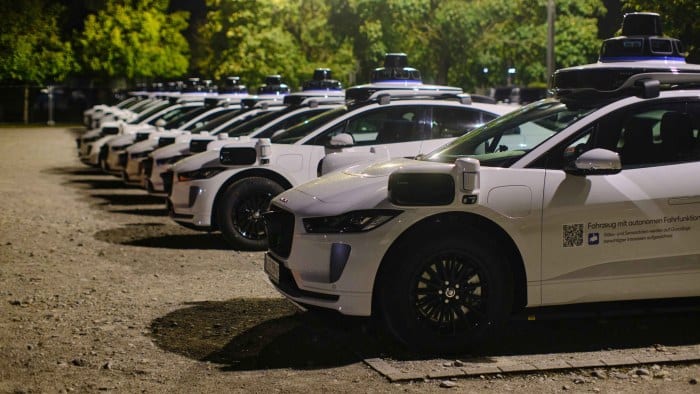
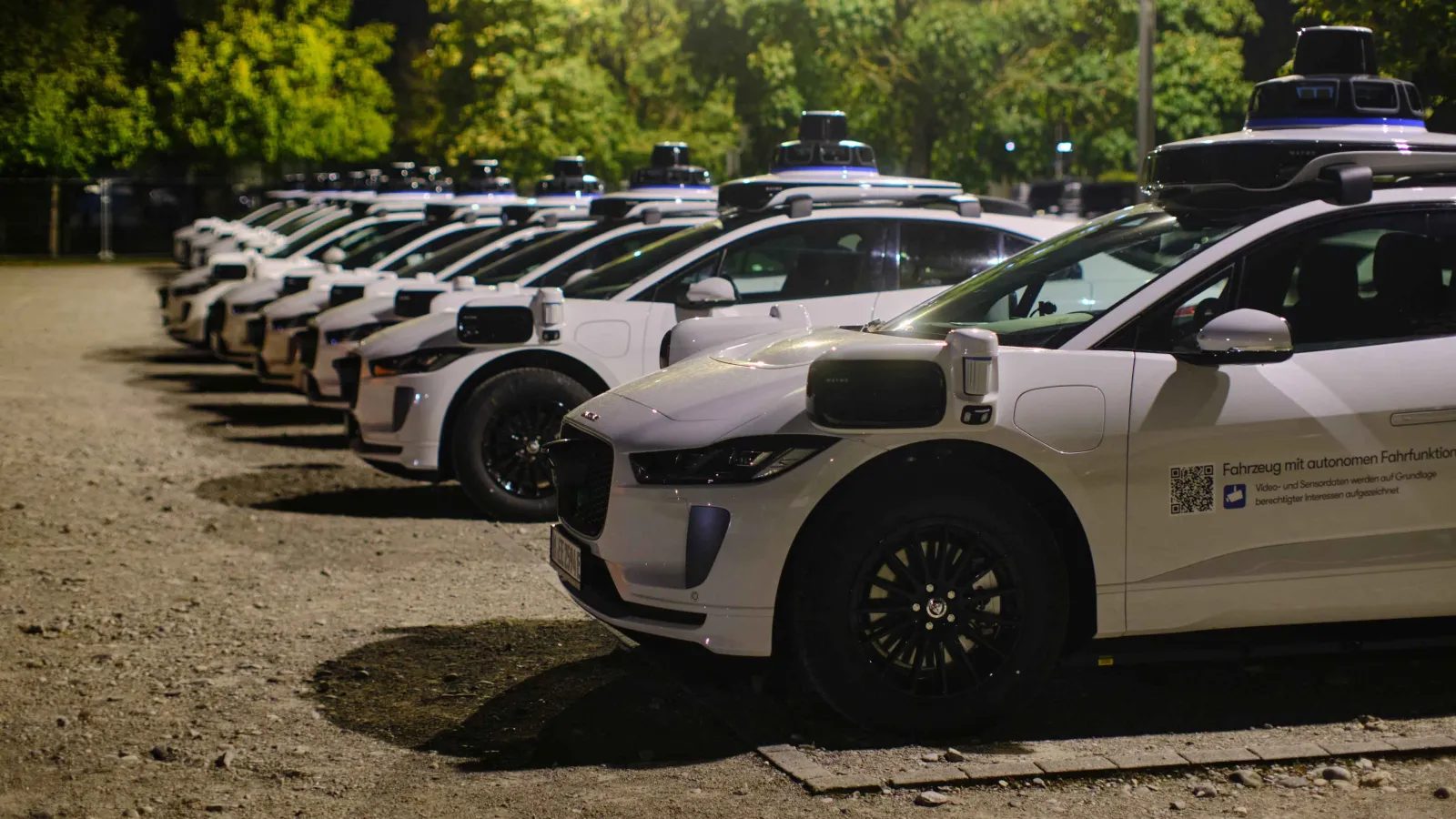
At least 10 white I-PACEs fitted with Waymo’s roof-mounted sensor dome were parked on Thursday evening on the grounds of an office building in Heimstetten, just east of Munich, according to photos posted on X by Michael Förtsch, a writer for German technology outlet 1E9.
“The #Waymo cars have arrived in Munich,” Förtsch wrote.
The vehicles carry German-language decals reading “vehicle with autonomous driving functions,” the photos show. A line beneath it says that video and sensor data are recorded on the basis of legitimate interests.
A video posted on X on Wednesday afternoon shows a Waymo-branded I-PACE driving at Königsplatz in central Munich.
Waymo said on August 25 that its vehicles would appear on Munich’s streets “in the coming weeks,” as it laid out plans for a commercial service targeted for the end of 2027.
The company has not publicly said that driving in Munich has begun.
Manual Driving First
Some of the vehicles are already on the road, driven by trained staff rather than autonomously, 1E9 reported on Thursday.
The sensors are collecting data on the surroundings to prepare the self-driving system for Munich’s streets.
Waymo is also preparing a workshop in the region to maintain the fleet, the outlet reported, without citing a source.
Waymo’s plan starts with manual driving and high-definition mapping, followed by testing “with trained autonomous specialists behind the wheel,” the company said in its August announcement.
Its Germany page lists 17 of Munich’s 25 districts where the cars will drive, and says testing “typically” runs 24 hours a day, seven days a week.
1E9 also reported that a first deployment with passengers is planned during the IAA Mobility show in September 2027.
Waymo has not announced such a trial and has only said it aims to open the service to the public “towards the end of 2027.”
Jaguars, Not Ojais
The I-PACE has been the backbone of Waymo’s fleet since the company agreed in 2018 to add up to 20,000 of the SUVs.
Contract manufacturer Magna Steyr built the model in Graz, Austria, until Jaguar ended production in 2024.
Waymo also uses the I-PACE in London, where about 100 of them have been testing since spring.
Its newer Ojai is built by Zeekr, the premium brand of China’s Geely, on the SEA-M platform in Ningbo, Zhejiang province.
The vans are shipped to the US without sensors and fitted with Waymo’s sixth-generation Driver in Mesa, Arizona, at a facility operated with Magna.
More than 3,200 have entered the US through the Port of Los Angeles, including 725 in July alone.
The sixth-generation system uses 13 cameras, four LiDAR units and six radars, fewer sensors than the I-PACE set-up, and Waymo opened the Ojai to its first public riders in May.
The vehicle’s Chinese origin has drawn scrutiny in Washington, where a bipartisan Senate bill would bar the Zeekr-built chassis by 2027.
In the European Union, China-built electric vehicles from Geely carry an 18.8% countervailing duty on top of the standard 10% import tariff.
Waymo has not said which vehicle it will use for commercial service in Munich.
Permits Still Ahead
The Federal Motor Transport Authority (KBA) has already approved Waymo’s test drives with drivers, the Süddeutsche Zeitung reported on August 25.
KBA data showed no Waymo testing permit in Germany at the time, other German outlets reported.
A driverless service needs a Level 4 testing permit and an operating licence from the KBA, state approval of the operating area and a licence under the Passenger Transport Act, according to Berlin Senate documents.
The KBA has yet to grant a regular operating licence for driverless vehicles to any company, electrive reported.
Munich’s mobility department says the Passenger Transport Act must be amended “to be able to successfully use the potential of autonomous robotaxis beyond pilot operations,” the Süddeutsche Zeitung reported.
Waymo said it is “already engaging with local, state and federal officials on the regulatory approvals and steps needed to responsibly serve the public in Germany.”
A Wider German Push
Waymo Germany GmbH was entered in the Munich commercial register under number HRB 313499 on June 15, with Google’s Munich office as its address.
French transport group Transdev is advertising for English-speaking test drivers for autonomous vehicles in Munich, although the listing does not name Waymo or any client.
The company also plans to map Berlin with up to 50 vehicles before the end of 2026, manager magazin and Spiegelreported on September 14, citing Senate documents.
Earlier this month, Waymo signed with Allianz Partners, the assistance arm of Munich-based insurer Allianz, to build its insurance and claims set-up in Europe, starting with London and Munich.
Waymo raised $16 billion in February at a $126 billion valuation to fund its global expansion.
Munich is also the planned test city for rival robotaxi projects from Uber with China’s Momenta and with Israel’s Autobrains and Nvidia.
City-owned transit operator MVG began testing three autonomous Volkswagen ID. Buzz vans in the Gern neighbourhood on September 7, in a project backed by about €13 million ($14.8 million) in federal funding.