
Tesla registered 7,768 vehicles in Germany in June, a 317.6% increase from a year earlier, data released on Friday by the Federal Motor Transport Authority (KBA) showed.
June marked the fifth consecutive month of triple-digit year-over-year gains in Europe’s largest auto market — and the strongest single month of the year so far.
Second-quarter registrations reached 16,028 units, roughly four times the 3,955 vehicles Tesla sold in the same period a year earlier.
First-half registrations totaled 28,857, more than tripling the 8,890 units recorded in the first six months of 2025 and extending a recovery that had already surpassed the company’s full-year 2025 total of 19,390 units by the end of May.
The KBA flagged Tesla as the strongest-performing import brand by year-over-year growth in June, with a 2.6% share of total passenger car registrations.
BYD followed with a 273.7% increase.
Across the full first half, both brands posted the largest gains among major import brands at +224.6% and +315.2%, respectively.
Monthly Trajectory
Tesla‘s 2026 performance in Germany has followed an accelerating curve since a slow January, when registrations barely rose above the year-earlier month.
January produced 1,301 units, a 2% year-over-year increase.
February reached 2,276 registrations, up 59%.
March then delivered a breakout result of 9,252 units — a 315% surge that marked the company’s strongest month in Germany since December 2022.
April came in at 3,149 units, up 256%, followed by May’s 5,111, up 322%.
June’s 7,768 registrations, up 318%, completed a five-month streak of gains exceeding 250%.
By comparison, 2025 was defined by persistent weakness.
Monthly registrations fell below 1,000 units for the first time in nearly three years in April 2025, when Tesla recorded 885 sales.
October 2025 brought a three-year low of just 750 units.
Full-year 2025 sales fell 48% year over year amid the transition to the refreshed Model Y, rising competition and fallout from CEO Elon Musk’s political involvement.
GigaBerlin Production Ramp
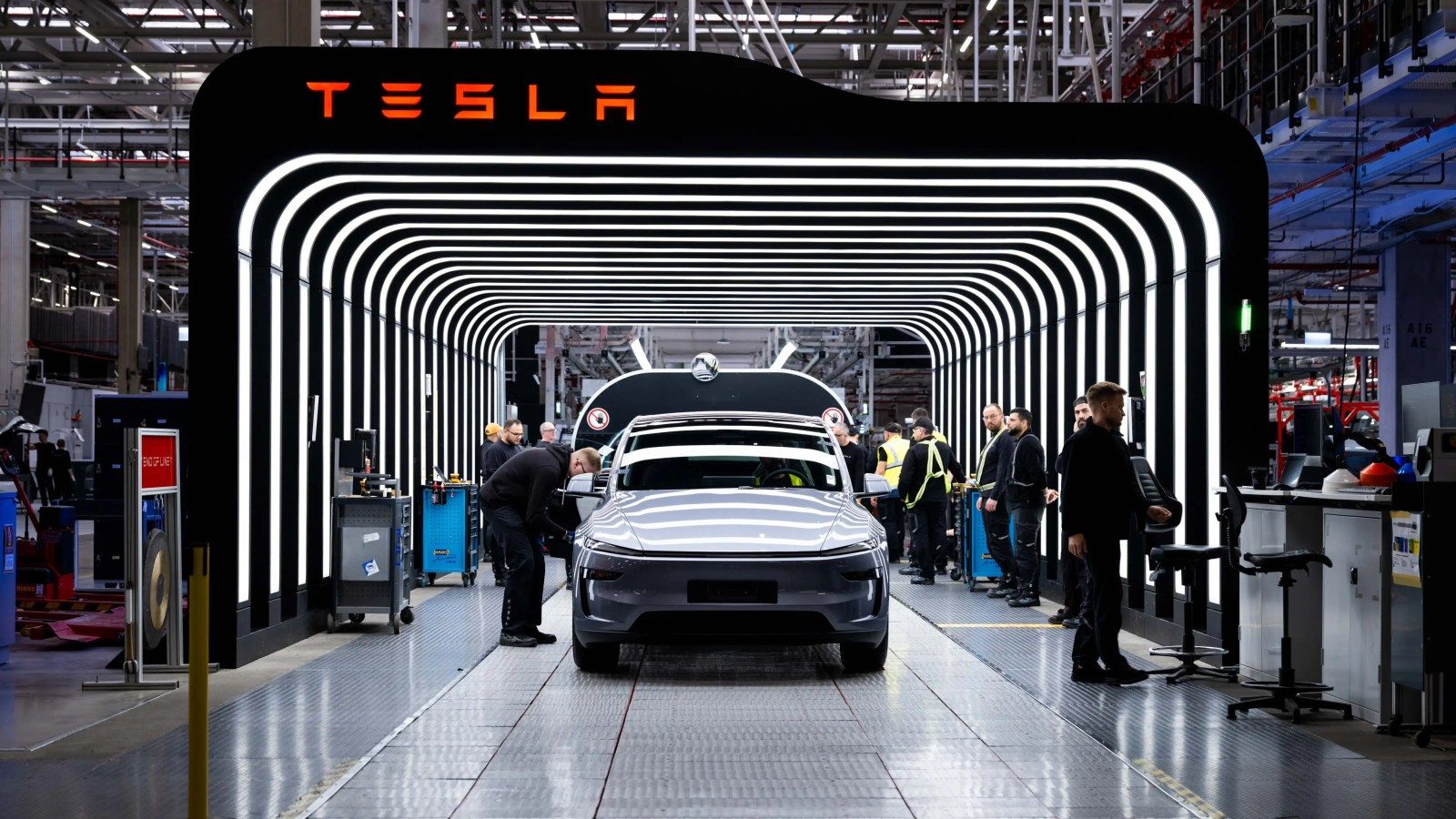
The German recovery is underpinned by rising output at Tesla‘s Grünheide factory outside Berlin — the company’s only European car assembly plant.
Plant chief André Thierig said in a mid-June interview that GigaBerlin was producing approximately 5,000 vehicles per week and aimed to ramp output to over 6,000 units starting in July.
Thierig described the facility as supply-chain constrained at the 5,000-unit weekly rate and said the company would continuously push above 6,000 once the ramp begins, representing a 20% increase in Model Y production.
Tesla has been hiring approximately 1,000 new employees at the facility and converting 500 temporary workers to permanent positions to support the expansion.
GigaBerlin currently employs around 11,000 workers and exports to more than 30 markets.
The company has also announced plans to invest approximately €100 million to begin battery cell production at the Grünheide site starting in 2027, with an initial annual capacity of eight GWh.
GigaBerlin plant chief Thierig recently framed the factory’s performance as a counterpoint to restructuring across Germany’s legacy auto industry.
Pointing to EV adoption trends, Thierig said manufacturing remains viable in Germany’s high-cost environment with the right product and speed of execution.
Broader German Market
Germany’s overall passenger car market registered 296,378 vehicles in June, a 15.7% increase from a year earlier, the KBA reported.
First-half registrations reached 1,484,393 units, up 5.8%.
Battery-electric vehicles (BEV) accounted for 84,057 of June’s registrations, a 78.2% year-over-year increase that brought the BEV share to 28.4%.
BEV registrations across the first half rose 48.0% compared with the same period in 2025.
The rebound in EV demand coincides with Germany’s reinstated federal purchase incentive, a €3 billion program that applies retroactively to all eligible electric vehicles registered since January 1, 2026.
Private buyers can receive between €3,000 and €6,000 depending on household income and family size.
Among domestic brands, Volkswagen remained the market leader in both June and the first half, holding a 17.2% and 18.4% share, respectively.
BMW registered 26,119 vehicles in June, up 18.6%, while Mercedes reached 23,728, up 5.9%.
Part of Global Q2 Beat
The German results form part of a broader European rebound that contributed to Tesla‘s global second-quarter delivery beat.
The company delivered 480,126 vehicles worldwide in Q2, a 25% increase year over year that exceeded the company-compiled analyst consensus of 406,024 by more than 74,000 units.
Europe was widely expected to have driven much of the upside, as registration data released this week showed double- and triple-digit year-over-year gains across most European markets in June.
France saw registrations double year over year to 7,474 units.
The global beat came even as US sales declined 19.7% in June to 36,642 units, marking the ninth consecutive month of year-over-year drops in Tesla‘s home market following the expiration of the $7,500 federal EV tax credit last September.
FSD European Rollout
The sales recovery in Europe has coincided with Tesla‘s rollout of its Full Self-Driving (Supervised) software across the continent.
Four countries — the Netherlands, Lithuania, Estonia and Denmark — have approved the driver-assistance system since April through national recognition of the Dutch type-approval authority RDW’s decision.
Germany, France, Spain, Italy, Greece and Ireland are at various stages of review or testing.
EU-wide authorization requires a qualified majority vote at the Technical Committee on Motor Vehicles, but the committee’s June 30 agenda listed further discussion rather than a formal vote.
Tesla had targeted bloc-wide availability by the summer of 2026.
The European Transport Safety Council has urged member states to take a precautionary approach until safety questions around FSD are resolved, citing concerns over the data Tesla has presented to regulators.
Tesla is scheduled to report full second-quarter financial results after market close on Wednesday, July 22.