
Tesla chief executive Elon Musk used Wednesday’s second-quarter earnings call to dismiss the humanoid field’s public evidence, telling investors that “most online robot demonstration videos rely on pre-programmed sequences or remote control.”
“No humanoid robot today can genuinely perform general-purpose daily tasks,” Musk said without naming any competitor.
Musk defined the unachieved benchmark precisely: a general-purpose humanoid “capable of autonomously executing tasks based solely on voice commands or video demonstrations — without any manual programming,” a capability he said “has not yet been achieved by any company worldwide.”
Tesla‘s rivals include XPeng, Unitree, UBTech, Boston Dynamics and Figure. Most of these companies have built their profiles on catwalks, kung fu, dance routines and viral set pieces.
Speaking during Tesla‘s first-quarter results in late April, Musk said the company hesitates to show Optimus V3 and other early-stage hardware because competitors run “a frame-by-frame analysis” of anything released and “copy everything” they can, pushing the next unveil closer to production readiness.
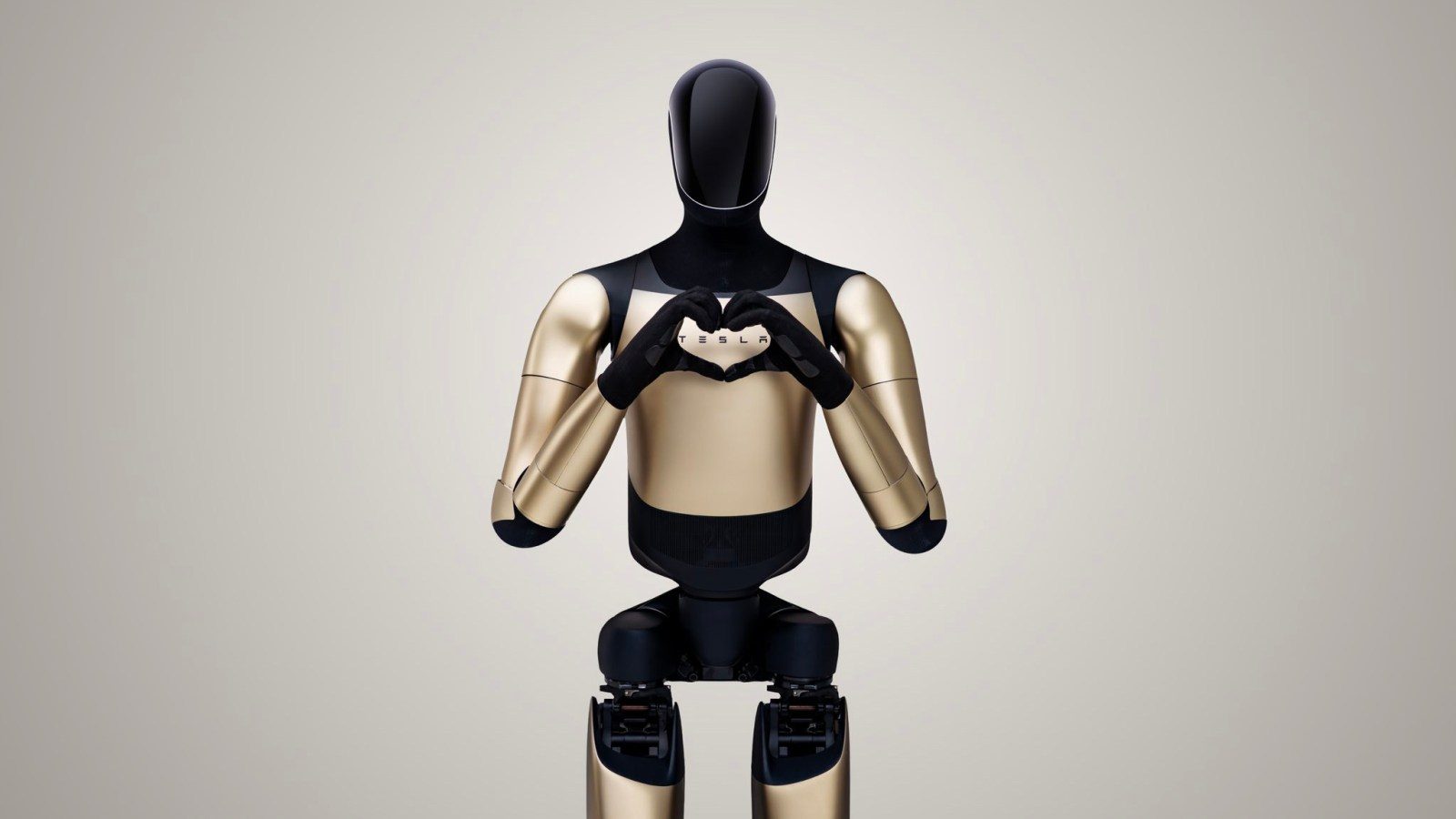
Musk told analysts on Wednesday that Optimus “will be the first product to achieve this capability — not just a demonstration prop, but a practical solution for real-world job requirements.”
Tesla‘s chief said the robot “is designed to match or even exceed the dexterity of the human hand,” calling the hand’s mechanics extraordinarily sophisticated well beyond the opposable thumb and noting that “the deeper one studies it, the more astonishing it becomes.”
Production Targets, in Musk’s Words
“Optimus has the potential to become the largest-volume product in human history,” Musk said, while conceding that “its development complexity is immense.”
“The production ramp for Optimus is far more challenging than for any previous Tesla product,” he continued, because “every component in the robot is newly developed” and “the higher the degree of innovation in these parts, the longer the production ramp-up cycle.”
Traditional electric vehicles can lean on mature supply chains for “body panels, side mirrors, and glass,” Musk noted, while for Optimus “we must either build the entire supply chain from scratch or develop and manufacture everything in-house.”
The former Model S and Model X lines at Fremont “have now been converted into dedicated Optimus production lines, featuring a highly innovative layout,” he confirmed, with output set to follow “the classic S-curve typical of manufacturing” and an initial phase that will be “exceptionally flat and prolonged — precisely because all components are entirely new.”
“We must eliminate any risk of robotic malfunction,” Musk said, since a 70-kilogram unit “would require manual handling after failure, severely undermining its practical utility.”
Beyond the prepared remarks, Musk identified semiconductor supply — spanning memory, logic and chip packaging — as a binding constraint, pointing to Samsung and TSMC plant investments that could serve both Optimus and the robotaxi program.
Additionally, Tesla‘s chief thanked Micron for a significant memory allocation for the company.
The first units off the Fremont line will collect training data internally rather than perform productive work or go on sale.
XPeng plans mass production by end-2026 with monthly capacity above 1,000 units, showroom deployment in China as a sales assistant in the first quarter of 2027, and a 110,000-square-meter production base under construction in Guangzhou’s Tianhe District.
The Record Mostly Backs Him
Evidence from the field’s own set-piece events supports the scripting charge more often than it contradicts him.
At the second Beijing E-Town half-marathon on April 19, a robot built by smartphone maker Honor won in 50 minutes 26 seconds, beating the 57:20 human world record Jacob Kiplimo set in Lisbon a month earlier.
However, organizers said only about 40.0% of the 300-plus robot field navigated autonomously, with the remainder remote-controlled.
1X Technologies offers the clearest case of teleoperation shipping as product.
The Norwegian-American firm opened pre-orders for its NEO robot at $20,000, with an “Expert Mode” that consists of a human operator wearing a VR headset, and chief executive Bernt Børnich told the Wall Street Journal that early buyers must accept remote operators occasionally seeing into their homes.
A viral clip from Indonesia showing a wig-wearing humanoid throwing kicks around office staff, widely read as a malfunction, was established by Interesting Engineering in July to be a staged routine uploaded by the robot’s own handlers.
XPeng Supplies the Counterexample
One episode ran in the opposite direction, and involved the only other carmaker with a humanoid program as advanced as Tesla‘s.
When XPeng unveiled its next-generation IRON at AI Day in Guangzhou on November 5, the robot’s gait proved so fluid that audiences concluded a person was hidden inside the shell.
Founder and CEO He Xiaopeng returned IRON to the stage the next day and had an engineer cut open its left leg with scissors, exposing actuators and wiring, before the robot walked off with its mechanics showing.
He called it a “rather forced last-resort solution.”
The Chairman took direct charge of the robotics business as chief executive in June, the month core product chief Shi Xiaoxin resigned after more than four years.
Chinese Firms Hold the Shipment Lead
Research firm Omdia estimates roughly 13,000 humanoid shipments globally in 2025, with the Associated Press reporting Chinese manufacturers produced about 85.0% of them.
Unitree says its 2025 deliveries exceeded 5,500 complete humanoids against more than 6,500 produced, a figure that explicitly excludes wheeled dual-arm systems, while Omdia ranks AgiBot first with more than 5,100 shipments and about 39.0% market share across a broader product universe.
UBTech’s audited results show 1,079 full-size humanoids sold in 2025, the best-evidenced number in the sector.
Figure AI had delivered more than 350 Figure 03 units from its BotQ facility by late April, though reporting indicates those units joined Figure’s own fleet rather than confirmed external customers — a distinction routinely lost in coverage.
Secondary reporting of BMW statements puts Figure 02’s output at the automaker’s Spartanburg plant at more than 90,000 components moved across roughly 30,000 X3 builds over ten months, the only humanoid deployment in the period with published production numbers attached, pending confirmation from BMW.
Among carmakers, Chery has moved furthest commercially, selling its Mornine M1 openly online at 280,000 to 285,800 yuan and delivering 220 units globally during 2025, while Xiaomi said in March that a self-developed humanoid had worked autonomously for three hours in the die-casting workshop of its vehicle plant.
BYD confirmed in June that a humanoid program sharing vehicle technology is under way, without disclosing a timeline, and Hyundai-owned Boston Dynamics sent its production Atlas onto the field at the FIFA World Cup on July 5.
Behavior director Alberto Rodriguez told Fortune the robot is trained on footage of professional footballers rather than executing fixed sequences.
At a Guangzhou development forum, a Chinese auto executive named Zhou warned against mistaking demo capability for real-world application, saying the industry needs robots that “work, collaborate, and create value.”