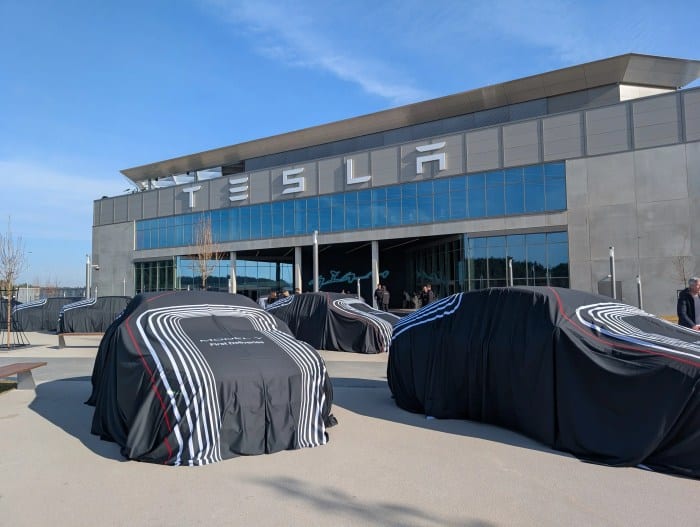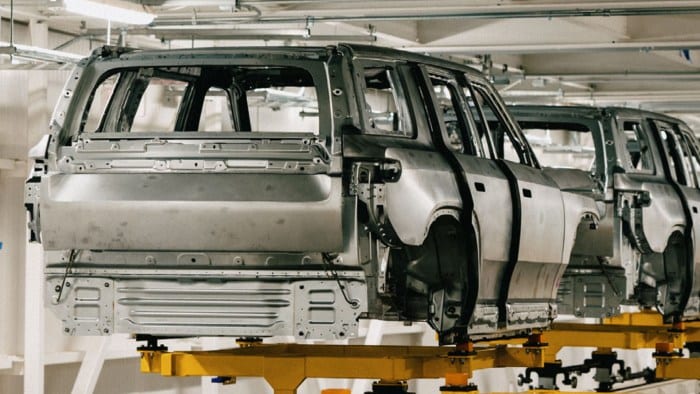

Tesla‘s GigaBerlin is producing approximately 5,000 vehicles per week and aims to ramp output to over 6,000 units in July, plant chief André Thierig reaffirmed in a new interview as the company maxes out its supply chain.
As of the last day of May, Tesla‘s vehicle registrations in Germany had already surpassed the full-year 2025 total of 19,390 units.
Speaking with Tesla Owners of Silicon Valley, Thierig framed the Grünheide factory’s performance as a counterpoint to the wave of restructuring and job cuts sweeping Germany’s legacy automakers.
“All the negative news that’s currently coming out of the rest of the German industry, it spreads a lot of negativity, pessimism, that people just don’t look positive into the future anymore,” the plant manager stated. “We just want to be that lighthouse that shows it can also be the other side, can be positive.”
He pointed to shifting market dynamics as evidence that the EV transition is progressing regardless of recent political headwinds in Europe — which include the revision of the 2035 ban on the sales of internal combustion engine (ICE) vehicles within the EU.
“There was this law in Europe that by 2035, ICE cars can no longer be registered and they’re trying to soften it,” Thierig explained.
He then added that “the EV adoption rate year over year has increased by more than 4% in the first month of this year. So consumers will take the decision. Politicians don’t have to actually do it anymore.”
Thierig noted that electricity prices have remained stable since the start of the year despite the Iran crisis, while fuel costs have risen sharply.
“You still pay the same electricity rate today that you paid at the beginning of the year, independent of the Iran war,” he noted, while “when you go to the gas station, you pay significantly less at the beginning of the year than you pay today.”
According to Thierig, “it’s still possible with the right product, the right mindset, speed of execution, to do this in Germany.”
The plant chief added that “manufacturing is still doable even in this high-cost environment. It’s the right thing to do to manufacture in the market where you’re also present and strongly present.”
Giga Berlin Production
Thierig revealed that Tesla‘s Grünheide facility — the company’s only European car factory — is supply-chain constrained at its current weekly rate.
He stated that the plant is “running right now just about 5,000 cars a week. That’s right now the maximum we can squeeze out of supply chain.”
GigaBerlin typically operates on a two-shift schedule and has previously added a third shift during periods of higher demand.
Whether a third shift has been introduced alongside the current ramp-up remains unclear.
Output is set to increase from July, when the plant begins a production ramp targeting approximately 6,200 vehicles per week.
“The factory can actually start ramping beyond 5K a week from July,” Thierig said. “We will basically continuously go above the 6K.”
Thierig announced the expansion on X on April 23, writing that Tesla would “increase Model Y production by 20% starting in July ’26.”
By then, the plant manager said that the company was hiring approximately 1,000 new employees starting in May and converting 500 temporary workers to permanent positions.
The facility produced its 100,000th refreshed Model Y in August 2025, roughly seven months after starting production of the updated SUV in January of that year. The plant currently employs around 11,000 workers and exports to more than 30 markets.
Tesla has announced plans to invest approximately €100 million to begin battery cell production at the Grünheide site starting in 2027, with an initial annual capacity of eight GWh — enough to supply roughly 2,000 vehicles per week.
First 5 Months Outpace 2025
Tesla has sold more cars in Europe’s largest auto market in less than half a year than it managed in a full 12 months last year.
In 2025, German sales fell 48% year over year amid the transition to the new Model Y, rising competition and fallout from CEO Elon Musk’s political involvement.
During this week’s interview, Thierig highlighted that the refresh of the model wasn’t merely a facelift, noting that “70% of all bump parts were new or newly designed or redesigned.”
Tesla registered 21,089 vehicles in Germany between January and May 2026, surpassing the 19,390 units the company sold in the country throughout 2025, according to monthly data from the Federal Motor Transport Authority (KBA).
May registrations reached 5,111 units, a 322% increase year over year.
Monthly Trajectory
Tesla‘s 2026 performance in Germany has built steadily from a slow January, when the company registered 1,301 vehicles — just 2% above the year-earlier month.
February saw 2,276 registrations, a 59% year-over-year increase, before March delivered a breakout result of 9,252 units — a 315% surge that marked the company’s strongest month in Germany since December 2022.
April registrations came in at 3,149, up 256% year over year, followed by May’s 5,111, extending the streak of triple-digit year-over-year gains that has now lasted four consecutive months.
By contrast, Tesla‘s 2025 in Germany was defined by persistent weakness.
Monthly registrations fell below 1,000 units for the first time in nearly three years in April 2025, when the company recorded 885 sales.
October 2025 brought a three-year low of just 750 units.
Model Y x Model 3
Tesla has sold 13,678 Model Ys this year in Germany, alongside 7,188 Model 3 sedans.
The Model 3 outsold the Model Y in Germany in May for the first time this year, accounting for 52% of Tesla‘s registrations in the month.
According to tracking platform EU-EVs, 2,664 of the month’s registrations were Model 3 sedans and 2,410 were Model Y SUVs.
The sedan has benefited from the late-2025 launch of the Model 3 Standard, which brought the entry price to €36,990 ($43,200).
The Model Y Standard, priced from €39,990 ($46,700), launched in European markets in October 2025, with production at Giga Berlin beginning in early November and deliveries commencing the following month.
The SUV was Germany’s best-selling BEV in March, when 6,841 of the 9,252 Tesla registrations were Model Y units — 86% of which went to private buyers.
Between January and May, the best-selling vehicle in Germany was the Skoda Elroq SUV (over 16,800 units), followed by the Volkswagen ID.3 (around 14,700). The Model Y ranked third.
The remaining 37 units were residual Model S and Model X inventory registrations, as Tesla ended production of both flagship models on March 31.
Incentive Tailwinds
The rebound coincides with Germany’s reinstated federal EV purchase incentive, a €3 billion program that applies retroactively to all eligible electric vehicles registered since January 1, 2026.
Private buyers can receive between €3,000 and €6,000 depending on household income and family size, with a taxable annual income cap of €80,000 — rising to €90,000 for households with two or more children.
The online application portal went live on May 19 through the Federal Office for Economic Affairs and Export Control (BAFA), after being originally expected to launch earlier in the month.
Buyers who purchased eligible EVs between January 1 and May 18 can apply retroactively.
The program replaces the previous Umweltbonus, which was abruptly scrapped in late 2023 and triggered a sharp slump in German EV demand throughout 2024 and early 2025.
Even before the portal opened, the prospect of retroactive eligibility appeared to support demand.
One of Four Countries to Hit the Mark
Germany is one of at least four countries where Tesla has already registered more vehicles in 2026 than it did throughout all of 2025.
According to registration data tracker Roland Pircher on X, the others are Uruguay, Chile, and Colombia — all significantly smaller markets.
Several larger markets are approaching the same threshold.
Pircher’s data shows Thailand at approximately 86.7% of its full 2025 total, followed by France at 83.3%, Japan at 76.7%, South Korea at 75.1%, New Zealand at 72.9%, and Romania at 71.9%.
At the current pace, multiple markets could cross the mark before the end of June.