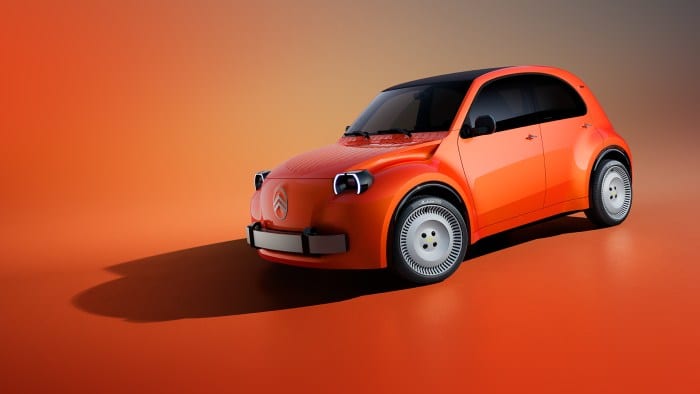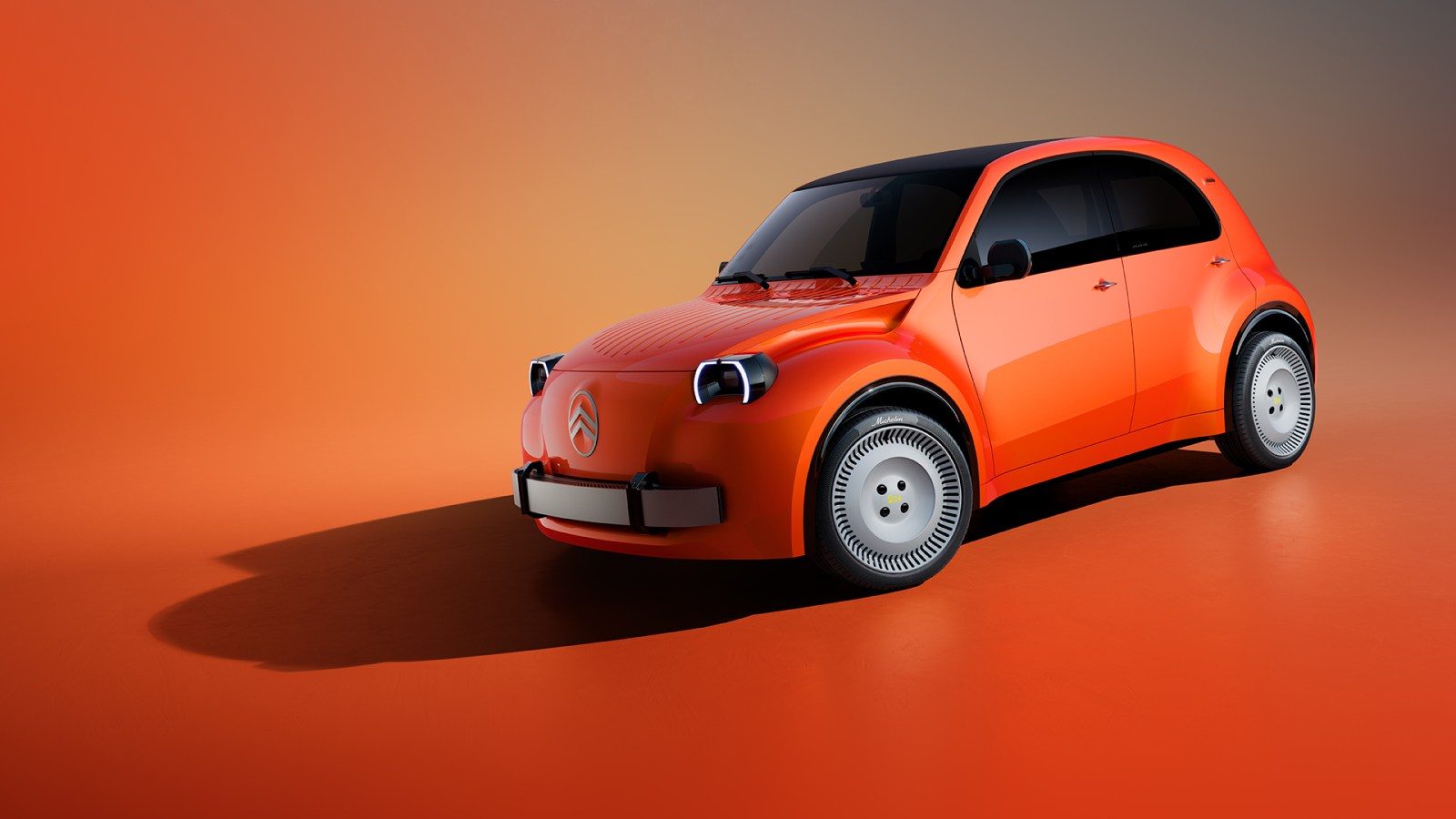

Citroën has unveiled an electric revival of the 2 CV, a concept car previewing a small European-built model the brand aims to sell from around €15,000 ($16,800) by 2028, 36 years after the original left production.
The 2 CV Concept was one of six concept cars Stellantis showed at an event on Sunday, the eve of the Paris Motor Show.
Alongside the 2 CV, Stellantis showed the Alfa Romeo Cuorerosso, the DS F3VER, the Fiat Multiplay, the Opel STX Concept and the Peugeot RCZ Vision.
The group said it would show nine concept cars and more than 60 vehicles at the Paris Motor Show.
“Electric. Made in Europe. €15,000,” Xavier Chardon, CEO of Citroën and DS Automobiles, wrote on LinkedIn after the reveal.
“The 2CV was never just a car. It was a bold idea. Making mobility accessible to everyone,” he wrote.
“Reinventing the 2 CV isn’t about replicating a car from the past,” Chardon said in the company’s statement.
The aim was “reinventing what made it unique: its simplicity, its accessibility and the freedom it offered,” he said.
Citroën did not disclose the car’s battery size, range, power output or charging speed. The brand also did not say where the car will be built or which platform it will use.
The Price
Citroën’s release describes “a target starting price of around 15,000 euros.” The group’s own statement was firmer, describing a car “accessible at a price of €15,000.”
Neither text says whether the figure is before or after government incentives.
That would put it below the current starting prices of its closest electric rivals. Renault‘s Twingo E-Tech starts at €19,490 ($21,800) in France, and Dacia has priced its new European-built Spring from €17,900 ($20,100).
The Chinese-built Leapmotor T03, which Stellantis sells in Europe, lists at about €18,900 ($21,200) in Germany.
Citroën said the production model would sit between the Ami, its two-seat electric quadricycle, and the C3. The brand has had no conventional car below the C3 since it ended production of the C1 city car in 2022.
Shorter and Lighter
The concept is 3.76 metres long, which Citroën said makes it shorter than the original 2 CV.
The car is 2 cm shorter than the first 2 CV of 1948, 1.68 metres wide without mirrors and 1.57 metres tall.
Citroën said it is aiming for a weight of about one tonne, because “less mass means a smaller, more cost-effective battery.”
The range will be suited to everyday use, the company said, without giving a figure.
L’argus reported that the base production version should have a range of just over 200 km on the WLTP cycle, and that the production car could measure between 3.65 and 3.75 metres.
Design Cues From 1948
The concept keeps the original’s round headlamps, set apart from the body, and rides on 18-inch steel wheels inspired by the 2 CV.
Its Michelin tyres carry the tyremaker’s Heritage logo and Citroën’s chevrons, and the body is painted in an orange-based shade Citroën calls Infra Red.
The door pockets are designed to hold eggs, which Citroën said pays homage to the original car’s specifications.
The pedals carry a tortoise for the brake and a rabbit for the accelerator, and the numbers 48, 90 and 26 on the windscreen mark the years of the original’s launch, its end of production and the concept.
Inside, a detachable radio called ‘Radioën’ doubles as a speaker, alongside an 8-inch square touchscreen.
Citroën said it had worked with Michelin on what the tyremaker calls a “universal digital twin of the tyre,” which it said enables the vehicle to adapt its behaviour to its environment.
Pomigliano and the E-Car
Stellantis said in May it would start building a small, low-cost electric model it calls the E-Car at its Pomigliano d’Arco plant near Naples in 2028, for “multiple brands” it did not name.
“Production is expected to start in 2028 in our Pomigliano (Italy) plant,” Stellantis Chief Executive Officer Antonio Filosa said at the time.
Citroën has not said the 2 CV will be built there. L’argus reported that the production car will share its technical base with the next Fiat Panda.
“This event brings our FaSTLAne 2030 strategy to life,” Filosa said on Sunday, referring to the strategic plan he presented in May.
A Regulation Still in Draft
Citroën said the car is “in line with the new European E-Car regulations.”
Those rules are not yet law.
The European Commission proposed in December 2025 a new sub-category of small electric passenger cars, known as M1E, as part of a package to simplify vehicle rules.
The proposal would define small affordable electric cars as up to 4.2 metres long and count each one assembled in Europe as 1.3 vehicles toward carmakers’ carbon dioxide targets until 2034, according to a summary by law firm Akin Gump.
The European Parliament’s joint committees are still considering the file, with a first-reading plenary vote pencilled in for November 23, according to the Parliament’s legislative tracker.
The European Transport Safety Council has warned that the proposal would “effectively freeze EU vehicle safety requirements” for these cars for up to ten years.
The Original
The first 2 CV was unveiled at the Paris Motor Show on October 7, 1948, the product of a project for a minimalist small car that Citroën started in 1936.
The last one left Citroën’s plant in Mangualde, Portugal, on July 27, 1990. Citroën built 5,114,969 units in total, including 1,246,335 vans, according to the company.
Citroën’s Electric Push
The 2 CV extends a strategy Citroën has built around cheaper electric cars, led by the ë-C3 and ë-C3 Aircross.
Orders for the brand’s electric vehicles rose 98% in the first half of 2026 and made up a third of its total orders, Citroën said in July.
The ë-C3 and ë-C3 Aircross were the top two models in their respective segments in France, according to the company.
“Our vision of more accessible mobility is gaining increasing traction, particularly in the electric segment,” Chardon said at the time.
Citroën sold 373,700 vehicles worldwide in the first half, up 4.4%, and lifted its registrations in Europe by 8% for a 3.4% market share, the company said.
France remains its largest market.
Citroën was the country’s third-largest brand in 2025, with 158,763 car and van registrations and an 8.0% share, and the third-largest seller of battery-electric cars, with 8.1% of that market, according to the company.