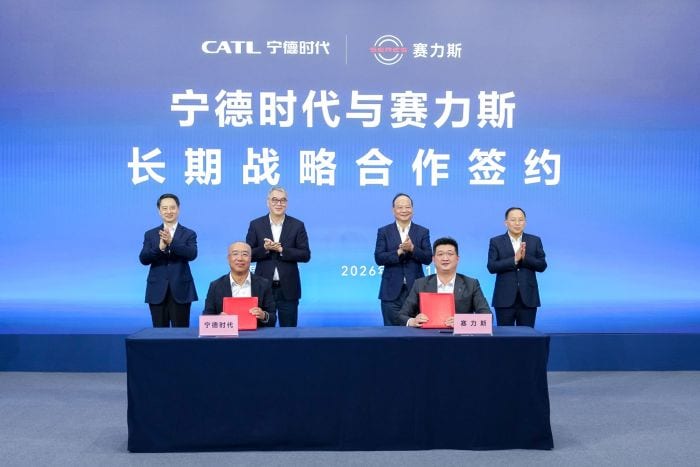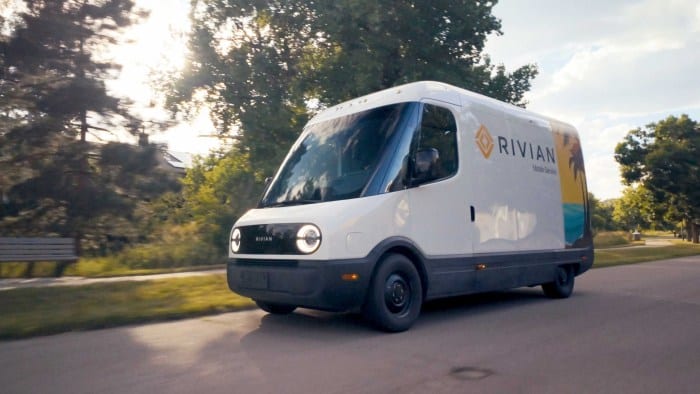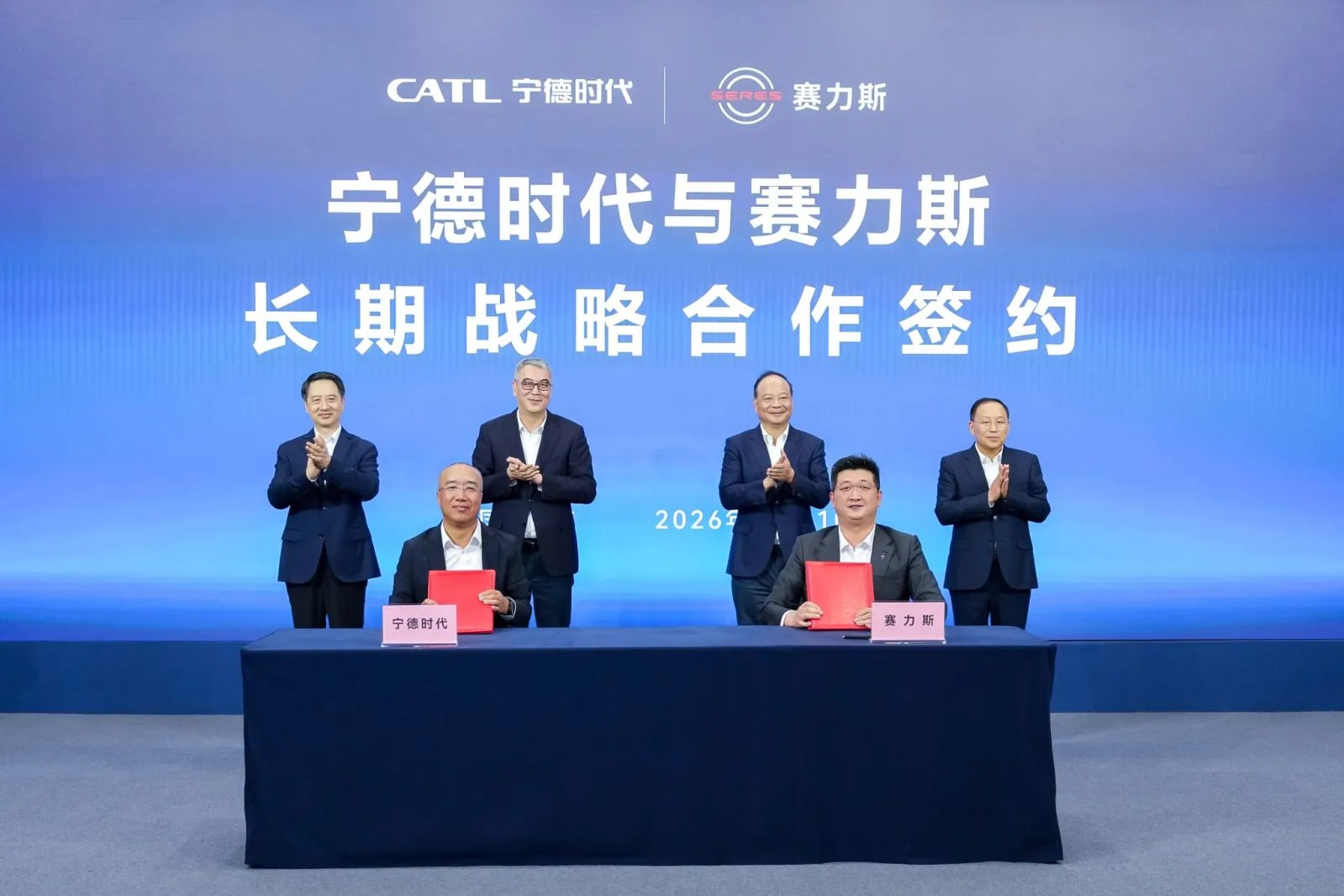

CATL has signed a long-term strategic cooperation agreement with Seres under which every model of the carmaker’s AITO brand will keep using CATL batteries, as the world’s largest battery maker faces customers moving volume to rival or in-house suppliers.
“Starting from this new point, AITO will continue to use CATL batteries across its entire lineup over the long term,” CATL said in a statement.
AITO has used CATL batteries in every model since the brand was launched, and its cumulative deliveries have passed 1.2 million vehicles, according to CATL.
The 1,000,000th AITO rolled off the line at the Seres plant in January, 46 months after the brand’s first vehicle was produced.
Neither company disclosed the agreement’s duration or financial terms.
A Second Plant Inside the Plant
The core of the deal is a larger version of the battery operation CATL runs inside Seres’ super factory in Chongqing.
The companies will accelerate the second phase of that “factory-in-factory” project, which has planned annual capacity of 10 to 12 gigawatt-hours (GWh).
Once it is complete, the two phases will have combined annual capacity of more than 20 GWh, the companies said.
That implies the first phase has more than 8 GWh, by EV‘s calculation, though neither company has disclosed its capacity. They also did not say when the second phase will start production.
CATL began operating two CTP 2.0 battery pack lines at the Seres plant on June 30, 2025, its first production base in Chongqing and the first time it had built packs inside a carmaker’s factory.
The arrangement lets packs go into AITO vehicles as soon as they are produced.
CATL said the aim of concentrating production on one site is to make the supply chain more resilient and competitive.
The agreement also commits CATL to increasing its investment in Chongqing, to help the city build a high-end intelligent connected new energy vehicle industry cluster worth a trillion yuan, according to the statement.
Charging and Overseas Markets
Beyond production, the two companies will work together on super-fast charging networks and battery services, building a service system that covers the battery’s full life cycle.
They will also jointly develop markets in Europe, the Middle East and Central Asia, without naming models or a timetable.
The agreement covers battery safety, supply chain coordination and global cooperation, the statement said.
It is the latest in a series of deals between the two companies.
A Seres subsidiary, then named Xiaokang, signed a five-year supply and capacity framework with CATL in September 2021 covering battery purchases from 2022 to 2026.
The two announced in August 2022 that CATL’s Qilin battery would go into AITO models and signed a five-year strategic agreement.
A year later, they signed a broader agreement covering fast charging, battery safety, vehicle-battery-charging integration, big data and overseas business.
Seres Under Pressure
Seres signed the deal with its earnings under strain.
It reported a net loss attributable to shareholders of 1.717 billion yuan ($256 million) for the first half of 2026, against a profit a year earlier, on revenue that fell 7.87% to 57.49 billion yuan ($8.6 billion).
The company blamed rising prices for upstream raw materials, including batteries and chips, and asset impairments.
Battery costs face a new levy as well.
China began charging a 2% consumption tax on lithium-ion batteries on September 1, rising to 4% from September 1, 2027, under a policy issued by the finance ministry, the customs administration and the tax authority, according to Xinhua news agency.
Sodium-ion and solid-state batteries are exempt until the end of 2028.
Its gross margin fell 5.6 percentage points to 23.3%.
Seres sold 29,271 new energy vehicles in September, down 34.5% from a year earlier, and about 256,500 in the first nine months, down 15.8%, according to its monthly sales report.
Responding to an investor question on September 28, Seres said CATL’s batteries had been validated at scale and met AITO’s “five highs” standard.
It said cost increases had affected short-term earnings, but that it would “never lower quality or sacrifice user value in exchange for short-term profit.”
The agreement also follows a reshaping of AITO’s ties with Huawei.
AITO and HIMA, Huawei’s car alliance, said on September 15 that Seres would take over the running of AITO, leading product definition, design, marketing, retail and service, with Huawei providing support.
Fifteen days later, on September 30, Seres and Huawei signed a new five-year cooperation agreement in Shenzhen and agreed to form a dedicated AITO team.
CATL’s Customers Shift
For CATL, the deal adds a public commitment from a major customer at a time when some carmakers are reducing their reliance on it.
Two of them, Li Auto and Xiaomi, were tied as CATL’s third-largest customers in June, each accounting for 6.8% of its installations in China, behind Geely and Changan, according to China Passenger Car Association data.
Li Auto said in September it would fit its own batteries across its entire lineup, moving models including its flagship Mega off CATL cells in the fourth quarter.
“Self-developing batteries does not change the fact that CATL is the leading battery brand,” Li Auto said at the time.
Li Auto also plans to invest 2.65 billion yuan ($395 million) in Sunwoda Power, a battery unit of Sunwoda Electronic, which would make it the second-largest shareholder with an indirect stake of 11.17%, Sunwoda said on September 4.
Xiaomi unveiled its own Longjia, or Dragon Armor, battery at an event in Beijing the same day, where it signed strategic partnerships with CALB and Sunwoda Power.
CATL has supplied batteries for both Xiaomi’s SU7 sedan and YU7 SUV, with BYD’s FinDreams also providing packs for some versions.
XPeng founder and CEO He Xiaopeng told reporters after the unveiling of the G9L in September that XPeng would lead all of its power battery technology itself from this year, while its three cell suppliers continue to manufacture the cells.
China’s industry ministry pushed back against concern over the shift, with commentary published by its news centre on September 23 describing supplier diversification and in-house battery projects as standard commercial practice rather than an attempt to weaken leading battery makers.
CATL’s share of China’s power battery installations slipped 0.89 percentage points in August to 41.5%, while BYD gained share, according to the China Automotive Battery Innovation Alliance.
CATL has also been cleared by China’s market regulator to buy a stake in a battery plant built by Geely in Chongqing.
Globally, CATL installed 333.0 GWh of electric vehicle batteries in the first eight months of 2026, up 25.2%, for a 39.4% share, according to SNE Research.
The two companies are also linked through AIVA, a new brand run by Saidou Technology, formerly Seres’ wholly owned Landian Technology.
After a capital increase of about 6.67 billion yuan ($1 billion) this year, a state-owned investor from Chongqing’s Shapingba district became Saidou’s largest shareholder, with Seres holding 32.96% and CATL about 9.89%.
AIVA unveiled its first production model, the ME7 crossover, in Paris on September 28, and Seres’ factory will build it.
AIVA was in talks with CATL on adopting battery swapping, LatePost reported in August, citing a source who said the plans were still being worked out.
It is the second time in less than a month that CATL has publicly reaffirmed a carmaker partnership.
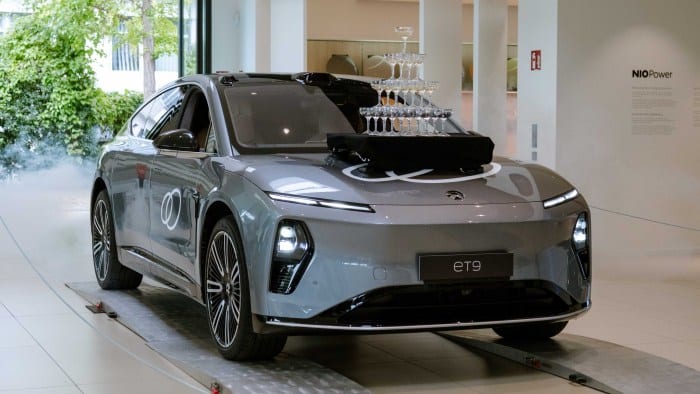
CATL said on September 18 that Zeng had held talks with Nio Founder and Chief Executive Officer William Li and that the two companies would expand their cooperation.
Shares Down Sharply
CATL’s Shenzhen-listed shares closed at 297.75 yuan ($44.40) on Friday, the last trading session before the signing, up 3.84% on the day.
That left the stock down 21.1% this year and 36.5% below the record of 468.75 yuan ($69.90) it reached in May, and not far above its 52-week low of 285.17 yuan.
CATL’s Hong Kong shares, listed in May 2025, closed at HK$491.40 ($62.60) on Friday, up 3.06%, and are down 4.5% this year.
That puts the Hong Kong shares at a premium of about 41% to the Shenzhen stock, by EV’s calculation.
CATL has also been buying back its own shares.
It had repurchased 10,945,162 A-shares, or 0.2482% of its A-share capital, for 3.30 billion yuan ($493 million) by September 30, at prices between 286.53 and 331.61 yuan, the company said on October 8.