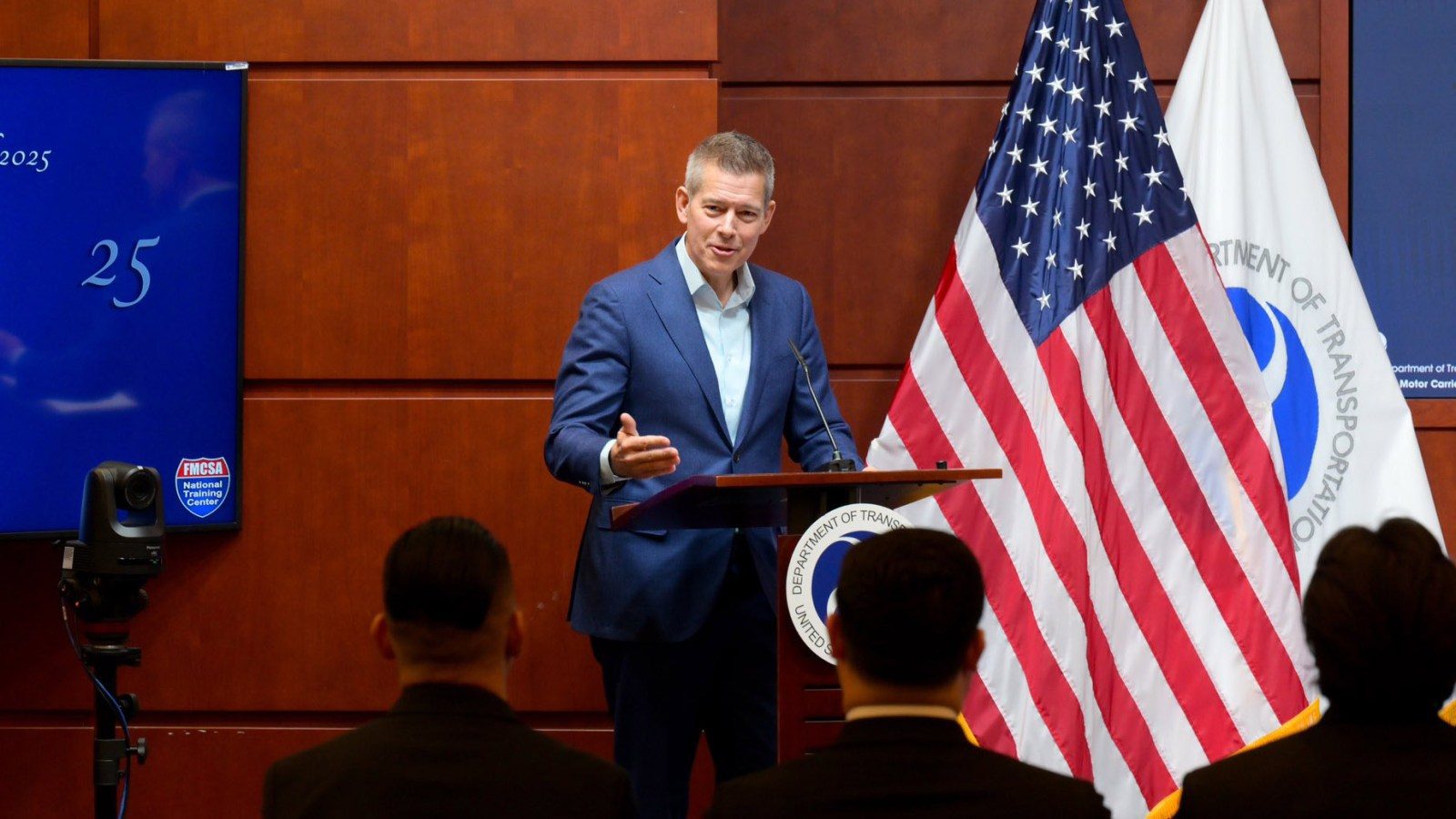

US Transportation Secretary Sean Duffy said the Chief Executive Officer of Stellantis “will make AFFORDABLE CARS because of our work” at his department, crediting new fuel economy standards for a product plan the carmaker announced four months before the rule was finalized.
Stellantis set out its plan for seven new North American models under $40,000 and two under $30,000 on May 21.
The National Highway Traffic Safety Administration finalized the standards on September 28, although the administration had first proposed the rollback in December.
“MORE CARS YOU WANT ARE COMING,” Duffy wrote in a post on X on Monday, adding that “American automakers couldn’t be happier”.
He also said the standards “will LOWER prices by $1,300 and save Americans $130 BILLION in 5 years”, claims that go beyond what his own agency’s analysis of the rule shows.
The rule sets a fleet average of 34.9 miles per gallon for the 2031 model year and takes effect on November 30.
What Stellantis’ CEO Said
Duffy attached an image built on a Detroit Free Press article about Stellantis Chief Executive Officer Antonio Filosa, who spoke at an industry conference in Detroit on September 30.
The text shown in quotation marks in the image is the newspaper’s own reporting, not a statement by Filosa.
The article does attribute to him the view that, with the stricter requirements gone, Stellantis can speed its recovery by “focusing on producing vehicles that customers want”.
His direct quotes in the article concern the company’s shift away from an EV-led strategy, its market coverage and its financial guidance.
“We fundamentally switched our business model from being anchored, let’s call it, to an ideology, to actually listening to our core customers,” he said.
He is not quoted on vehicle prices or on the Department of Transportation, and the word “affordable” does not appear in the article.
The company did welcome the rule.
“We welcome the Administration’s efforts to reset the CAFE regulations to more achievable targets that are better aligned with market realities,” Stellantis Senior Vice President Shane Karr said in a statement distributed by the department.
The $1,300
The agency’s analysis estimates that the rule will cut the regulatory cost built into a 2031 model-year vehicle by $1,289, compared with keeping the standards set under former President Joe Biden.
That is a cost increase carmakers would avoid, not a reduction from current prices, and the department rounded it to $1,300 in its press release.
The analysis makes the effect on buyers conditional.
“If those savings are passed on to consumers (rather than, for example, to shareholders as increased gains, or to employees as increased compensation)”, it says, the cost of a new vehicle would fall by $1,289 on average.
The average US new-vehicle transaction price was $50,089 in August, according to Kelley Blue Book.
The same table in the analysis shows that the owner of that 2031 vehicle would spend $1,624 more on fuel over its lifetime, at a 3% discount rate.
The agency’s own tally of costs and benefits to the buyer of that vehicle shows a net gain of $289.
That tally also counts lower insurance and ownership fees and a $783 saving the agency labels “implicit opportunity cost”, and on purchase cost and fuel alone the buyer is $335 worse off.
Duffy’s post does not mention fuel.
The $130 Billion
The department’s own press release on September 28 put the saving at $138 billion “over the next five years”, and Duffy used the same $138 billion figure on X that day.
He gave no explanation for the lower number on Monday.
The underlying figure in the rule is $137.5 billion in avoided costs, at a 3% discount rate.
It covers the full lifetime of vehicles built through the 2031 model year, a period that runs well beyond five years, and falls to $96.9 billion at the 7% rate the agency also reports.
It is also a gross number.
The agency subtracts $95.8 billion in benefits given up, mainly fuel savings, to reach a net benefit of $41.8 billion.
The rule estimates US drivers will burn an additional 122 billion gallons of gasoline through 2050 as a result.
‘Couldn’t Be Happier’
Ford Chief Executive Officer Jim Farley and General Motors also issued supportive statements, as did the Alliance for Automotive Innovation, the industry’s main lobby group.
Relations are not uniformly warm.
Duffy wrote to Farley in a letter dated September 3 to say he was “deeply alarmed” by Ford’s ties to Chinese companies, and Ford called the letter “a wrongheaded attempt to capture headlines”.
The rule also ends the trading of fuel economy credits between carmakers from the 2028 model year, a market in which EV makers such as Tesla and Rivian have been sellers.
The ‘EV Mandate’
Duffy’s post also said the administration was “ENDING Biden’s CRAZY EV MANDATE”.
No federal law required carmakers to sell a set share of EVs.
The administration’s argument is that the previous standards were set so high that they could not be met without EVs, and that the agency broke the law by taking EVs into account when setting them.
The statute says the Transportation Secretary “may not consider the fuel economy of dedicated automobiles”, a category that includes battery-electric vehicles, when setting standards.
The agency adopted its reading of that clause in an interpretive rule in June 2025, and the White House has described the earlier rules as an “EV mandate”.
A coalition of 26 states and local governments led by California asked the US Court of Appeals for the First Circuit on October 2 to review the rule.