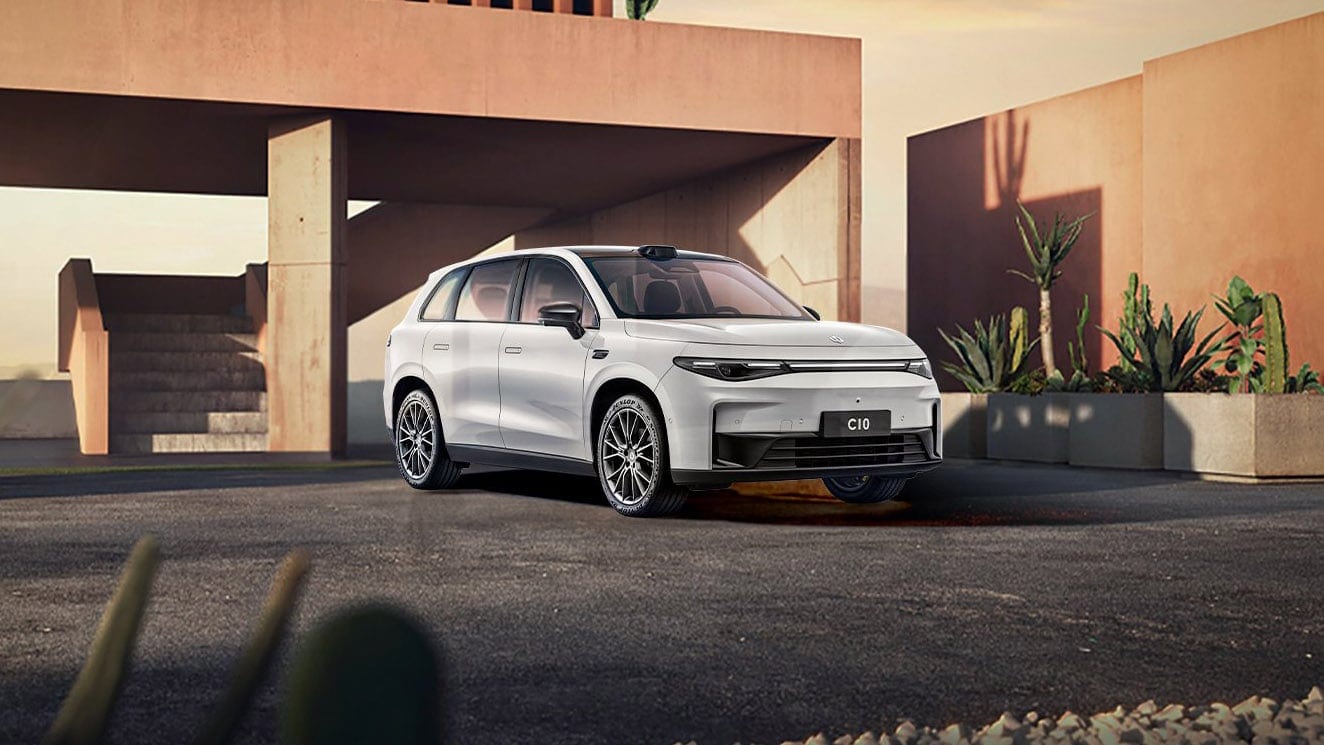

Leapmotor has entered Argentina with extended-range electric vehicle (EREV) versions of its B10 and C10 SUVs, deepening the Stellantis-backed Chinese automaker’s push across the Americas.
Argentina marks its third South American market and its fourth in the Americas, after Mexico last month.
Leapmotor entered Brazil and Chile in November 2025 and at the time named Argentina, Colombia, and Ecuador among its next expansion targets.
The EV maker has initially established 12 sales outlets and 20 after-sales service locations in Argentina, covering major cities.
The retail network draws on Stellantis‘ existing dealerships, supplemented by dedicated Leapmotor spaces offering test drives and localized auto-financing options.
Owners will have access to basic maintenance and roadside assistance through more than 300 Stellantis-branded service outlets across Argentina.
The decision to lead with EREV models reflects constraints in Argentina’s charging infrastructure.
According to Leapmotor, the technology can ease range anxiety and reduce drivers’ dependence on charging availability.
Americas Expansion
Argentina extends a broader Americas campaign that reached North America for the first time in July, when Leapmotor launched the B10 compact SUV in Mexico.
The Mexican-spec B10 arrived as an EREV with a 1.5-litre engine acting solely as a generator, a 160 kW electric motor, and a combined range of up to 990 km.
Leapmotor priced the model at 575,000 Mexican pesos (approximately $33,700) and established more than 40 authorized outlets in major cities.
Company executives described the launch as the starting point of Leapmotor‘s North American expansion.
The C10 and C16 SUVs are set to follow in Mexico, targeting family and multi-passenger buyers.
Canada Quota Opens a Path
Leapmotor‘s Mexico launch raised immediate questions about whether Canada could follow.
Canada dropped its 100% tariff on Chinese-made EVs in January, replacing the effective barrier with a 49,000-vehicle annual quota at a 6.1% most-favored-nation tariff rate.
The quota took effect on March 1, 2026, and will increase by 6.5% annually.
BYD, Chery, and Geely are all confirmed to enter the Canadian market under the quota framework by year-end.
Leapmotor has not publicly confirmed plans to sell vehicles in Canada under the quota.
However, the infrastructure and distribution relationships already in place through Stellantis‘ Canadian operations could provide a foundation for direct sales, as they have in every other market Leapmotor International has entered.
Industry Minister Mélanie Joly has said Ottawa is pressing Chinese automakers to build locally and to support the Canadian auto parts supply chain, rather than simply importing finished vehicles.
Stellantis Brampton Plant Saga
Leapmotor‘s relationship with Canada has so far been defined by the contested Brampton assembly proposal.
In April, Stellantis proposed assembling Leapmotor EVs at its idled Brampton, Ontario plant using knock-down kits shipped from China.
The proposal drew immediate opposition from Unifor, Ontario Premier Doug Ford, and the Automotive Parts Manufacturers’ Association.
Canada rejected the proposal, laying out three conditions for any new production at the site: labour standards at or above previous levels, use of Canadian auto parts suppliers, and compliance with North American software-security rules under the Canada-United States-Mexico Agreement.
All three conditions would preclude the KD assembly model Leapmotor uses in markets like Malaysia and Indonesia.
Stellantis received $529 million in federal subsidies through the Strategic Innovation Fund to retool Brampton for electric Jeep Compass production.
The retooling was paused in February 2025 after the US imposed 25% tariffs on Canadian-built vehicles.
Last October, Stellantis moved the Compass to its Belvidere, Illinois plant as part of a US$13 billion American manufacturing plan, leaving approximately 2,200 Unifor-represented workers on layoff.
The situation escalated last week.
Stellantis told Unifor on August 12 that it is seriously considering the closure and sale of the Brampton plant.
National president Lana Payne said the company intends to open discussions with another firm about a sale but declined to name it.
Stellantis has not issued the formal written notice of closure its collective agreement requires, which must provide no less than one year’s notice.
Joly reiterated that Ottawa considers Stellantis‘ abandonment of Brampton production “completely unacceptable” and said the government will recover taxpayer funds unless the company restores manufacturing at the site.
Ottawa opened a formal dispute resolution process in November 2025, demanded a plan for Brampton, paused further payments, and served a notice of default in December.
Overseas Expansion Push
Leapmotor now operates in more than 40 countries and regions worldwide, with more than 2,000 sales and service outlets.
The overseas push is being driven by Leapmotor International, a joint venture formed after Stellantis invested €1.5 billion ($1.7 billion) in Leapmotor in 2023, giving the company control over the Chinese brand’s international operations.
Exports are becoming a significant growth driver.
Leapmotor exported 17,569 vehicles in July, up 281.5% year-on-year but down 16.3% from June. Exports in the first seven months totaled 113,863 vehicles.
The company set a target at the beginning of the year for overseas sales to account for 20% to 35% of its total, with the share already approaching 30% in the first half.
Overall delivery momentum remains strong.
Leapmotor delivered 101,267 vehicles globally in July, surpassing 100,000 units in a single month for the first time.
Deliveries rose 102.0% year-on-year, marking a record for the fourth consecutive month.
In the first seven months, the figures totaled 457,754 vehicles, up 68.4% year-on-year and equivalent to about 46% of the company’s full-year target of 1,000,000 vehicles.
In China, Leapmotor‘s refreshed B10 SUV, launched in July, starts at 99,800 yuan ($14,800).
The refreshed C10, launched in June, starts at 125,800 yuan — equivalent to $18,700.