
Stellantis has applied for a US patent on a system that drops an overheating high-voltage battery from an electrified vehicle onto the ground and uses the car’s 12-volt battery to drive it away from the pack.
The application was published by the US Patent and Trademark Office (USPTO) on September 17, according to Justia Patents. It was filed by Stellantis’ US subsidiary, FCA US LLC, on May 6.
Stellantis’ North American brands are Chrysler, Dodge, Jeep, Ram, Alfa Romeo, FIAT and Maserati.
It is a divisional of an application FCA US first filed in March 2023, which was granted on June 2, according to Justia.
The patent’s stated concern is the vehicle rather than its occupants, who it says can already get out.
“In rare examples the high voltage battery system can overheat potentially leading to a thermal event. In such scenarios the vehicle occupants can safely exit the vehicle. However, as the battery system is coupled to the vehicle, some thermal events can potentially lead to the vehicle being a total loss,” the background section says, according to the 2023 application as published.
How It Works
A person activates a quick-release switch. It can be “an electrical lever, a mechanical lever, a physical button, a touchscreen button and a toggle switch,” according to the filing.
A controller then electrically disconnects the high-voltage battery and releases it from the vehicle “onto the ground,” in what the filing calls “one motion.”
The patent describes two ways to release the pack.
In the first, two opposing “castellated frames” with alternating extensions and notches slide against each other until they separate. One frame is fixed to the vehicle and the other to the battery. The filing does not say what moves them, only that one translates “such as by an actuator, etc.”
In the second, “pyrotechnic fasteners,” described as “a nut and bolt incorporating a charge,” break apart when an electric current fires them.
The controller then connects the low-voltage battery, 12 volts in the patent’s example, to an electric motor, in one case only the rear motor.
The flow chart puts the electrical disconnection before the mechanical release, but the description says the two can happen “subsequently or concurrently.”
The motor then propels the vehicle “a predetermined distance away from the decoupled high-voltage battery,” under the method claims. The filing does not say how far that is.
If the pack is wider than the rear track, “the rear wheels may roll at least partially over the high-voltage battery” as the car pulls away, the published application says.
Who Presses the Button
The system is manual. The published 2023 application, whose description the new filing repeats, describes no sensors that trigger the release automatically, and none of the claims in either filing mentions them.
The patent places one switch in the cabin and a second in the trunk.
The system “allows a vehicle operator or an individual outside the vehicle (such as a first responder, etc.) to quickly and easily decouple the high-voltage battery from the vehicle,” the published application says.
The trunk switch “can be activated by an individual outside of the vehicle such as the vehicle owner, a passenger, a bystander or a first response personnel,” it says.
The published application describes no safeguard before release, such as requiring the vehicle to be stopped. The Hyundai-Kia patent described below does require that.
CarBuzz first reported the filing on Friday.
A Coupe in the Drawings
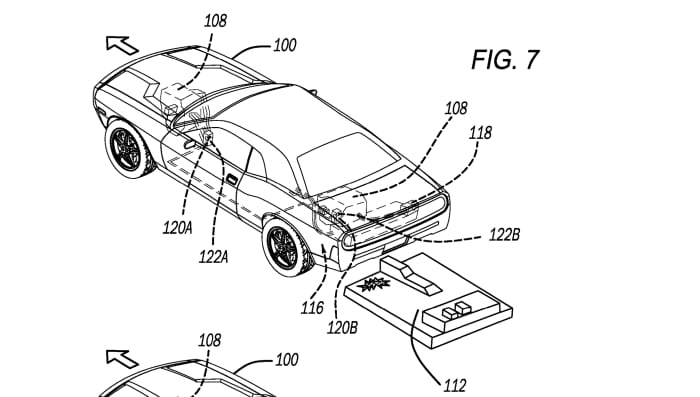
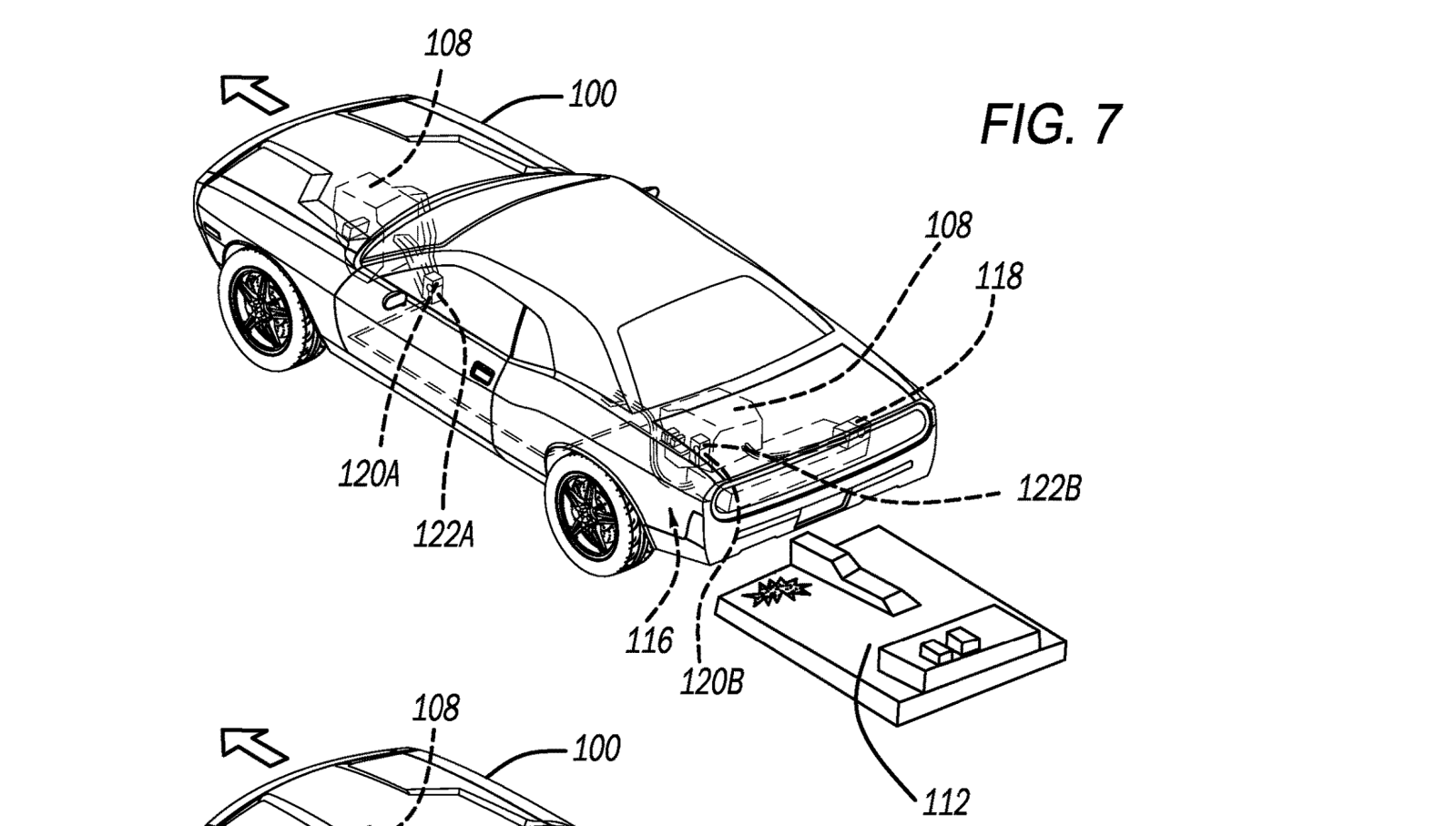
The drawings show a two-door coupe with lines resembling the combustion-engined Dodge Challenger.
The application calls it only “a passenger car coupe” and names no model. Figures 5 to 8 mark the pack with a symbol for the thermal event as it drops and the car drives off.
Its example battery is “a 16 kilowatt-hour (kWh) lithium-ion battery pack,” far smaller than the packs in most fully electric cars.
The system could be used on “any electrified vehicle,” including sedans, SUVs, trucks, light commercial vehicles, people movers and “motor racing vehicles,” the application says.
Two Filings, Different Claims
The two filings protect different parts of the idea.
The granted patent covers the system. Its only independent claim requires a switch, a controller, an electrical decoupler and a mechanical decoupler made of “first and second opposing castellated frames.”
The new application covers the method. Its only independent claim is receiving the request, disconnecting the battery electrically, “electrically connecting a low-voltage battery to an electric motor” and releasing the battery mechanically.
It does not require the castellated frames. The pyrotechnic fasteners and the drive-away step appear in dependent claims.
When the 2023 application was published, its main system claim required only a switch, a controller and the two decouplers. The castellated frames appeared in a dependent claim. The granted version writes them into claim 1, so the patent as granted covers the frame design.
The new application has not been granted.
Not the First Battery-Drop Patent
Hyundai and Kia were granted US Patent 11,904,704 B2, “Battery Release System for Vehicle,” on February 20, 2024, with a priority date of March 11, 2020, according to Google Patents.
That system releases the battery pack when a controller “determines that a fire occurs” and that the vehicle is stopped, and it can also be released with a lever.
It does not describe driving the vehicle away on low-voltage power.
Another FCA Battery-Fire Filing
FCA US has also applied to patent an automatic system that fights a battery fire inside the pack.
That application, “Electric Vehicle Having Battery Thermal Runaway Suppression System,” was filed on May 28, 2024 and published on in December 2025, according to Justia.
Temperature sensors trigger blades that puncture a bladder of fire-retardant material and pierce coolant lines, and the two mix into a foam that smothers the cells, the filing says.