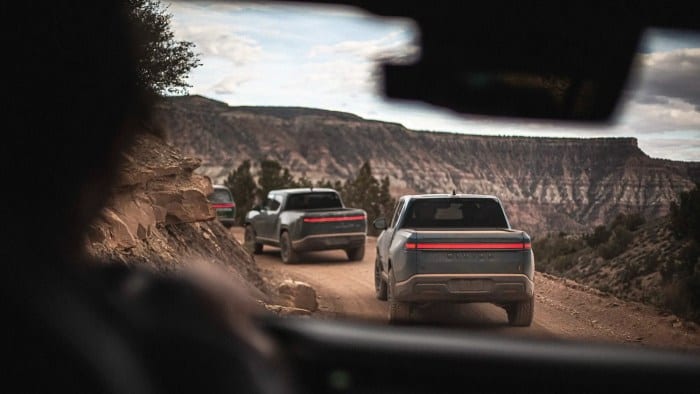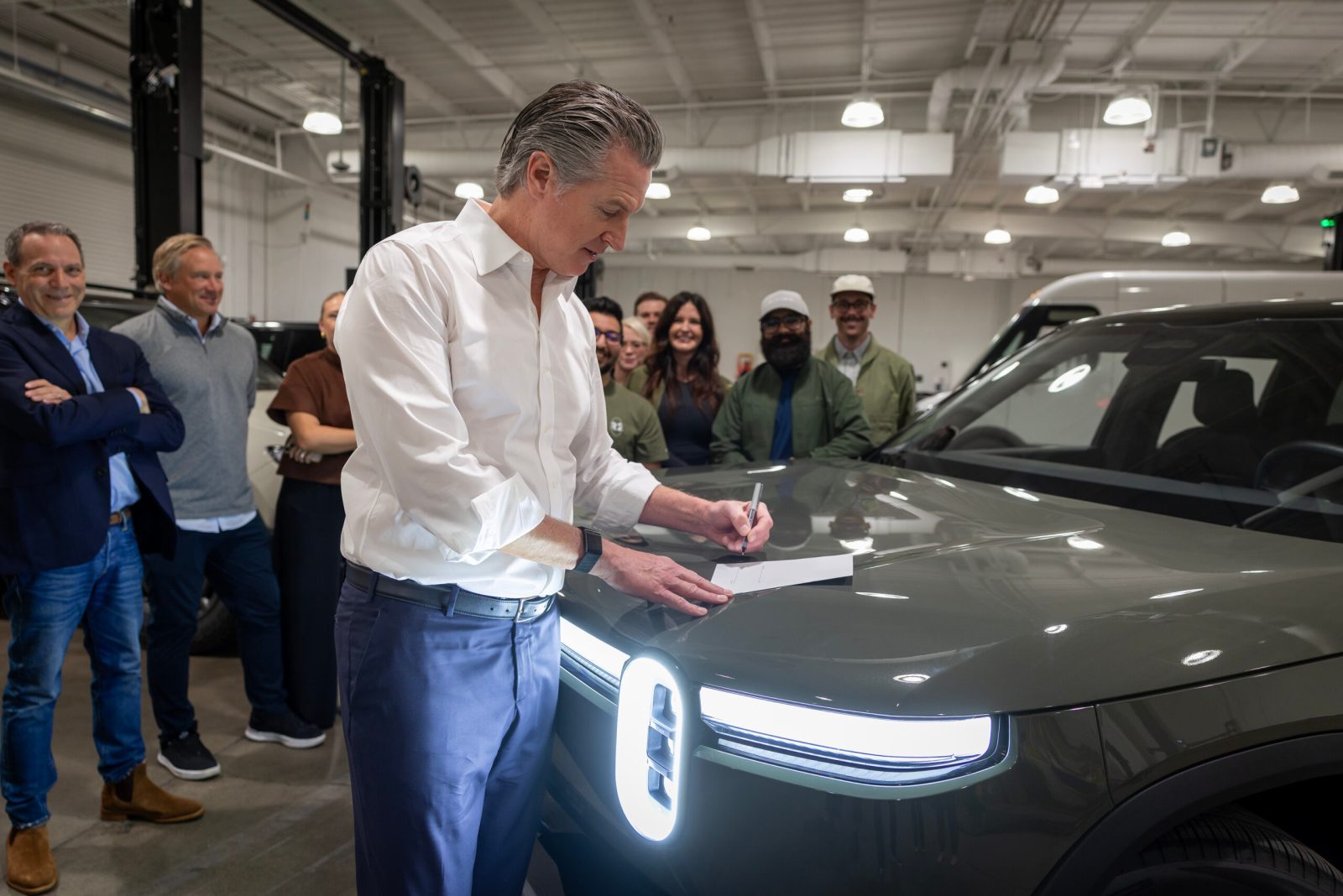

Rivian confirmed on Wednesday that only its 2026 model-year R1S and R1T models are currently eligible for California’s new MyFirstEV rebate program.
The omission leaves the R2 — the vehicle on whose hood Gov. Gavin Newsom signed Senate Bill 168 into law on July 13 — out of the state’s first direct purchase subsidy since the Clean Vehicle Rebate Project closed in 2023.
The blog post specifies a $3,500 point-of-sale discount on any 2026 R1T or R1S, regardless of configuration or price, and a $1,750 discount on Rivian Pre-Owned vehicles from model year 2024 or earlier.
Rivian had said on X last week that “at launch, 2026 R1 configurations and Rivian pre-owned vehicles are eligible, and we estimate R2 will be eligible in 2027.”
The EV maker added that it would share more details with the community as they became available, days before the blog post went live.
The incentive applies only to vehicles ordered on or after August 12 and purchased or leased directly from Rivian, and the vehicle must be delivered and registered in California.
Rivian says the rebate may be combined with its other public offers.
No mention of the R2 appears anywhere in the post.
Additionally, the company did not confirm if the upcoming 2027 model year vehicles will also be eligible.
Clearing 2026 R1 Stock
The timing of the R1-only rollout aligns with a broader push to move 2026 model-year R1 inventory before a 2027 update arrives.
Filings submitted to the US Environmental Protection Agency late last month point to an imminent launch, despite the Irvine EV maker not having confirmed a date yet.
Rivian has cycled through financing rate changes, lease adjustments and inventory discounts on the R1 roughly every two to four weeks since the spring.
As EV reported on Tuesday, the company raised its promotional financing rate on the R1 Tri to 1.99% APR from 0.99%.
The August incentive slate for R1 models still includes a $3,000 savings offer on select R1 Tri leases and 3.99% financing on 2026 R1 Dual builds.
Combined R1S and R1T deliveries fell 6.3% year over year in the second quarter, according to Cox Automotive figures, with the R1T down 30.4% and the R1S roughly flat.
The full-year decline for the nameplate reached 15.1% in 2025.
Adding a $3,500 state-backed rebate to the R1’s existing promotional stack gives Rivian a deeper incentive on a line that needs it, funded in part by California rather than entirely from its own balance sheet.
Under the program’s even per-manufacturer split, each participating brand’s combined pool — counting both the state’s contribution and the automaker’s mandatory match — runs near $20.8 million, or roughly 5,900 new-vehicle rebates.
R2 Production in Early Ramp
The R2’s VIN assignments have reached nearly 6,000 units, according to owner tracking on the Rivian Forums, adding close to 950 serials in the two weeks since the count passed 5,000 in late July.
A VIN is assigned before production and does not equal a delivery or a registration.
With Rivian declining to disclose model-level production or delivery figures for the R2, the community-logged count remains the closest public read on the ramp.
The pace has settled at roughly 500 assignments a week — less than half the mid-July peak — while Cox Automotive data imply only about 789 R2s reached buyers in the model’s first quarter on sale.
Rivian has guided to 20,000 to 25,000 R2 deliveries this year, a target the second half must carry almost entirely.
The company has been moving R2 order windows forward for reservation holders in at least two waves since July, with some holders seeing estimates advance by roughly three months.
The pattern points to a model that is not struggling to find buyers — and one that does not need a state rebate to convert reservations into orders during a supply-constrained ramp.
Rivian cited a record of more than 57,000 R2 demo drives instead of giving unit counts for the second quarter.
The Program’s Structure
MyFirstEV, funded through the California Air Resources Board under California Climate Investments, offers a $3,500 point-of-sale discount on new zero-emission vehicles and $1,750 on used models priced up to $25,000.
The state’s $135 million commitment is matched dollar for dollar by participating automakers, for a combined pool of roughly $270 million split across 13 manufacturers.
Eligibility is limited to California residents buying or leasing their first zero-emission vehicle, with buyers signing a declaration at the point of sale confirming that status.
Previous electric vehicle owners and lessees do not qualify and no income cap applies.
The $50,000 MSRP cap on new vehicles is waived for California-headquartered companies that manufacture exclusively zero-emission vehicles — Rivian, based in Irvine, and Lucid, based in Newark.
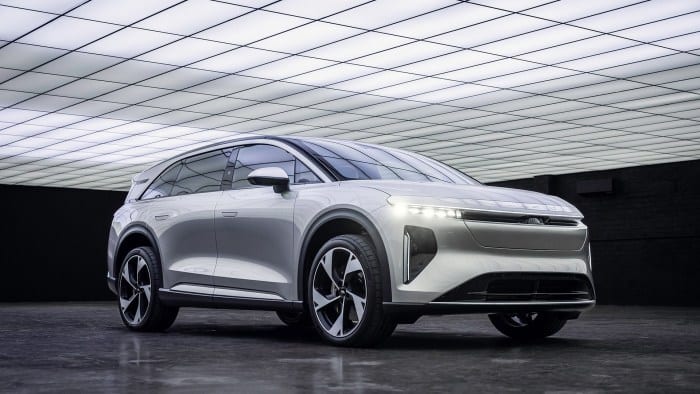
Lucid began participating in August, offering the rebate on all new and pre-owned vehicles alongside its existing $10,000 Lucid Credit and zero-percent financing for 72 months.
Tesla Already Exhausted Its Allocation
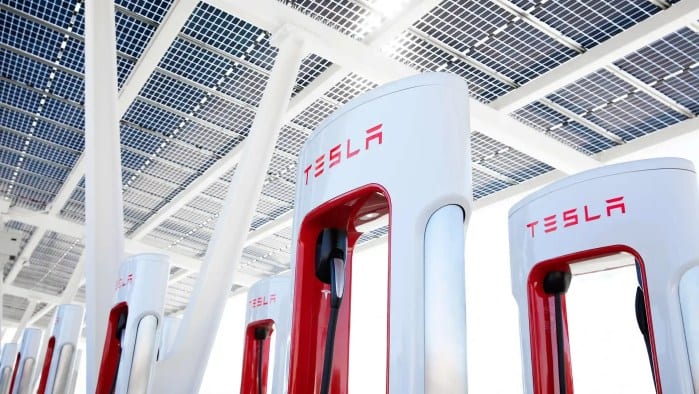
Tesla began participating in MyFirstEV on August 3 and confirmed that eligible Model 3 and Model Y inventory vehicles qualified for the full $3,500 rebate.
Having relocated its headquarters to Texas in 2021, Tesla qualifies for no MSRP waiver: its sub-$50,000 trims carry the rebate like any other brand’s vehicles, while higher-priced configurations and the Cybertruck sit outside the program.
The demand response was immediate.
As EV reported on Tuesday, Model 3 Rear-Wheel Drive delivery estimates stretched to January through March 2027 — up from four-to-five-week windows as recently as late July.
The $34,990 trim, the cheapest new Tesla on sale, showed the same five-to-seven-month wait regardless of delivery location.
Tesla has since confirmed on a support page that the MyFirstEV incentive is no longer available for its vehicles, indicating the brand’s allocation was exhausted within roughly 10 days.