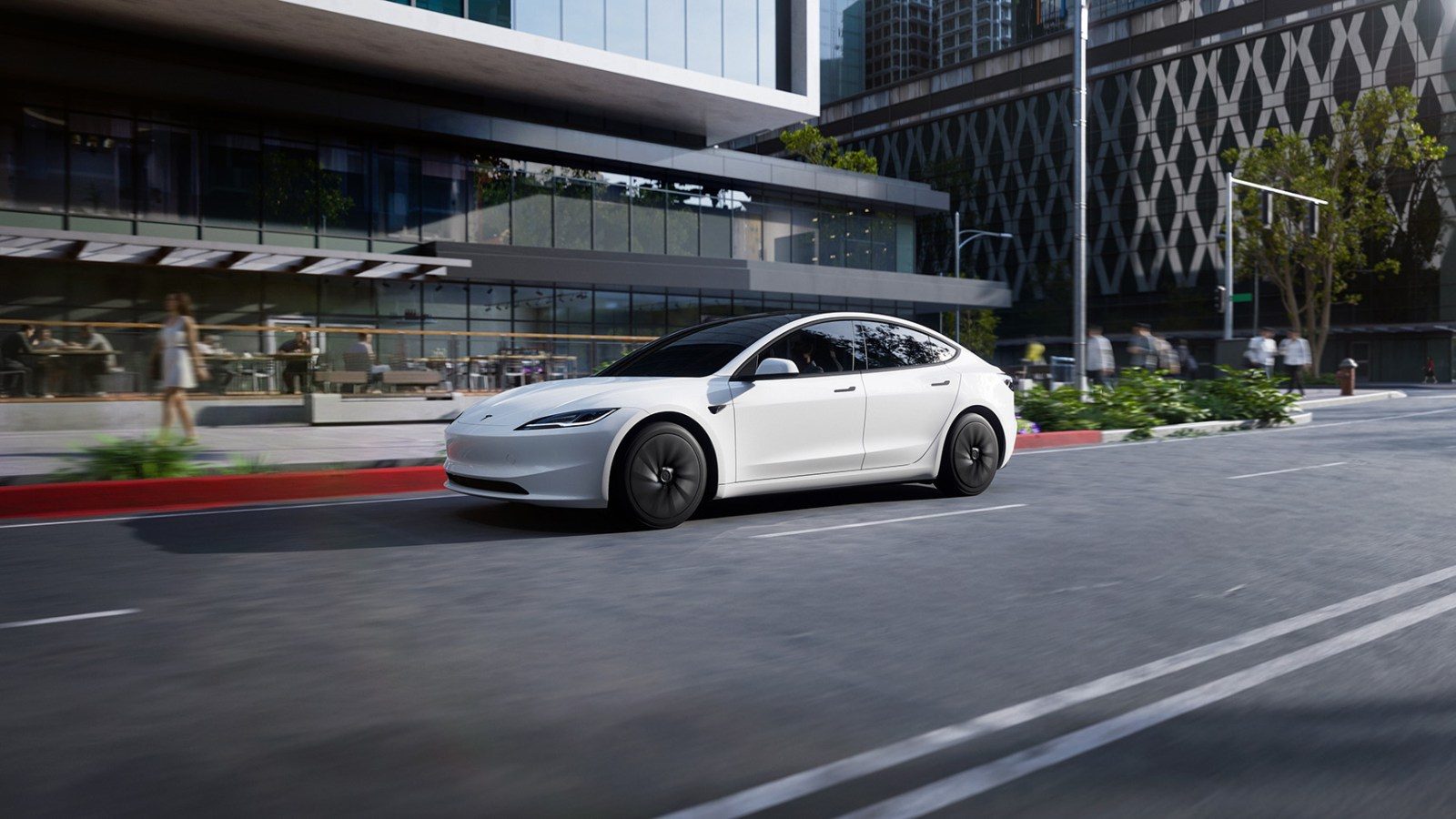

Tesla Model 3’s cheapest trim in the United States now carries a delivery window of January to March 2027, a dramatic extension from the four-to-five-week estimates shown on the company’s configurator as of late July.
The Model 3 Rear-Wheel Drive (RWD), priced from $34,990, displays the same five-to-seven-month wait whether a buyer selects New York, California or Texas as the delivery location, according to Tesla‘s website as of Wednesday.
Other Tesla trims have not experienced the same degree of backlog.
Premium Rear-Wheel Drive, All-Wheel Drive and Performance variants of the Model 3 show delivery windows around September or October 2026, with Model Y trims — including Standard ones — following a similar pattern.
California’s MyFirstEV Program
The timing of the Model 3 RWD backlog coincides with the launch of California’s MyFirstEV rebate program, a point-of-sale incentive signed into law by Governor Gavin Newsom on July 13 under Senate Bill 168.
The program offers first-time zero-emission vehicle buyers in California a $3,500 discount on new vehicles, split equally between the state and the participating automaker, with no income cap.
Used EVs qualify for a $1,750 rebate under the same structure.
The discount is applied instantly at purchase, with no application or reimbursement wait.
Tesla began participating on August 3 and confirmed that eligible Model 3 and Model Y inventory vehicles qualified for the full $3,500 rebate, provided the buyer placed an order on or after that date and took delivery while funds remained.
The company applied the rebate primarily to vehicles already in inventory rather than custom factory orders.
The funds did not last long, however.
Tesla shareholder and content creator Sawyer Merritt posted on X on August 8 that the allocation had been fully claimed.
“The program launched on August 3rd, so this means buyers used up all of Tesla’s allocated funds in just 4 days,” Merritt wrote, noting that 30% of the funds had still remained just 22 hours earlier.
California set aside $135.5 million in state funding for the program, split equally among roughly 15 participating automakers.
Each manufacturer matched its share dollar for dollar.
Tesla‘s allocation amounted to approximately $9 million in state funds and $9 million in matching company funds, for a combined total of roughly $18 million.
At the full $3,500 rebate level, that sum supported on the order of a few thousand vehicles before running out.
The specific number of vehicles supported by the incentive has not yet been revealed.
Price Cap
The program’s eligibility rules draw a distinction based on corporate headquarters.
California-headquartered EV-only manufacturers — specifically Rivian and Lucid — are exempt from the $50,000 base-MSRP cap that applies to other brands.
Because Tesla relocated its headquarters to Texas in 2021, the standard price ceiling applies.
The Model 3 Standard RWD at $34,990 and several Model Y configurations fall below the threshold, but higher-priced trims, along with the Cybertruck, do not qualify.
Once a manufacturer’s allocation is exhausted, no further MyFirstEV discounts are available on that brand’s vehicles even if the broader program retains funding for other automakers.
Tesla has confirmed on a support page that the incentive is no longer available for its vehicles.
Cheapest Tesla Attracts the Largest Wave
The concentration of demand on the Model 3 Standard RWD is consistent with its position as the most affordable new Tesla on sale.
At $34,990 before destination charges, the trim sits roughly $3,000 below the Model Y Standard RWD and more than $10,000 below the Model 3 Premium RWD.
For first-time EV buyers drawn to the MyFirstEV rebate, the entry-level sedan offered the lowest out-of-pocket cost of any new Tesla in inventory.
The pattern echoes what happened in Canada earlier this summer.
As previously reported by EV, estimated delivery dates for all three Tesla Model Y variants stretched to the final weeks of 2026 and into early 2027, driven by a combination of elevated order volumes and supply chain constraints tied to sourcing from GigaBerlin.
Buyers Now Come for FSD, Musk Says
The demand surge also aligns with a broader shift in purchase motivation that Chief Executive Officer Elon Musk described during Tesla‘s second-quarter 2026 earnings call on July 22.
“I think for a lot of people, they’re actually buying Tesla Full Self-Driving with a car attached, as opposed to a car with FSD,” he stated. “They’re coming into our stores in the US and saying they want the Full Self-Driving and with whatever car it comes with, essentially.”
For buyers entering the Tesla ecosystem for the first time through the Model 3 Standard RWD, the $99-per-month FSD subscription represents a low barrier to accessing the software that Musk has positioned as the company’s most important product.
Tesla eliminated the option to purchase FSD outright in February, channeling all new customers into the subscription model.
The company delivered 480,126 vehicles globally in the second quarter, which Musk called the company’s best-ever second-quarter result.
The Fremont factory builds every Model 3 sold in the United States and shares US Model Y production with Tesla’s plant in Texas.
Globally, the Model 3 is built in Fremont and Shanghai, while the Model Y is produced at four plants — Fremont, Austin, Shanghai and Berlin.