
Rivian‘s published timeline for Point-to-Point assisted driving is a limited rollout beginning later this year and a widespread customer rollout targeted for 2027.
That two-phase schedule first appeared on June 9, 2026, in a press release announcing R2 customer deliveries. It was repeated on August 14 in a blog post setting out the R2 autonomy roadmap.
Before June, the company and its chief executive had described the capability as arriving in 2026 without reference to phases.
The Record
In August 2025, Founder and chief executive RJ Scaringe told InsideEVs‘ Plugged-In Podcast: “But we’ve said is in 2026 we’ll be hands-free point-to-point. We’re going to show some of this at our autonomy day. Then we’ll increasingly start to allow eyes off.”
Four months later, at the inaugural Autonomy & AI Day held in December in Palo Alto, Scaringe described the capability from the stage.
“What that means is you can get into the vehicle at your house, plug in the address to where you’re going, and the vehicle will completely drive you there.”
He added that the next stage would let drivers look away: “This gives you your time back. You can be on your phone, or reading a book, no longer needing to be actively involved in the operation of vehicle.”
Rivian‘s press release from that day describes “a clear trajectory including point-to-point, eyes off and personal L4” for Gen 2 R1 and future R2 vehicles while attaching no date to point-to-point.
The only date in the release is for Autonomy+ itself, launching in early 2026 at $2,500 or $49.99 a month.
On June 9, amid the R2 delivery release introduced the phased rollout for the first time.
“This system brings L2+ hands-free assisted driving to 3.5 million miles of roads across the U.S. and Canada via Universal Hands-Free, with a limited rollout of Point-to-Point driving coming to R2 and R1 Gen 2 fleet later this year, followed by widespread rollout in 2027,” the company stated.
Two days later, at the Masters of Scale event in Anaheim, Scaringe said: “Later this year, we’ll have full supervised point-to-point, which will be very similar to Tesla’s FSD. And that’ll roll out to all of our Gen 2 vehicles and, of course, R2.”
On the second-quarter earnings call, held on July 30, Scaringe said development was on track. “Our autonomy development is on track, and we expect to begin rolling out point-to-point capabilities by the end of this year,” the founder stated.
Last Friday, in a R2 autonomy roadmap post, Rivian reaffirmed the phased rollout.
“Point-to-Point assisted driving is the next milestone we’re building toward,” the EV maker said. “Enter an address and supervise while your vehicle follows the route from start to finish, handling city streets, highway interchanges and everything in between. A limited rollout begins later this year, with a widespread customer rollout targeted for 2027.”
The August post is the first time Rivian has attached “eyes-on” to Point-to-Point in its own consumer copy, and the first time it has carried a definitional footnote.
The feature is “designed to assist in navigating your vehicle along a designated route — including turns, lane changes, and intersection maneuvers — under your continuous supervision.”
Autonomy+ Pricing
Autonomy+ costs $2,500 as a one-time purchase or $49.99 a month after a 60-day trial, and Point-to-Point is the next capability it is meant to unlock.
Rivian markets the one-time fee partly on resale, describing it as staying “attached to the vehicle, adding long-term value for future resale.”
Asked on the July call by Morgan Stanley’s Andrew Percoco about pricing as the company moves to point-to-point and then eyes-off, Scaringe said: “We certainly believe there’s opportunity to grow pricing for our autonomous capabilities as we add those capabilities.”
He added that any rise “needs to be earned through the expansion of the feature set and expansion of the capability,” and that the company had to be cognisant of market dynamics.
Rivian left the Autonomy+ price unchanged when it announced the 2027 R1 line on August 13, while raising every lease quote in the range by $100 a month.
Scaringe also told the call that the market would shift from treating autonomy as a nice-to-have to a must-have when eyes-off arrives: “When that happens, it’ll make it far easier to explain, far easier to see mass scale adoption.”
Eyes-off is targeted for 2027, and he told WIRED in June that it will not come to the current lineup and will require later hardware.
Recent Developments
Two changes shipped this month support the company’s claim that “the path from Universal Hands-Free to Point-to-Point is shorter than it looks from the outside, because so much of the work is already done.”
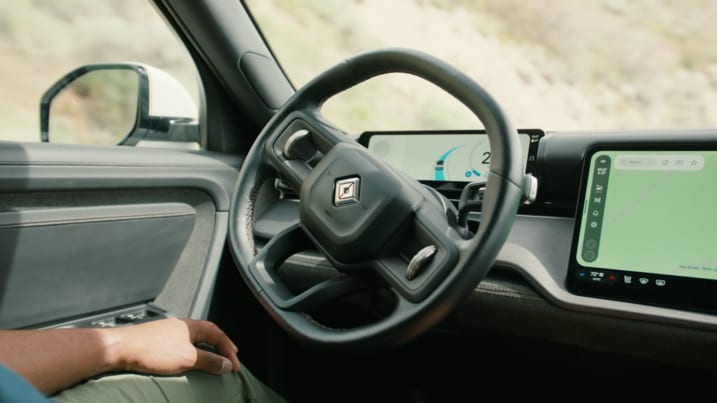
Lane Change on Command has moved beyond the highway and now works on any road where Universal Hands-Free is available. And the driver display renders traffic lights, stop signs and traffic cones in the Autonomy view.
The vehicle perceives them but does not act on them. Rivian‘s footnote still states that Universal Hands-Free will not stop or slow down for traffic lights or stop signs — the gap point-to-point has to close.
CFO Claire McDonough told analysts in July that a further Autonomy & AI Day is planned, focused on the technology roadmap, with a broader investor day under consideration.