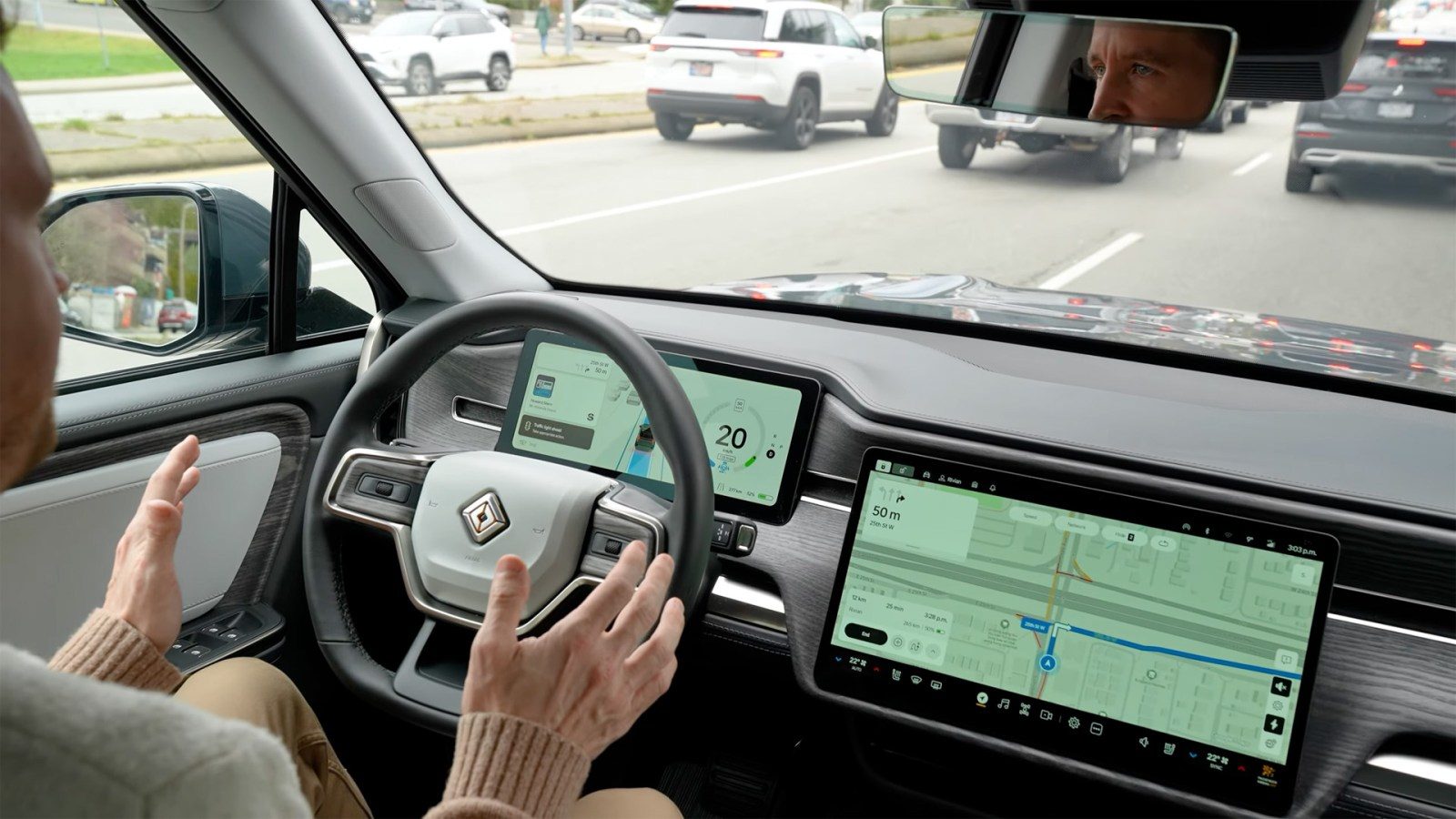

Rivian has left the price of its Autonomy+ driver assistance package unchanged at $2,500 across the 2027 model year R1T and R1S, holding a figure set in December 2025 and unmoved since the software went on sale.
The package carries the same one-time price on every configuration of both vehicles — Premium, Premium Long Range, Performance and Quad — according to the company’s configurator, which offers it after a 60-day trial.
Connect+, the connectivity subscription, remains $15 a month.
Founder and chief executive RJ Scaringe said two weeks ago that Rivian sees opportunity to raise pricing for its autonomous capabilities as those capabilities expand.
What Scaringe Said
On Rivian‘s second-quarter earnings call, Morgan Stanley analyst Andrew Percoco asked how the company was thinking about the pricing side and potential uplifts to average revenue per user as it moved to point-to-point driving and then eyes-off operation in 2027, and how it would enact those pricing changes over time.
“We certainly believe there’s opportunity to grow pricing for our autonomous capabilities as we add those capabilities,” Scaringe answered.
He immediately attached a condition to it: “We believe very deeply that needs to be earned through the expansion of the feature set and expansion of the capability.”
Scaringe then pointed to a second constraint, saying the company had to be cognizant of the market dynamics around autonomy pricing. The quotes match the full transcript published by Investing.com.
He also told analysts that take rates had trended positively since the paid launch and that further feature releases would drive continued increased uptake, without disclosing any figures.
By his own condition, then, the price rises when the features do.
The capability that would justify it is due within months. Scaringe said on the same call that point-to-point driving remains on track to begin rolling out to customers by the end of this year.
The feature allows the driver to enter a destination and the vehicle handles the journey from address to address, rather than only holding a lane once already underway.
He has described it as very similar to Tesla‘s Full Self-Driving, and said it will reach every second-generation R1T, R1S and R2. Beyond it sits eyes-off operation in 2027, which Scaringe has said will require later hardware than the current lineup carries.
The founder and CEO also told the call that Rivian‘s in-house RAP1 silicon was in final testing for a third-generation autonomy hardware launch scheduled for later this year.
No Price Movement
Autonomy+ was announced on December 11, 2025 at Rivian‘s first Autonomy and AI Day in Palo Alto, alongside a custom AI chip and the company’s Large Driving Model.
The pricing then was $2,500 as a one-time purchase or $49.99 a month — the latter described at the time as a starting figure.
Rivian began charging in April 2026.
The subscription has not moved either.
Rivian‘s autonomy page still lists $49.99 a month or $2,500 to purchase, with a 60-day trial included on all new R1 and R2 deliveries.
The gap with Tesla has widened in the meantime.
Tesla charged $8,000 for Full Self-Driving before ending the one-time purchase option in February and moving to subscription only at $99 a month — leaving Rivian selling outright a capability its largest rival will now only rent.
The Premium Is Temporary
The Q2 remarks were not the only signal on pricing this year, and the other one points the opposite way.
In an interview with WIRED published in June, Scaringe compared autonomy to airbags — a paid option once, standard equipment now, absorbed into the price of the car.
Asked by the magazine’s Jeremy White how long Rivian could charge so much for something rivals such as BYD were giving away free, he answered that the company can today, just as you could in 1991 on airbags, and that if you can, you should, if it supports building your business and your technology.
BYD bundles its God’s Eye driver assistance suite into its cars in China at no extra cost.
The two positions are compatible. Charge while the capability is rare, raise the price as the feature set grows, and accept that the window closes. But they make the $2,500 look less like a floor to build on than a number being held while it still holds.
What Buyers Get
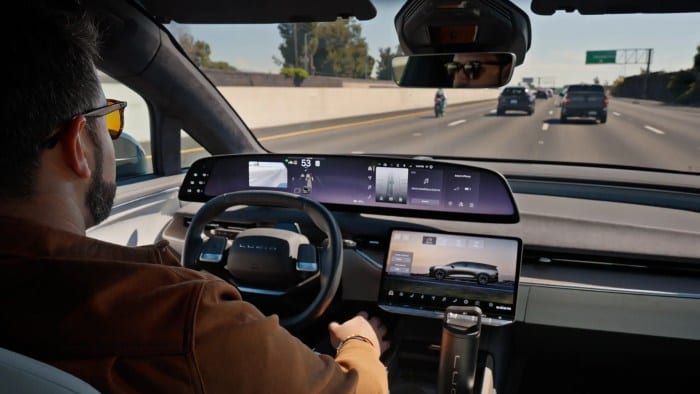
Rivian‘s own autonomy page lists two features behind the paywall today: Universal Hands-Free, which works on 3.5 million miles of roads in the US and Canada wherever lanes are clearly marked, and Lane Change on Command, which changes lanes when the driver signals.
Two more — Auto Parking and On-Ramp to Off-Ramp — are listed as coming in 2026.
Highway Assist, adaptive cruise control, Drive Styles and Co-steer ship as standard on new vehicles, along with the usual suite of warnings and automatic emergency braking.
The page also carries a limitation in its own footnotes: Universal Hands-Free will not stop or slow for traffic lights or stop signs.
The hardware behind it is ten high-dynamic-range cameras and five radars, perceiving objects up to 1,000 feet away, running on an onboard processor Rivian rates at 200 trillion operations per second.
Two terms attached to the one-time purchase matter for resale. Rivian says Autonomy+ features remain available for the lifetime of feature support for the hardware fitted at delivery, and that the upgrade stays with the vehicle when ownership transfers.
Buyers of the R2 Performance Launch Edition receive lifetime access included in the $57,990 price while the package is available.
What the $2,500 does not buy on a current R1 is the top of the roadmap.
Scaringe said in June that eyes-off and Level 4 capability will not come to the existing lineup and will require later hardware — which on Rivian‘s stated timeline means the third-generation autonomy platform arriving on R2.
Point-to-point driving, the feature Scaringe told analysts would begin reaching customers by the end of this year, does not appear on the company’s public autonomy page at all.
The only additions it lists for 2026 are Auto Parking and On-Ramp to Off-Ramp.
2027 Model Year EVs
Holding the software price does not mean Rivian held prices generally.
Sticker prices on the 2027 R1 are unchanged — $79,990 for the R1T Premium and $83,990 for the R1S — but every lease quote in the range rose by $100 a month, from $1,129 to $1,229 on the entry pickup through to $2,029 to $2,129 on the R1S Quad.
Across a 36-month term that is $3,600 on every configuration.
The $5,000 Power Upgrade and the $4,000 captain’s chairs option on the R1S Premium sit alongside it as paid additions.
Against a lineup where the financing cost went up across the board, the autonomy package is the line Rivian chose not to touch — in a year when Scaringe has said the vast majority of a $458 million first-quarter research and development budget went to autonomy, implying more than $229 million in that quarter alone.