
Rivian repeated its second-quarter guidance on the R2 ramp and its path to positive automotive gross profit without adding new operating numbers at Goldman Sachs’s Communacopia conference on Tuesday, and corrected a common reading of the $14 billion it cites for its funding.
“It’s not cash and available liquidity,” Chip Newcom, VP of Investor Relations, told Goldman Sachs Analyst Mark Delaney. “That’s cash and then the investments that we expect to receive, plus then our Department of Energy loan gets us up to the $14 billion.”
Rivian had $5.3 billion of cash and short-term investments at June 30.
The company raised about $1.3 billion in a July share sale, expects $1 billion of non-recourse debt from Volkswagen Group later this year and a further $250 million from Uber on a milestone due by year-end, and holds a $4.5 billion Department of Energy loan.
R2 Message
Newcom restated the R2 story from the July 30 earnings call.
Conversion from the $100 refundable reservations, which Rivian invites in waves to configure and order, shows “increasingly a very good conversion rate,” with each new trim, the Coastal Cloud interior “we just launched,” bringing more interest, according to the VP.
In July, founder and CEO RJ Scaringe had said conversion for the $57,990 Launch Edition was “meaningfully above expectations,” that 57,000 demo drives set a company record, and that most non-converters were waiting for the Premium trim due late 2026 at $53,990 or the Standard due in the first half of 2027 at $48,490.
The second shift at Normal is “still planning to add” in the third quarter, which has three weeks left.
Chief Operations Officer Javier Varela said in July its volume would show mainly in the fourth quarter.
Rivian guided in July to 65,000 to 70,000 deliveries in 2026, including 20,000 to 25,000 R2s, with second-half deliveries weighted to the fourth quarter.
The Margin Path
The cost sequence was restated.
About $100 million of incremental R2 ramp cost ran through cost of revenue in the second quarter, covering expedited freight, supplier premiums and unabsorbed expense.
More follows in the third quarter before the fourth “flipping the other way and being on our way towards achieving automotive gross profit positive on an exit rate basis for the year.”
Rivian has not given the volume needed. “It really is around continuing to see our supply chain mature,” Newcom said, so that the fixed cost of Normal’s paint shop and stamping press is shared “across R1, R2, and EDV.”
Asked whether the target assumes pricing or cost changes: “No, correct. It’s all about scaling and building more R2s.”
The 50% bill-of-materials reduction against R1 remains the target once R2 is fully ramped.
LG will begin supplying the R2’s 4695 cells from the United States “next year.” The cells were chosen for power density and because the structural pack needs fewer of them, which Newcom tied to the long-run cost of building R2.
No long-term EBITDA target replaces the 2027 breakeven goal Rivian withdrew in March when it signed the Uber deal, as EV reported. The drivers, Newcom said, are the speed of the R2 ramp, R2 demand and the trajectory of R&D and SG&A.
The Uber Economics
Newcom laid out the tranche structure more plainly than Rivian has before. Uber’s $1.25 billion is equity capital over several years.
The first $300 million, released on the first milestone in April, closed on May 4 with 19.55 million shares issued at $15.34, EV reported.
The second milestone unlocks $250 million “later this year.”
Three further milestones, tied to “an L4-capable R2 for the Robotaxi service” and expansion “to up to 25 markets around the world, including at least one in Europe,” release the final $700 million.
The vehicle commitment is unchanged at 10,000 R2 robotaxis for Uber or its fleet partners, with an option to negotiate 40,000 more from 2030.
Newcom pressed the point investors “miss”: once the cars run on Uber’s network, Rivian earns software licensing fees because “it is going to be Rivian’s driver that is going to be driving around.”
Asked to quantify the fee, he said Rivian has not.
Balance Sheet, VW, Europe
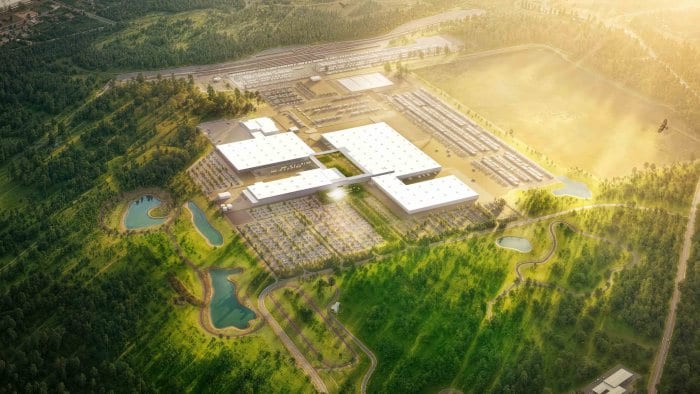
The July raise, Newcom said, was to fund equity commitments and reserves around the Georgia plant.
Rivian will “remain opportunistic should we need to raise additional capital” but has “a good line of sight for a significant amount of capital for the next good period of time.”
On Volkswagen, VW expects its first vehicle on Rivian’s zonal architecture and software next year, which unlocks VW’s last equity tranche.
Licensing the architecture to other carmakers is “a latent opportunity” behind executing on R2 and VW, and Scaringe “is talking with any number of other OEMs.”
On Europe, R2 and “even R3 eventually” would be “very well-priced” for the market, but “our focus right now remains on continuing to ramp here in North America first,” recognising “some very interesting vehicles coming into the European market.”
Fast Charging: Not Yet
Asked about cells that charge in three to five minutes, Newcom said most US owners charge overnight and current technology “can cover the vast majority” of road trips, describing a 15-to-20-minute stop as “a very nice and different way of approaching” one.
Vidya Rajagopalan, Senior VP of Electrical Hardware, compared it to LiDAR, which Rivian adopted on R2 only when “the price was right, and the form factor was right.”
The complexity of such cells “move to the BMS,” she said, “and I don’t think that’s easily a solvable problem.”