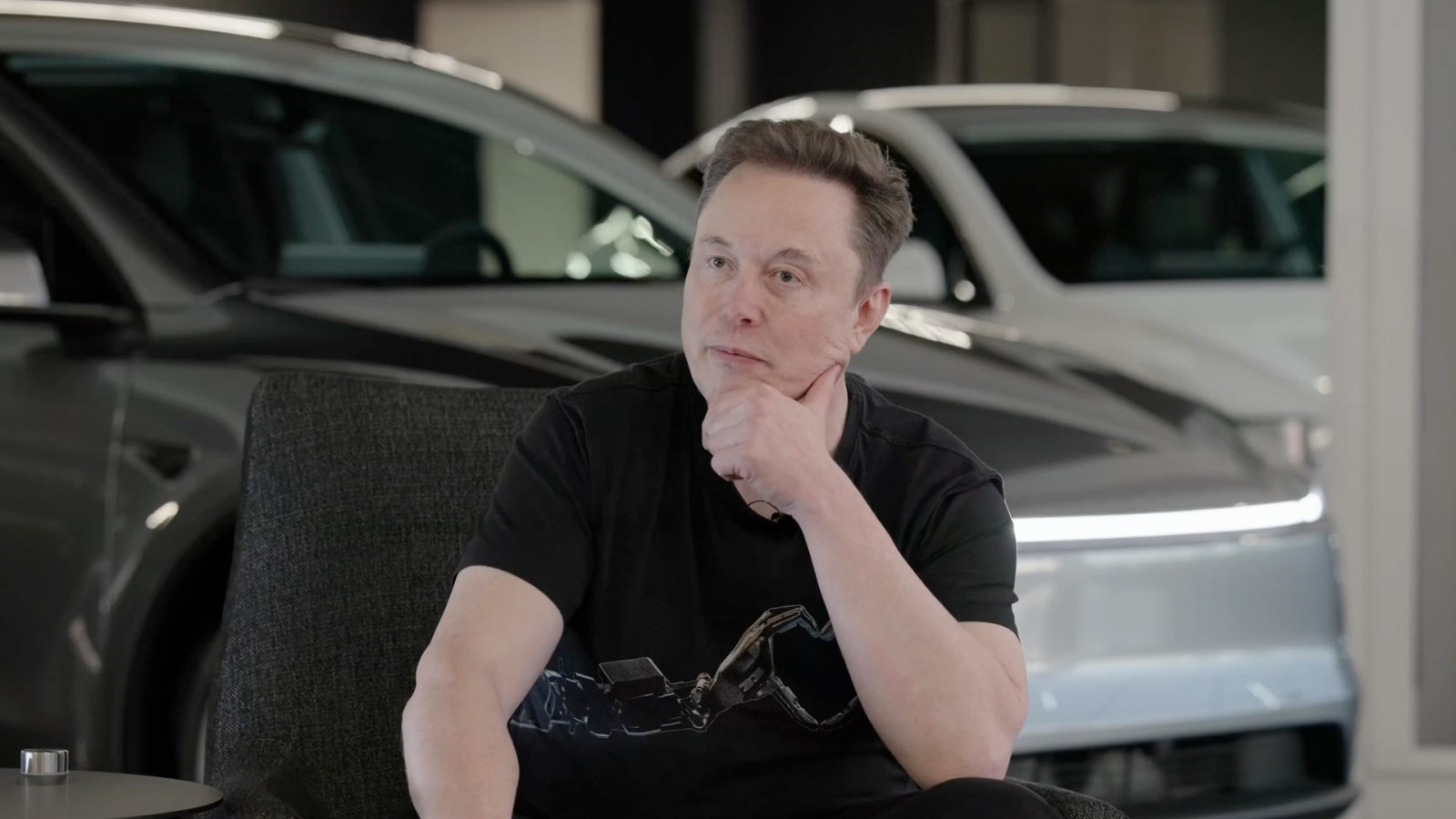
Tesla plans an autonomous version of the Model Y without a steering wheel or pedals for groups of six or seven people, Chief Executive Officer Elon Musk said on Wednesday.
Musk also said the company may move all Model Y production to the longer, six-seat Model Y L.
“I think we probably need to change all of the Model Y production to the Y L because it’s what most people seem to want,” Musk said in an interview with Andrew Ross Sorkin at The New York Times‘ DealBook Summit.
Musk joined by video amid his trip to Shenzhen, China.
Beyond the Two-Seat Cybercab
The remarks came after Sorkin said he had ordered a Model Y L for his family of five and asked whether Tesla would keep selling cars or make only Cybercabs.
“Certainly our most popular car,” Musk replied, referring to the Model Y L.
He said the two-seat Cybercab “seats 2 people, which covers 90% of all passenger miles,” but that “it’s going to make sense for us to make cars that can seat different amounts of people.”
“What we plan to do is have an autonomous version of Model Y that wouldn’t have steering wheels and pedals and would be good for transporting groups of six or seven people,” he said.
The average number of people in a car is 1.2, Musk said. “If you’ve got a whole family in the car, you still need autonomous vehicles for that.”
Musk gave no timeline for the vehicle and did not say whether it would be sold to customers, used in Tesla’s Robotaxi fleet or both.
Sorkin also raised the Cybertruck, which Tesla plans to stop building in 2027. Musk did not address it in his answer.
Removing the steering wheel from a Model Y is not a new idea for Musk. Wall Street Journal reporter Tim Higgins wrote in his 2021 book Power Play that Musk had pushed for the Model Y to launch without a steering wheel or pedals.
Model Y L
Tesla first launched the Model Y L in China on August 19, 2025, at 339,000 yuan (about $50,500) and began taking U.S. orders in July this year.
In South Korea it was the best-selling imported model in September, with 8,690 registrations, or 70.2% of Tesla’s total there, according to importers’ association KAIDA.
In the U.S., Tesla launched it as a single all-wheel-drive version priced at $61,990, with six seats in three rows and an EPA-rated range of 325 miles. The U.S. car is built at Tesla’s factory in Austin, Texas.
It is the most expensive Model Y in the U.S. lineup, $4,000 above the $57,990 Performance, after Tesla ended custom orders for its $41,990 all-wheel-drive version last week.
It is not offered in Canada, and Tesla’s Berlin plant does not build it.
A full switch would make the larger and more expensive version the core of Tesla’s best-selling line, which today runs from a cheaper Model Y Standard to Performance versions.
It would also mean retooling lines that build the five-seat car in Texas, California, Shanghai and Berlin, although Musk gave no sign that such a change had been decided.
Cybercab Ramp
Tesla unveiled the two-seat Cybercab, which has no steering wheel or pedals, at its “We, Robot” event in October 2024.
It opened Cybercab orders for personal use on November 13 at $29,990 plus a mandatory $299 monthly subscription, a fee Musk said was too high. Buyers must take delivery in one of five Texas cities where Tesla runs its Robotaxi service.
The company added about 200 Cybercabs to the Texas vehicle registry in a single day this week.
On Tuesday the registry listed 773 Tesla Cybercabs and 734 Model Ys, taking the total past 1,500. It also plans to spend about $3.3 billion on a new hall in Berlin that could build the vehicle.
In a letter to shareholders published the same day as Musk’s interview, Tesla said it had launched the Cybercab, “deploying fully autonomous vehicles without steering wheels or pedals in our Robotaxi fleet.”
The same letter said Tesla’s Full Self-Driving (Supervised) software had 1.74 million paid customers worldwide at the end of the third quarter, with about 75% of new vehicles delivered in North America sold with it.
Tesla’s AI software team is “primarily focused on real-world AI with the Tesla self-driving and with the Optimus robot,” Musk said in the interview.
SpaceX Merger
Musk was also asked about a possible combination of Tesla and SpaceX, which he also runs.
“You don’t need them to be together, but would they be better together? I mean, probably yes,” he said.
“This is not, let’s merge the companies no matter what,” Musk said.
He added that “these require shareholder votes, which may or may not succeed, at least in the case of Tesla.”
“Even for my shareholder vote for SpaceX, I have to represent other shareholders,” Musk said, adding that he would “obviously get sued” if he pushed them into a bad deal.
Tesla and SpaceX have each formed special committees of independent directors to weigh a merger, Musk said in October. He said then that a deal would need the support of 50% of all Tesla shares.
Sorkin said readers had asked whether Musk should still earn Tesla stock awards tied to operating goals if a merger happened.
“I don’t think I should be compensated with any kind of award just for doing a merger,” Musk said. “That would be unreasonable and not right.”
“You should keep your deals and stay true to your word,” he said. “I should only get those stock options for Tesla performance, not just because of a merger.”
Tesla shareholders approved Musk’s 2025 CEO Performance Award with 75% of votes cast, according to the company.
Musk is up for re-election to Tesla’s board at the company’s annual meeting on December 3, alongside Chair Robyn Denholm and Director JB Straubel. Tesla on Wednesday rejected calls by proxy advisers ISS and Glass Lewis to vote against Denholm.