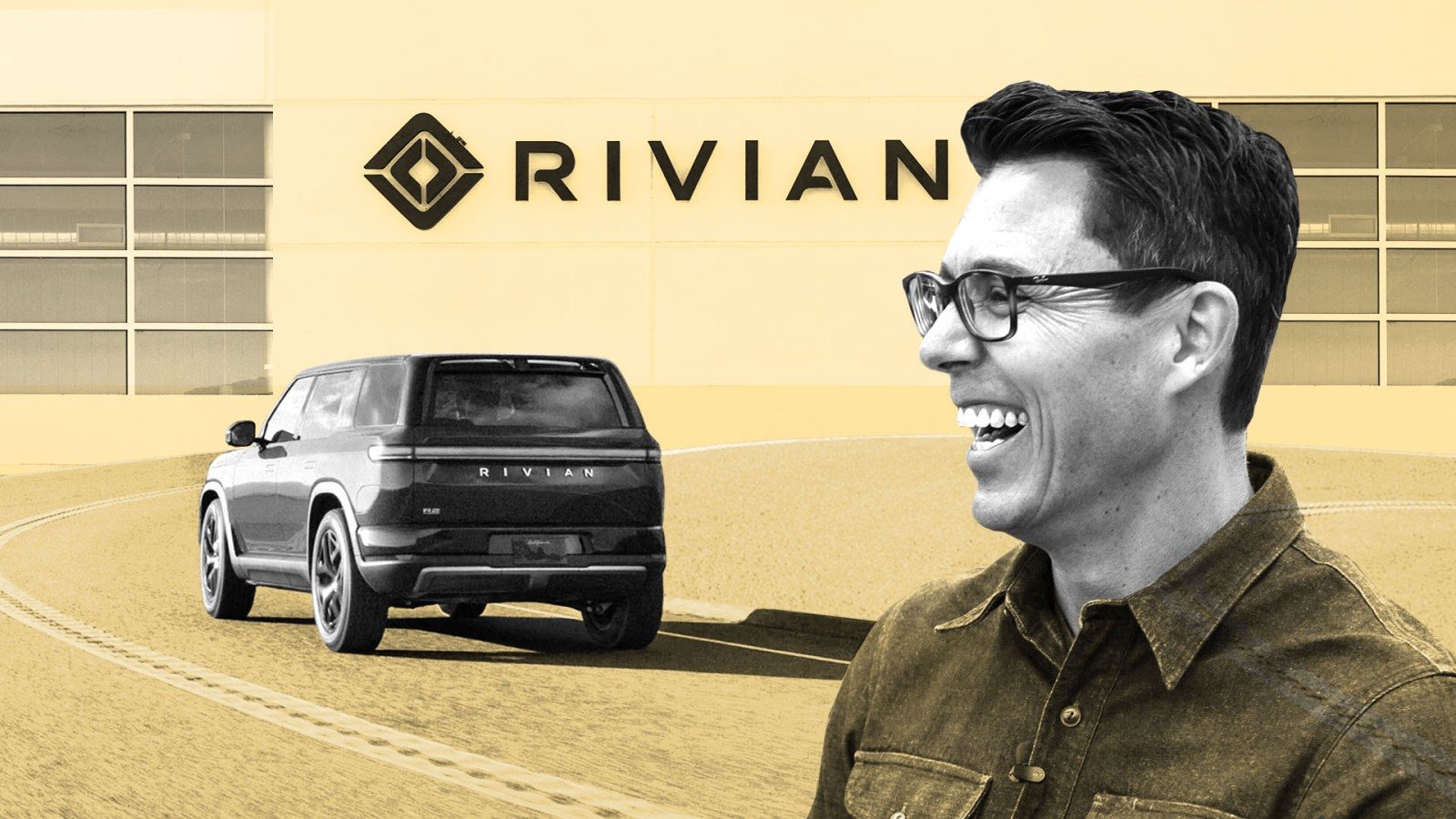

Rivian reported a second-quarter adjusted EBITDA loss of $379 million on Thursday, against a $472 million loss in the first quarter and a $667 million loss a year earlier.
The figures marked the smallest quarterly loss on that measure since the $329 million of the first quarter of 2025, as the EV maker improved its full-year loss and spending guidance — even as the cost of launching the R2 landed on the accounts for the first time.
Revenue came in at $1.658 billion, up 27.0% and just above the top of the $1.55 billion to $1.65 billion range the company pre-announced earlier this month, driven by a 14.0% increase in deliveries, $108 million of regulatory credit revenue and the software segment.
The company recognized approximately $100 million in incremental cost of revenues from ramping R2 production against normalized levels.
Gross profit reached $179 million at a 10.8% margin, from $119 million and 8.6% in the first quarter — a $385 million improvement on the year-earlier quarter’s $206 million gross loss.
The automotive segment posted a gross loss of $36 million, narrowed from $335 million a year earlier and $62 million in the first quarter.
The figures were helped by higher volumes, a $103 million increase in regulatory credit revenue and a tariff refund receivable booked under the International Emergency Economic Powers Act — the levies Rivian has sued the US government to recover in full.
Chief financial officer Claire McDonough had guided in April that the complexity of the R2 launch would weigh on automotive gross profit through the second and third quarters before turning to a benefit in the fourth.
Cash, cash equivalents and short-term investments stood at $5.310 billion at 30 June, in line with the $5.3 billion Rivian estimated earlier this month and up from $4.83 billion three months earlier.
The figures were lifted by the Volkswagen and Uber placements that closed in the quarter.
The Guidance
Rivian improved its full-year adjusted EBITDA guidance to a loss of $1.80 billion to $2.00 billion, a $50 million improvement at the midpoint that it attributed to better than expected regulatory credit revenue and rising delivery volumes, partially offset by increasing raw material, memory and logistics costs.
Capital expenditure guidance was cut by $250 million at the midpoint to $1.70 billion to $1.80 billion, on project efficiencies and timing of spend, while the delivery range of 65,000 to 70,000 vehicles stands as raised on 2 July from 62,000 to 67,000.
The half-year arithmetic gives the improved range a shape.
First-half adjusted EBITDA losses total $851 million, meaning even the better guidance implies losses of $949 million to $1.149 billion across the remaining two quarters — a deepening, not an improvement, as the R2 ramp costs build toward the second shift.
The delivery arithmetic is equally ambitious for the Irvine-based brand.
With 22,559 vehicles delivered across the first half, reaching 65,000 requires 42,441 in the remaining two quarters and reaching 70,000 requires 47,441 — between 21,220 and 23,720 a quarter, or 1.9 to 2.1 times the first-half quarterly average of 11,280.
Where the Volume Has to Come From
Second-quarter production reached 12,613 vehicles and deliveries 12,194, both disclosed on 2 July and ahead of the 9,000 to 11,000 the company had guided.
Cox Automotive figures imply roughly 789 R2 units reached US buyers in the quarter, against a full-year target of 20,000 to 25,000. The release again gives no R2 production or delivery figure, while reporting a company-record 57,000 demo drives in the quarter.
Commercial vans supplied 4,003 US registrations, up 48.0% year over year and 32.8% of group deliveries, in the segment where Amazon supplied 52.0% of automotive revenue in the first quarter.
Management has guided R1 and commercial van volumes to stay roughly in line with 2025’s 42,247 units.
Added to the stated R2 range of 20,000 to 25,000, that produces 62,000 to 67,000 — precisely the guidance Rivian abandoned in July. Reaching the new range on the same flat assumption would require R2 deliveries of 23,000 to 28,000, above the top of the published R2 figure.
The release does not say which of the two assumptions has moved.
The R2 Ramp
Chief executive RJ Scaringe called the R2 “a driver of Rivian’s long-term growth and profitability” and said the US market is starved for high-quality EV choice.
The release attributes the decline in average selling prices to a higher mix of commercial van and R2 deliveries — the first time the R2 has been named on that metric.
Normal runs a single shift, with a second planned for late 2026 and a third for 2027. Plant capacity is 215,000 vehicles a year including up to 155,000 R2s, and McDonough has described a target of profitably building 4,000 vehicles a week as the company’s “North Star.”
The release names no line rate or second-shift date; independent modeling put cumulative output near 3,900 at 27 July on a rate of roughly 600 a week.
Owner-logged vehicle identification numbers, the only public proxy, passed 5,000 on 28 July, though the pace of assignment slowed over the preceding two weeks from 4,100 on 15 July.
The launch has produced friction. Five separate quality issues surfaced in the first 47 days of customer deliveries, spanning paint, exterior lighting software, high-voltage battery hardware, charging equipment and cabin components.
A Half Moon Grey paint mismatch halted deliveries of that color, affecting roughly 800 orders, and transportation problemspushed some handovers into August.
An independent test this week found the R2 Performance covering 253 miles at a constant 70 mph against a 330-mile EPA rating.
The Funding Position
Rivian sold 86.25 million Class A shares in the July follow-on offering — the full base deal plus the exercised 11.25 million-share option — for net proceeds of approximately $1.317 billion, earmarked in part for equity contributions and reserves under the amended Department of Energy loan for the Georgia plant.
The stock fell between 14.0% and 18.0% when the deal was announced, its steepest drop in more than a year.
Total liquidity stood at $5.846 billion at quarter-end including the revolving credit facility, or $7.163 billion pro forma for the offering proceeds.
Rivian said its current liquidity and targeted future capital exceed $14 billion — a figure that folds in the $4.5 billion DOE facility and further conditional investments from Volkswagen Group and Uber.
The company expects $1 billion in non-recourse debt financing from Volkswagen later this year — the loan facility backed by Rivian‘s JV stake that becomes available in October — and an additional $250 million equity investment from Uber, both subject to conditions.
A final Volkswagen tranche of about $460 million remains tied to the start of production of the first Volkswagen model using the shared architecture.
Volkswagen became Rivian’s largest shareholder in May at 15.9%, displacing Amazon at 12.28%.
Free cash flow was a negative $849 million, against a negative $398 million a year earlier — a quarter flattered by deferred revenue from the first Volkswagen investment — and a negative $1.075 billion in the first quarter.
Capital expenditure fell to $362 million from $462 million a year earlier.
No Date for Profitability
Rivian withdrew its target of reaching positive adjusted EBITDA in 2027 in a filing on 19 March, citing higher research and development spending tied to its autonomy roadmap.
EV reported at the time that the reversal came five weeks after McDonough had reaffirmed the path to analysts. The release offers no replacement date.
Net loss narrowed to $837 million from $1.115 billion a year earlier, or $833 million attributable to common stockholders — a loss of $0.63 per share against $0.97, on a share count 14.7% higher at 1.325 billion weighted-average shares.
The comparison with the first quarter’s $416 million loss flatters that period, which carried a one-off gain of roughly $506 million from the Mind Robotics Series A deconsolidation.
Research and development expense rose to $466 million from $410 million a year earlier, driven by software spending on AI and autonomy initiatives and R2 launch payroll.
Selling, general and administrative expense rose to $549 million from $498 million on the expanding go-to-market footprint for the R2. The company’s accumulated deficit reached $28.2 billion at 30 June.
Software Is the Only Profitable Segment
Software and services revenue reached $515 million, up 37.0% year over year, and generated $215 million of gross profit at a 42.0% margin — more than the group’s entire gross profit, carrying the group while automotive lost money.
For the first time, Rivian disclosed the joint venture’s share: $308 million, or 60.0% of segment revenue, was attributable to the venture with Volkswagen Group, which has been expanding its leadership as attention shifts from the core architecture to the software layer above it.
Growth came from vehicle electrical architecture and software development services, repair and maintenance, and Autonomy+, offset by lower remarketing sales.