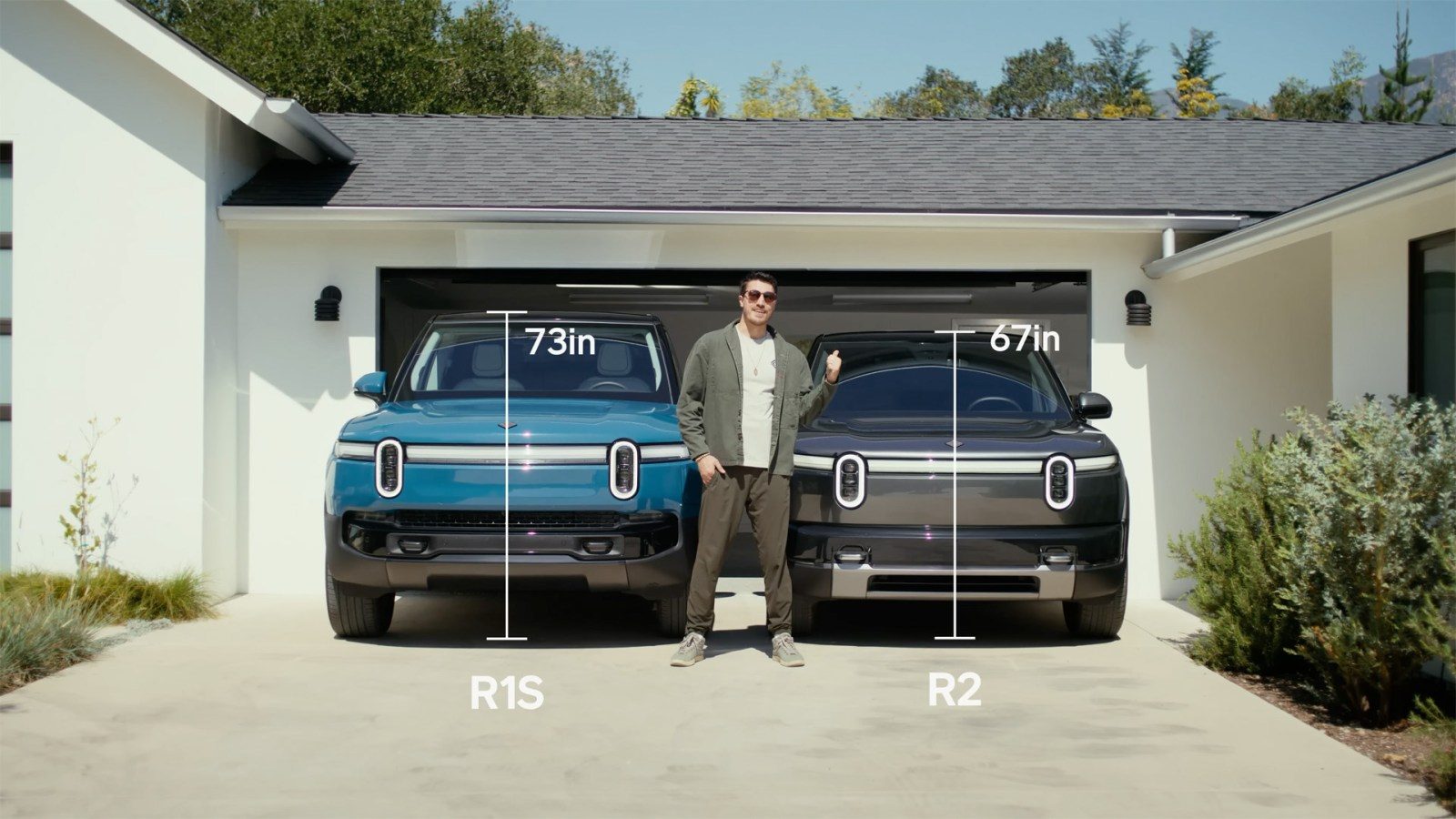

Rivian again declined to disclose how many R2s it built in the second quarter, leaving almost all of a 20,000-to-25,000 full-year target to the six months remaining.
The EV maker’s founder and CEO RJ Scaringe called the SUV “a driver of Rivian’s long-term growth and profitability” and the company reported more than 57,000 demo drives in the quarter, a record.
Cox Automotive figures imply about 789 units reached US buyers between April and June, after customer deliveries opened on 9 June — still the only volume proxy available.
Scaringe said the US market is “starved for high-quality EV choice” and described the R2 as an attractively priced option that will resonate with a broad set of consumers.
Shortly after Rivian published its second-quarter results, the shares were trading 1% higher at $17.02 in after-hours trading, after jumping 3.06% during the regular session.
The Arithmetic Is the Story
First-half deliveries totaled 22,559 across all three product lines.
The recently increased guidance of 65,000 to 70,000 requires between 42,441 and 47,441 vehicles in the second half — 21,220 to 23,720 a quarter, or 1.9 to 2.1 times the first-half quarterly average of 11,280.
A gap sits inside those numbers.
Management has previously guided R1 and commercial van volumes to stay roughly in line with 2025’s 42,247 units.
Added to the stated R2 range of 20,000 to 25,000, that gives 62,000 to 67,000 — exactly the guidance Rivian raised away from on 2 July.
Reaching the new range on the same flat assumption requires R2 deliveries of 23,000 to 28,000, above the top of the published R2 figure.
The company does not say which of the two assumptions has moved.
R2 Diluting ASP
Automotive segment revenue reached $1.143 billion, up 23% year over year, lifted by higher deliveries and a $103m increase in regulatory credit revenue — a reversal of the $100m decline Rivian reported in the first quarter.
The gains were partially offset by lower average selling prices, which the company attributed to a higher mix of commercial van and R2 deliveries.
The second quarter report marks the first time Rivian has named the R2 alongside the vans as a drag on the metric.
What Is Known About the Line
Saleable production began on 22 April, five days after an EF-1 tornado struck the south end of the Normal plant.
Scaringe said vehicles came off the line that morning and the ramp plan was unchanged. The R2 runs on a new manufacturing line at the facility.
Normal runs a single shift, with a second planned for late 2026 and a third for 2027. Plant capacity is 215,000 vehicles a year including up to 155,000 R2s, and chief financial officer Claire McDonough has described profitably building 4,000 vehicles a week as the company’s ‘North Star.’
The release names no line rate, weekly output, or second-shift date; independent modeling put cumulative output near 3,900 on 27 July at roughly 600 a week, with the second shift landing in October.
Owner-logged vehicle identification numbers remain the only public proxy. Assignments passed 5,000 on 28 July, after reaching 4,100 on 15 July and crossing 1,300 in the ten days following the delivery launch.
The pace has slowed markedly. The move from 4,100 to 5,000 took roughly two weeks, against a far steeper climb through the first half of July. VINs are assigned by build slot rather than order position, and in batches, so the count runs ahead of completed vehicles and a two-week reading can mislead on the line rate.
Non-Performance R2 units were photographed on the assembly line last week, the first evidence of build variety beyond the launch trim.
The Friction
Five separate quality issues surfaced in the first 47 days of customer deliveries, covering paint, exterior lighting software, high-voltage battery hardware, charging equipment and cabin components.
A Half Moon Grey paint mismatch halted deliveries of that color, affecting roughly 800 orders, and owners have reported handovers held over a high-voltage battery communications module with VINs clustering in the 2100s.
Transportation problems pushed some deliveries into August, with buyers switched to factory collection after rail delays.
EV exclusively reported this week that a person familiar with the matter attributes the inspection failures to the October 2025 restructuring that dismantled the teams owning pre-delivery inspection.
An independent test found the R2 Performance covering 253 miles at a constant 70 mph against a 330-mile rating. The release does not quantify any delivery impact from the issues, nor characterize them.
The Product Ladder
The Performance Launch Edition sells at $57,990 with 656 hp, 609 lb-ft, a 3.6-second 0-60 mph time and 4,400 lb of towing.
The Premium follows at $53,990 in late 2026, a Standard Long Range at $48,490 in early 2027 and a further Standard at $44,990 in summer 2027.
The Georgia plant at Stanton Springs, targeted for a 2028 start of production with first Department of Energy (DOE) loan advances expected in early 2027, is now described as adding up to 300,000 units of annual capacity for the R2, a future Robotaxi variant of R2, and upcoming models including R3.
Thursday’s release mark the first time Rivian has placed a robotaxi derivative of the SUV in its Georgia capacity plans, following the $1.25 billion robotaxi agreement with Uber announced in March.
Rivian showed the R3 and R3X at a design meeting in Irvine earlier this month, and saw the EPA documents revealing 2027 model-year R1S and R1T details this week.