Nio tested its China-trained driver-assistance model on Berlin streets earlier this year without adapting it for Europe, and aims to launch its driving system to other companies, including in Europe, its head of overseas assisted driving said in a keynote published last week.
Hezeng Wei, Nio’s Head of Overseas ADAS/AD in Europe, also said the company plans to bring its full-stack autonomous driving system, built around its in-house NX9031 chip, to its next-generation platform in overseas markets.
“It gives us a big confidence to bring this in the global markets,” Wei said of the Berlin results.
He gave the talk, titled “AI-Native Architecture for Global Autonomous Driving,” at AutoSens Europe, an industry conference on driver assistance and autonomous driving, in Barcelona on September 24, according to the event agenda.
Wei has worked at Nio since June 2021, first as Head of AD Software Delivery Europe and, since September 2024, as Lead of AD Europe, according to his LinkedIn profile. He previously developed driver-assistance systems for BMW at engineering firm Bertrandt.
One Model for Many Markets
Driving rules and habits in China and Europe differ, Wei said, citing how cars react to pedestrians crossing the road or at yield intersections. “Sometimes even they are contradicting to each other,” he said.
Under the older, rule-based approach, Nio had to “make one software for this market, one software for that market,” which required a lot of manpower to maintain, he said. “It’s very hard to keep one branch for all the global markets.”
An AI model that can reason, he argued, can cover “as many countries or as many regions as we can,” including situations it was never trained on.
The Berlin Test
To test that, Nio ran its Chinese software in Berlin “early this year,” Wei said, describing the city as one with “very complex traffic.”
Wei said the model handled scenarios similar to those in China and also showed what Nio calls “emergent behavior” in situations that do not exist in China, still finding “a proper way” through.
He then played a seven-minute video of the drive, titled “NIO World Model in Berlin.”
The video showed day and night footage from inside the car, including a stretch past the Brandenburg Gate, with on-screen labels such as “Consecutive Turns” and “Auto Bypass Hazard Vehicle.”
The positions of traffic lights, the geometry of intersections, construction zones and “even the German courtesy” are quite different from China, he said. “But as you see, it still can kindly tackle the driving task pretty well.”
“If we use the conventional approaches, we’ll take thousands or 10,000 coding rules to define how to react,” he said. “But for this, we just use the Chinese software.”
Wei did not say how many kilometers the test covered, whether a safety driver intervened, or which vehicle model was used.
The Nio World Model
The system at the center of the pitch is the Nio World Model, or NWM, which Nio first presented in July 2024 and has since rolled out to its cars in China. Wei said Nio has developed its driving software in-house since 2021 and moved its L2+ products to the world model approach from 2024.
A world model, Wei said, fuses camera, radar and other sensor data with map and navigation information into a single representation, and predicts how a scene could unfold in the near future.
Using the last 3 seconds of frames, the in-car computer can generate up to 2 minutes of video of possible futures, and within 200 milliseconds it can produce around 128 scenarios to pick the most likely one, Wei said.
Those figures differ from Nio’s own 2024 description of NWM, which said it simulated 216 possible scenarios in 100 milliseconds. Wei did not explain the difference.
Nio trains the driving policy on top of the model with reinforcement learning, which lets it target objectives such as safety, comfort or efficiency, Wei said.
With “over 1 million” vehicles on the road in China, Nio has enough data, plus its own tools to generate synthetic data for “the last 1% corner cases,” he said. Nio’s cumulative deliveries reached 1,024,774 by the end of January, the company said.
Wei also said Nio’s active safety features had convinced insurers in China “to reduce 30% of the insurance fee annually for the user.”
That claim goes further than Nio’s published figures, which describe accident losses rather than premiums.
Four Chinese insurers found that Nio users’ accident losses fell 38.4% in the first half of 2026, after a 25.2% reduction in 2024, Nio said in September, adding that passing those savings on to premiums would take time.
Nio has built a string of active safety features on top of NWM in China since 2024, including a general obstacle warning, automatic emergency braking, automatic emergency steering from January 2025 and rear-collision mitigation from May 2025, the company said in September.
It said the system was running on more than 950,000 vehicles and had helped avoid or mitigate more than 8.5 million accidents.
The NX9031 Chip
Hardware is the other half of the platform, Wei said. Nio unveiled its NX9031 chip in 2024, describing it as the industry’s first 5-nanometer chip for autonomous driving, with more than 50 billion transistors.
Wei said one NX9031 has computing power equivalent to four Nvidia Orin chips and was designed to meet the strict ASIL-D automotive functional-safety level.
The chip is installed in “more than 300,000” vehicles in China, across sensor setups with and without LiDAR and across high-end and low-end models, he said. Nio said in July that cumulative shipments of the chip had passed 300,000.
A higher-end version, the NX9031X, now powers the top trims of Nio’s family-focused Onvo brand, whose models were upgraded in the second quarter, according to Onvo’s head of brand marketing.
The L90 SUV of the sub-brand also carries the chip with the latest version of NWM.
Wei said Nio had delivered the chip in China “for more than two years without any accident.” The timeline is shorter than that. Nio’s ET9 sedan, the first model to carry the chip, launched in December 2024 with deliveries scheduled from March 2025.
“We are also aiming to bring this for the whole full-stack AD solution in our next-generation platform in the overseas markets,” Wei said. He did not give a timeline or name the models.
Selling to Other Carmakers
Nio also wants to supply the system to others. “As Nio AD, we also aiming to try to sell this solution for different companies, not only in China but also for Europe,” Wei said.
Nio has already moved its chip business into a separate company, Shenji, which it spun off in June 2025.
Shenji raised more than 2.2 billion yuan ($330 million) in its first funding round, signed in February, from investors including IDG Capital and Hefei state funds.
Shenji and Chinese chip designer Axera have developed a chip called the M97 for other carmakers and have approached companies including Geely and Leapmotor about supply, according to the same report.
The M97 has more than 700 TOPS of computing power and is positioned against Horizon Robotics’ J6P. Axera said in its Hong Kong listing prospectus that the chip would launch in the third quarter of this year, and Axera holds 36.4% of the joint venture that will ship it, according to the report.
Shenji’s first funding round valued the company at close to 10 billion yuan ($1.5 billion) after the investment, IT Home reported earlier this year.
He acknowledged a knowledge gap in Europe despite Nio’s local team in Berlin, and said Nio wants to work with European partners on safety frameworks and compliance, combining “the Chinese rapid iteration” with European expertise.
Nio’s European Position
Nio opened a Smart Driving Technology Center in Schönefeld, near Berlin, in April 2024, its first outside China, to develop driver-assistance systems for European users.
The center supports Nio’s Berlin Innovation Center, which opened in 2023, and was led by Mirko Reuter, Nio’s Senior Director of Autonomous Driving, the company said at the opening.
Reuter said then that he expected the center “to become NIO’s future hub for all smart and digital development in Europe.” The executive has since left the company.
Nio also lists research and development sites in Munich, Oxford and Budapest.
Nio’s European drivers still use a much simpler system. Nio’s latest European software update, released this month, tuned emergency braking and its Pilot Assist feature, but did not bring NWM-based features to Europe.
Its European sales remain small. Nio Inc. registered 171 vehicles across eight European markets in October, down from 238 in September.
Nio was founded 12 years ago and opened a design office in Munich a decade ago.
It launched in Norway in 2021 with its first-generation SUV and expanded to Germany, the Netherlands, Sweden and Denmark the following year with its second-generation platform.
Nio founder and CEO William Li said in October that the next phase of autonomous driving would be decided by whether users pay for it and whether they can feel it is safer than human driving.
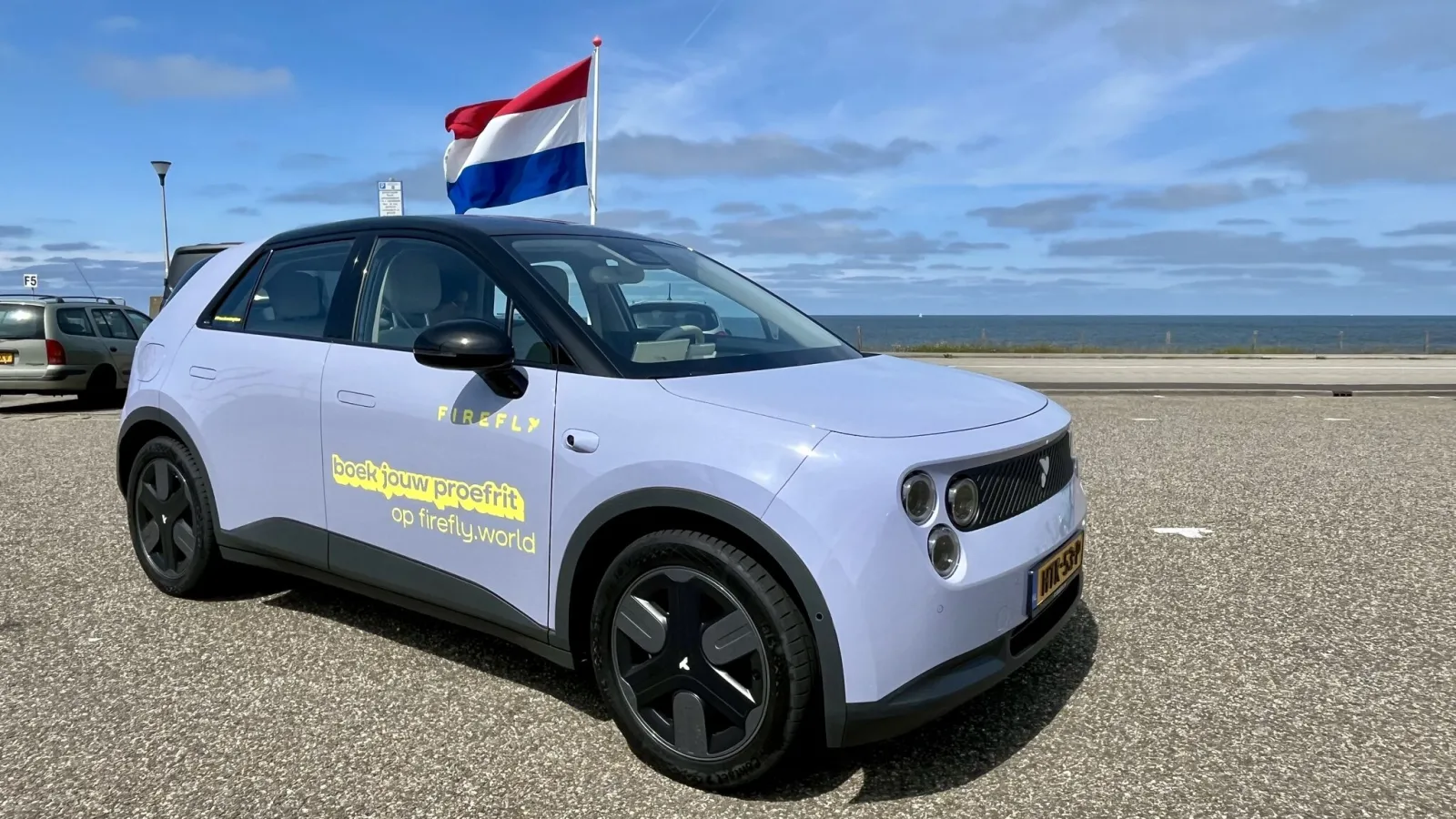
Its small-car brand Firefly has scheduled a European reveal for November 20.