
Einride said on Monday it will build its next-generation autonomous driving system on NVIDIA‘s Drive Hyperion platform, a collaboration that extends what NVIDIA describes as a production-ready compute and sensor reference architecture for Level 4 autonomy into heavy-duty freight.
The Nasdaq-listed Swedish freight technology company will adapt Hyperion’s compute, sensor, software and safety systems for the demands of large trucks, working directly with NVIDIA. Einride said the work would accelerate its push into highway and suburban autonomous trucking.
Einride designs, builds and operates its autonomous driving stack end-to-end. NVIDIA provides the underlying compute platform and AI development tools.
“We have the customers, the operational experience and the technology,” Henrik Green, Einride’s Chief Technology Officer, said. “Building the next generation of the Einride Driver on the NVIDIA Hyperion platform will enable us to scale autonomous deployment across a freight network that’s already serving customers today.”
Rishi Dhall, NVIDIA’s Vice President of Automotive, called autonomous trucking “one of the clearest opportunities to improve the safety and efficiency of global freight.”
Einride’s shares rose about 8.6% before the open.
What the Deal Covers
Drive Hyperion is Nvidia’s production-ready reference architecture for Level 4 autonomy, combining a standardized sensor suite, high-performance compute and a full software stack.
Automakers including BYD, Geely and Nissan adopted the platform for passenger-vehicle programs at Nvidia’s GTC 2026 conference in March.
Einride’s collaboration extends Hyperion into commercial freight under a direct partnership with the chipmaker.
Alongside Hyperion, Einride will integrate Nvidia’s Halos safety system, which provides functional safety validation tools.
Einride is also using Nvidia Cosmos, a platform that lets autonomous vehicle developers search and curate camera data to identify complex edge cases and generate photorealistic synthetic driving scenarios for AI training.
Cosmos allows Einride to augment real-world data with synthetic scenarios that increase the diversity of its training and validation sets — a technique that reduces the need for physical test miles.
Einride plans to deploy Nvidia Blackwell architecture at scale through an Nvidia Exemplar Cloud partner, a cloud provider whose infrastructure Nvidia has validated for large-scale AI training performance, to train, test and refine its autonomous driving models.
Nvidia’s compute infrastructure supports Einride’s own proprietary stack rather than replacing any part of the driving system.
Neither company disclosed financial terms or a timeline for when the Hyperion-based system will enter production deployment.
Einride’s Freight Network
Einride operates hundreds of electric trucks for shippers across the United States, Europe and the Middle East, including autonomous trucks in contracted customer deployments.
The release does not say how many of those are autonomous, and the company’s reporting suggests they are a small fraction of the fleet. Customers include Amazon, PepsiCo and Heineken.
The company expects its fleet to reach 1,500 to 2,000 vehicles by 2028, based on customer demand captured on its platform, the size of fleet at which it has said it expects to reach cash-flow breakeven. About 80% of that demand is suitable for automation in the medium term, according to Einride’s own estimate.
Einride runs two business lines, freight capacity as a service and a software platform built on its Saga AI system, which the company said had logged 18.5 million electric miles and more than 5,400 driverless autonomous hours by the end of June.
The company listed on Nasdaq under the ticker ENRD on June 10 after completing a merger with Legato Merger Corp. III at a pre-money equity value of $1.35 billion, cut from $1.8 billion when the deal was announced. An oversubscribed $113 million PIPE backed the transaction, with investors including Stockholm-based EQT Ventures.
The shares more than doubled on the first day and closed their first week at $9.39, a market value of about $1.3 billion.
At listing, Einride reported about $92 million of annual recurring revenue from signed contracts and about $49 million in run-rate operating revenue. First-half revenue rose 26% at constant currency to $27 million, and it has guided second-half growth of 60% to 73%.
A Concentrated Stretch
The Nvidia collaboration caps several weeks of announcements.
In August, Einride ordered 500 Tesla Semi trucks for deployment across North America over 24 months — the largest publicly announced order for the Class 8 electric truck and about triple the size of Einride’s then-deployed fleet of around 200 heavy-duty electric vehicles.
Deployment began in September on Amazon freight corridors in California, Texas, New Jersey, Illinois and Georgia.
Those Tesla Semis are conventional cab-equipped trucks with human drivers.
Einride also agreed with DAF, part of PACCAR, to integrate the Einride Driver onto DAF’s premium electric trucks, with interface testing this year and integration on DAF vehicles in 2027, according to its earnings call.
That is the first commitment of Einride’s stack to a conventional cab truck from a major manufacturer, and it is the programme most likely to meet the “highway and suburban” ambition in Monday’s release.
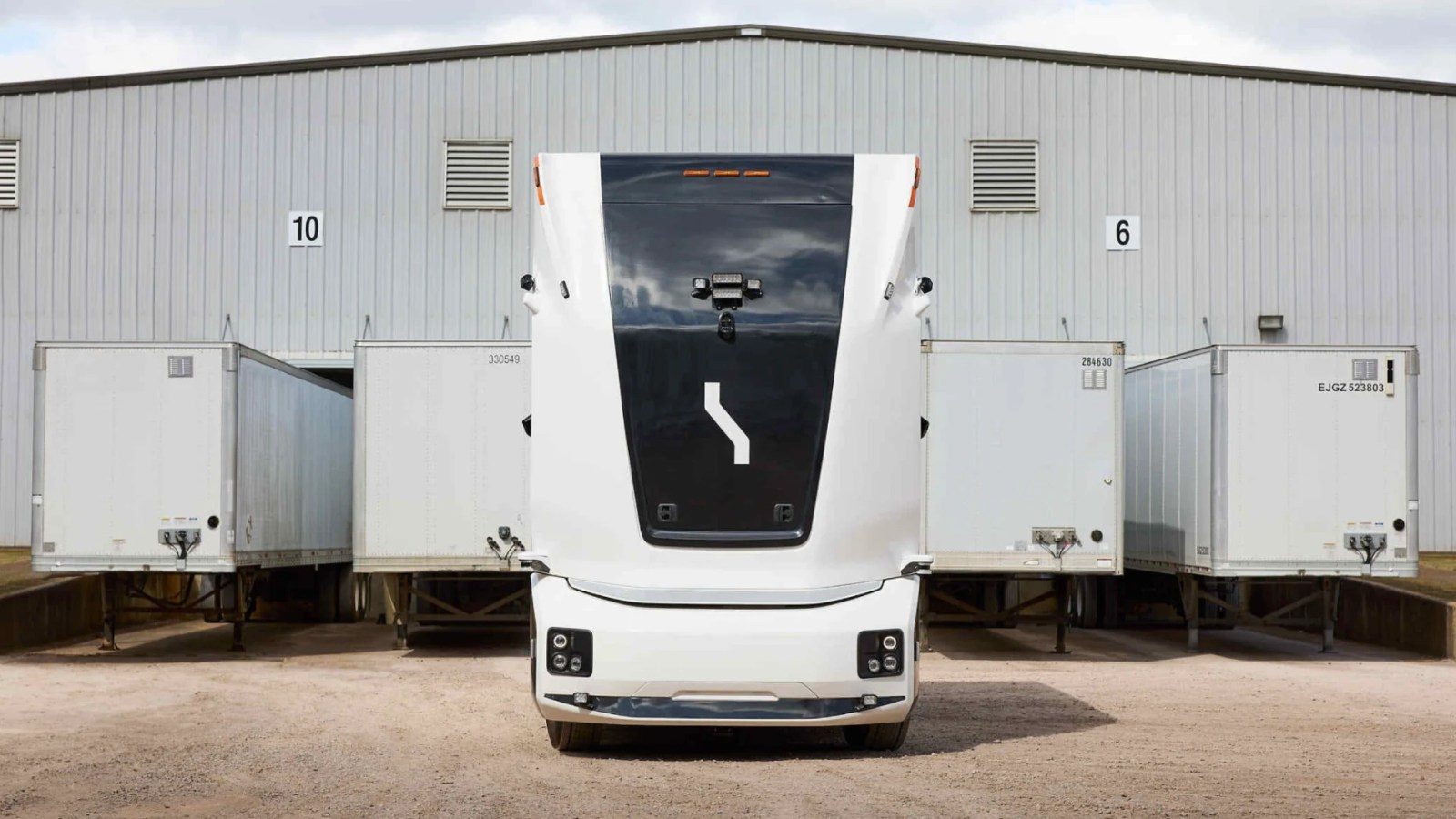
Six days before the Nvidia announcement, Einride and Lidl put the first cab-less SAE Level 4 autonomous truck into daily logistics operations on a public road in Germany, running between a distribution centre and a store in Edermünde, Hesse.
No driver or safety operator rides on board.
The Federal Motor Transport Authority granted the operating permit — the first authorization of its kind in the country — on August 14.
Lidl and Einride have worked together since 2017.
In late August, the two nearly doubled their Swedish freight contract from 474,000 to 832,000 kilometres a year.
Broader Context
Einride’s announcement brings a platform NVIDIA markets for Level 4 vehicles into heavy freight, a segment where payloads are heavier and braking distances longer, and where the industry’s case for removing the driver rests on labour cost and driver shortages.
Competitors in autonomous trucking include Aurora Innovation and Kodiak AI, both publicly listed. Aurora launched its commercial driverless trucking service between Dallas and Houston in 2025.
Einride’s dual approach — running human-driven electric fleets at commercial scale while developing cab-less autonomous vehicles in parallel — differentiates the company from pure-play autonomy developers that have no revenue-generating freight operations.
Germany’s Level 4 freight permit for the Lidl route and Einride’s contracted deployments in the United States represent the two operating domains where the Hyperion-based system will need to perform.