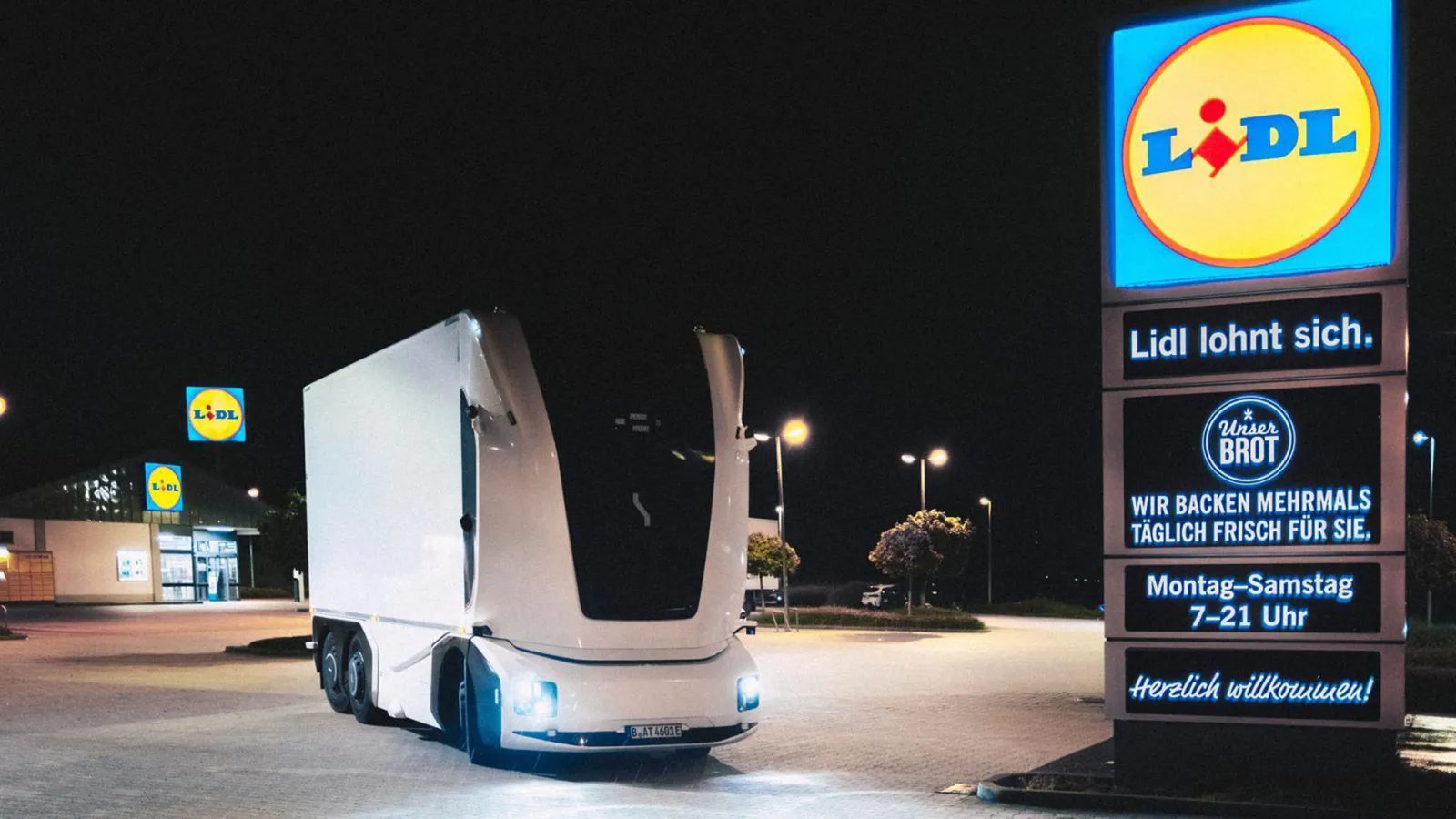

Einride and Lidl put the first cab-less SAE Level 4 autonomous truck into daily logistics operations on a public road in Germany, the companies said on Tuesday.
No driver or safety operator rides on board. The route is about 400 metres and the permit caps the truck at 25 kilometres an hour.
A car with a driver must follow the autonomous truck, German outlet Handelsblatt reported, describing it as a condition imposed by the KBA for the pilot.
A local operator in a separate vehicle also handles loading and unloading during the first phase. Neither company mentions the escort vehicle in its announcement.
The electric truck runs between a Lidl warehouse and distribution centre and a Lidl store in Edermünde, Hesse, under an operating permit from the Federal Motor Transport Authority (KBA) — the first authorization of its kind granted in the country.
Einride, a Nasdaq-listed Swedish freight technology company, builds cab-less electric trucks reported to carry nine cameras, six radars and four LiDAR units.
A contract manufacturer in the Netherlands assembles the vehicles.
Lidl, a discount grocery chain with more than 3,250 stores and 39 distribution centres in Germany, is part of Schwarz Group, which describes itself as Europe’s largest retailer and reported €185.6 billion of sales in fiscal 2025.
Germany is the world’s third-largest economy and the largest road transport market in Europe.
Achieving a Level 4 operating permit under its regulatory framework — widely described as among the world’s strictest — sets a benchmark for what autonomous freight technology can clear commercially.
The KBA did not issue a standalone public statement on the permit. Einride and Lidl are the primary sources for the announcement.
What the Permit Allows
Germany structured its Level 4 framework through a 2021 amendment to the Road Traffic Act, known as the Act on Autonomous Driving, and a 2022 ordinance called the AFGBV that details approval and operating rules for autonomous vehicles inside defined, geo-fenced zones.
Under these rules, the vehicle must handle the full dynamic driving task independently within the approved domain and bring itself to a safe stop if it reaches its operational limits or encounters a fault.
No human is required to take over the wheel while the system operates inside the approved area.
Approval is split across two levels.
The KBA issues a national operating permit for the vehicle and its autonomous driving function after reviewing the manufacturer’s safety concept, functional safety evidence, a cybersecurity assessment verified with the federal IT security office (BSI) and a catalogue of test scenarios.
State authorities separately approve the specific operating area.
Each vehicle type and each route requires its own clearance — there is no blanket authorisation for a technology class, and the permit does not allow cross-border operation.
The KBA entry recorded for the project was granted on 14 August 2026 and runs until at least 28 February 2027, according to Electrive, which found it on the authority’s published list of trial approvals.
Einride and Lidl describe the clearance as an operating permit for daily logistics.
A designated natural person must serve as remote technical supervisor.
This person monitors the system, can approve certain proposed manoeuvres in edge cases and can deactivate the autonomous function, but cannot remotely drive the vehicle on the public-road route.
Reports indicate the remote operator can move the truck at up to about 6 kilometres an hour for docking or narrow-edge situations. It is not established whether that function is remote assistance under the AFGBV, which covers approving manoeuvres and deactivating the system, or remote driving, which Germany governs under a separate ordinance.
Liability sits primarily with the vehicle keeper under German rules, though the AFGBV and the Road Traffic Act divide duties between manufacturer, keeper and technical supervisor.
Earlier autonomous truck programmes on German roads operated under a different category.
The ATLAS-L4 project using MAN trucks on motorways from 2024 ran on testing permits that still required an onboard safety driver.
Deutsche Bahn and Mobileye launched Level 4 autonomous passenger shuttle rides in towns near Frankfurt using Nio ES8 vehicles under the KIRA programme, but those also carried a safety driver on board.
Einride and Lidl say their deployment moves into the category of regular daily logistics under the Level 4 operating rules — not a test, and not supervised from inside the vehicle.
Route and Operations
The route links the Lidl distribution centre at Lange Heideteile 1 to a store at Lange Heideteile 11, on the same street. German reporting puts the distance at about 400 metres, or a quarter of a mile.
Each trip carries up to 15 Euro pallets.
The truck makes up to three runs a day, covering the full dry-goods delivery on that segment.
An initial phase of four months is planned, with an expected throughput of more than 3,000 pallets.
Einride and Lidl said they plan to expand the route toward a full multi-stop delivery network — a milkrun model — and are discussing further deployments across other divisions of Schwarz Group, which also includes supermarket chain Kaufland, recycling arm PreZero and digital unit Schwarz Digits.
Both companies framed the initiative as addressing commercial driver shortages and strengthening supply-chain resilience across Lidl’s network.
“Einride is already running real autonomous deliveries, with real volumes on real schedules with customers in the US and Europe,” CEO Roozbeh Charli stated. “Germany’s approval process is among the toughest in the world, and obtaining clearance there gives us a foundation to scale with confidence.”
Thomas Dangelmayer, head of operational logistics at Lidl in Germany, said the company is testing the technology “step by step and safely in real-world operations to examine how future-proof solutions can be optimally integrated into our site logistics.”
Einride’s Electric Trucking
Einride operates across two business lines: freight-capacity-as-a-service and a software-as-a-service platform built on its Saga AI system, which the company reported had powered 18.5 million electric miles as of June 2026, across seven years of commercial operations.
Customers include Amazon, PepsiCo and Heineken.
In August, the company ordered 500 Tesla Semi trucks for deployment across North America over 24 months — the largest publicly announced order for the Class 8 electric truck and about triple the size of Einride’s then-deployed fleet of around 200 heavy-duty electric vehicles.
Deployment began in September on Amazon freight corridors in California, Texas, New Jersey, Illinois and Georgia.
Tesla is separately pushing into European trucking, having shown a European-specification Semi at IAA Transportation in Hannover this week and begun selling Megacharger and Basecharger hardware in five European markets.
The German deployment uses Einride’s own cab-less autonomous vehicle — a fundamentally different machine from the Tesla Semi, which has a cab and a human driver.
Autonomous trucking and electrification are converging across Europe. The companies describe this as the first cab-less vehicle running daily retail logistics on a German public road under an operating permit rather than a trial permit with an onboard safety driver, which is the distinction that separates it from ATLAS-L4 and KIRA.
The Relationship Is Not New
Lidl and Einride have worked together since 2017, when Lidl tested Einride’s first T-Pod prototype in Sweden, with electric freight running around Stockholm since 2020.
In late August, the two nearly doubled their Swedish contract, from 474,000 to 832,000 kilometres a year, extending it across Värmland, Östergötland, Mälardalen, Dalarna and parts of Västergötland and Småland.
The German vehicle is a new legal step rather than a new relationship.
Broader European Context
Europe’s autonomous driving regulatory landscape is evolving on multiple fronts. Pony.ai and Rimac-backed Verne began driverless robotaxi test rides without a safety operator in Zagreb this month.
The European Commission has said it will prioritise regulatory frameworks for autonomous vehicles, including hub-to-hub freight use cases in 2026.
Germany’s approach remains deliberately incremental and location-specific. Expanding the route or adding a new operating area requires fresh or amended approvals.
The initial segment in Edermünde is short and low-complexity compared with open highway or mixed urban traffic — consistent with how German regulators have structured Level 4 roll-out.
Christian Hirte, parliamentary state secretary at the Federal Ministry of Transport, said the project demonstrated that Germany can align climate goals with economic competitiveness and technological sovereignty.