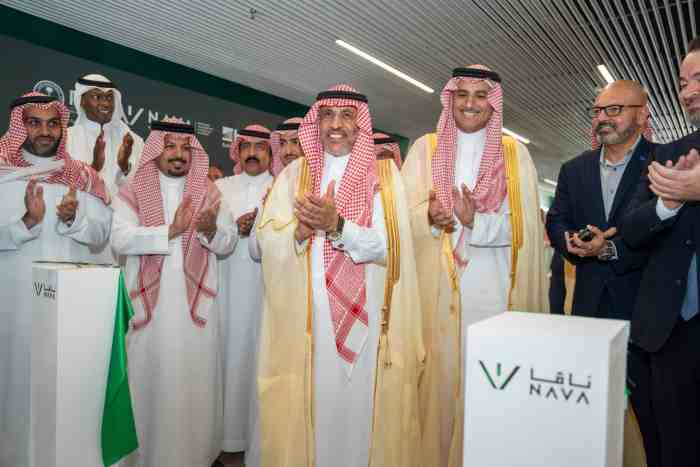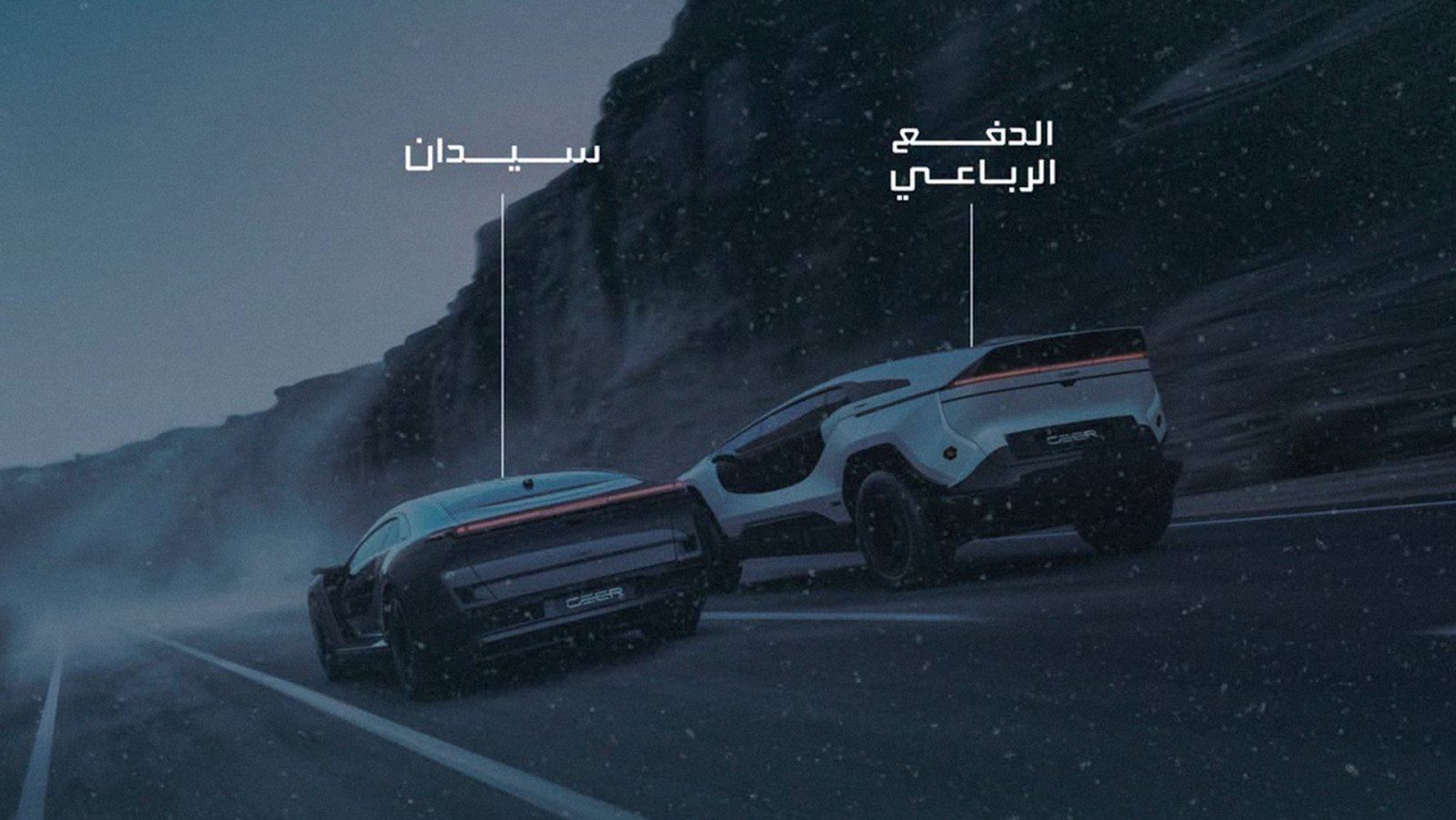

Crown Prince Mohammed bin Salman unveiled Ceer‘s first EVs on Monday, a sedan and an SUV sold under the name Exobot, nearly four years after he launched the Saudi electric-vehicle brand with a promise of cars on the market by 2025.
Ceer, which the Public Investment Fund (PIF) created with Foxconn in 2022, gave no price, range, battery supplier, performance figures, production date or ordering details in its announcement.
It did not publish specifications for either model.
“The launch of CEER’s first vehicles represents another step forward in Saudi Arabia’s progression to build a sustainable and prosperous industrial ecosystem,” the Crown Prince, who is also Prime Minister and Chairman of PIF, said in a statement published on Ceer’s website.
“It further enables the automotive sector as a key driver of economic growth, through attracting investments, empowering national talent, and expanding the private sector’s role to further position Saudi Arabia to become a leading regional and global hub for this industry,” the Crown Prince added.
The reveal came on the date Ceer set on September 11, two days before Saudi National Day and a year to the day after the company launched its brand identity and said its flagship designs were “finalized and soon to be revealed.”
What Ceer Said
The company described the two cars as “designed, engineered, and manufactured in Saudi Arabia,” with a design “inspired by Saudi Arabia’s landscape, rooted in its culture, and reflective of its vision.”
Series production has not started, and the same statement says the cars will be manufactured at its plant.
Design Director Rob Melville, formerly of McLaren, has previously described a design language drawn from Najdi architecture, Red Sea coral and Sadu weaving.
The sedan and SUV are the first of seven models Ceer plans to launch over the next five years, which it said will include “midsize and compact vehicles with various propulsion options to serve different customer needs.”
Ceer has described itself since 2022 as Saudi Arabia’s first electric-vehicle brand, and the statement does not say whether “various propulsion options” means different electric drivetrains or powertrains other than battery-electric.
All models will be built at the Ceer Manufacturing Complex in King Abdullah Economic City, part of what the Saudi Press Agency’s Arabic release calls the King Salman Automotive Cluster, which Ceer called “the largest automotive production facility in the Middle East.”
What It Left Out
The statement does not restate the fourth-quarter production start Ceer has given since 2025, most recently in January when it said the Dürr paint-shop contract kept the plant on schedule.
It does not say when customers can order, and no ordering channel has opened.
It also does not name the partners Ceer has said it depends on. BMW licenses component technology to the company, Foxconn develops the electrical architecture, Hyundai Transys supplies integrated drive units under a SAR 8.2 billion ($2.2 billion) ten-year contract signed in June 2024, and Rimac Technology supplies high-performance drive systems for the flagship versions.
The economic projections are unchanged in value but narrower in one respect.
Ceer repeated that by 2034 it expects to contribute $8 billion (SAR 30 billion) to gross domestic product and $21 billion (SAR 80 billion) to the trade balance.
It said only that it would “create quality direct and indirect jobs,” dropping the figure of about 30,000 that it gave in its reveal-date release of September 11 and at its 2022 launch.
Four Years From Launch
The Crown Prince announced Ceer on November 3, 2022, when the company said its first cars would reach the market in 2025. Ground was broken on the $1.3 billion plant in March 2024.
The site covers more than one million square metres, with 530,000 under roof.
Ceer said this month it had grown from 20 employees to 2,300. It signed SAR 5.5 billion ($1.5 billion) of supplier agreements in February 2025, more than 80% with Saudi companies, and a further SAR 3.7 billion ($1 billion) across 16 agreements this February, targeting 45% local content by 2034.
Since then it has signed a memorandum with SABIC on July 21 to explore the use of the chemical group’s materials in its cars, and two agreements on August 4 with the Local Content and Government Procurement Authority, placing its vehicles on the mandatory list of national products in exchange for localisation and knowledge-transfer commitments that the authority valued at SAR 9 billion in economic impact.
That listing matters for sales. Inclusion on the national-products list gives Ceer preference in government procurement, which positions the state as a likely early customer before a retail price has been set.
The Kingdom’s Wider Bet
Ceer is one of three PIF-linked vehicle projects at King Abdullah Economic City. Lucid, in which PIF holds about 60%, assembles EVs there from kits, and a PIF-Hyundai plant is also due to start production this year.
The Ministry of Investment has set a sector target of 500,000 electric vehicles produced a year by 2030.