Nio Inc.‘s founder and CEO William Li said at an industry conference on Friday that the company still plans to add 1,000 battery swap stations in China this year — despite the slower-than-expected rollout so far.
“Battery-swap stations — we’ll build them, no hesitation,” Li stated during the 4th Future Auto Pioneers Conference in Shenzhen. “This year we’ll add another 1,000, resolutely.”
Li placed swap station deployment in the same category as investment in chips, operating systems, batteries, and other core technologies — areas he said Nio would continue to fund aggressively while cutting back elsewhere in the business.
“Resolute investment in technology R&D, and resolute investment in swap stations,” he said, noting that “that way our company’s returns, the value to users, and our competitive advantage all improve.”
Li first set the 1,000-station target in a New Year’s Day letter to staff, alongside a year-end network goal of more than 4,600 stations globally.
The founder reiterated the target in March and again during the ES9 launch livestream earlier this month, where he adjusted the year-end range to between 4,500 and 4,600 stations and outlined plans to add approximately 1,000 stations annually through 2028.
Nio opened its first battery swap station in Shenzhen in June 2018.
The network has since logged more than 110 million cumulative swaps.
According to management, more than 1,000 stations are now positioned along highways in China, and nine provincial-level regions have achieved full county-level swap coverage.
William Li indicated full nationwide county coverage is approximately two years away, with exceptions for remote areas of Xinjiang and Tibet.
Slow Rollout
Nio ended 2025 with 3,676 battery swap stations in China.
As of Friday, the network stood at 3,873 stations, which indicates that the company has added 197 stations since January 1 — a pace of roughly 39 per month.
With five months elapsed, Nio needs to add 803 more stations between June and December to reach the 1,000-unit target.
The target requires an average of approximately 115 new openings per month across the remaining seven months.
Global Output
According to the company’s most recent annual report filed with the U.S. Securities and Exchange Commission, the global station count at year-end 2025 stood at 3,737, reflecting 60 stations in Europe and one in the Yas Marina, in the UAE.
The European count has stagnated last year amid investment cuts in the continent’s operations.
As exclusively reported by EV, the Shanghai-based EV maker closed one of its European stations — located in Denmark — late last year, for the first time since rolling out the technology in Europe.
Nio‘s European management said this week that no new swap stations will be added in the region, meaning all 2026 deployments will likely take place in China.
Second Half Back-Loaded
Earlier this year, Nio said the bulk of this year’s openings will come in the second half, tied to the rollout of its fifth-generation battery swap stations.
According to deployment plans reported in April, Nio intends to open more than 100 stations per month from September, rising to more than 150 per month from October through December — a fourth-quarter total of around 450 stations.
The fifth-generation rollout plans have, however, slipped repeatedly.
Nio originally targeted a pilot before Christmas 2025, then revised to the first quarter of 2026, then the second, and most recently to July or August for mass deployment.
A pioneer batch of five to ten stations is expected to be installed between June and early July.
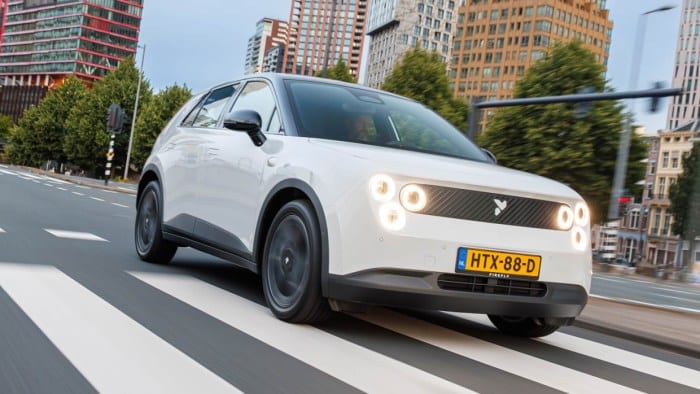
Firefly vehicles have already been spotted testing the new stations.
The sub-brand began rolling out version 1.5.0 of its Aster operating system earlier this month, which added a battery-swap station compatibility function, as the first battery swaps are scheduled for late June.
The fifth-generation stations are the first in Nio’s network compatible with vehicles from outside the group — a prerequisite for the company’s battery-swap alliance with eight external automakers to produce results.
Earlier this year, however, management clarified the company is now prioritizing expansion for its own brands rather than continuing to build the previously announced battery swap alliance.
Where Nio Is Cutting Back
At the same conference, Li described a broad tightening of product development spending, drawing a distinction between investment in core technology and spending at the application layer.
Models that are not expected to be profitable will not be developed, he said.
“Cars that clearly won’t make money — we simply stop developing them,” Li stated. “More models aren’t necessarily better.”
According to the CEO, Nio would not develop an MPV, citing the ES9 as sufficient coverage of that segment — an idea he’s been reiterating for the past months.
Range-extender and plug-in hybrid variants are also off the table, he said, as are certain model configurations intended for international markets.
R&D in chips, operating systems, batteries, advanced materials, vehicle lightweighting, and new architectures will continue at full scale, he said.