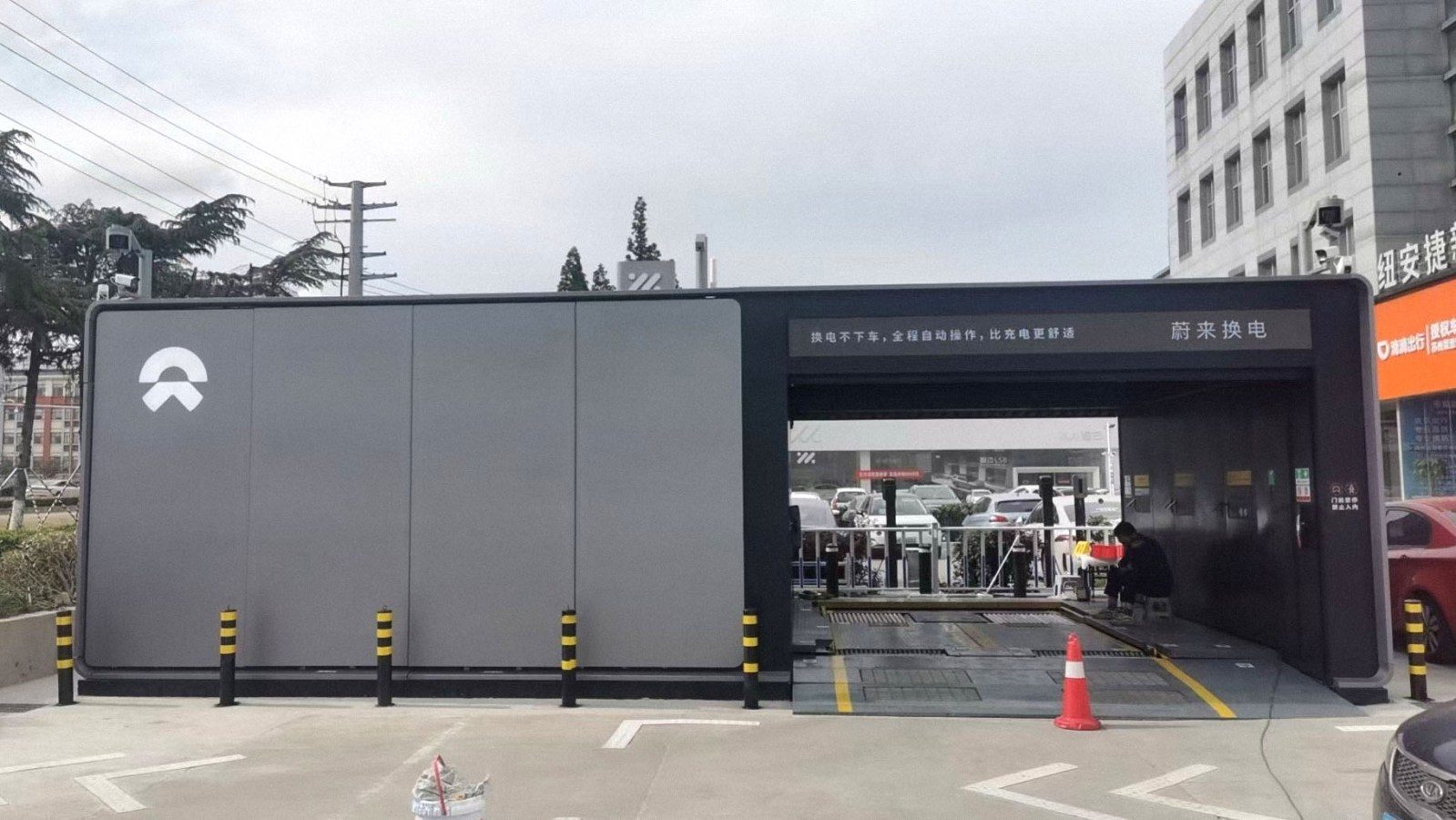

Shanghai-based EV maker Nio has begun deploying its fifth-generation battery swap stations — with the first unit now installed in Kunshan, Jiangsu Province.
The information was revealed by Weibo user ‘德卤爱开车’ on Thursday, who said the station is currently undergoing debugging and internal testing.
“The main visual changes are to the station’s exterior shell panels, and the swap bay dimensions have likely changed as well,” the user wrote.
Dimensions and slot capacity are also expected to have increased over the fourth-generation model.
The Kunshan installation appears to be the first physical deployment of the hardware that Nio has been developing for more than a year.
Initial deployment across China will feature pioneer stations, with the official ramp-up scheduled for the third quarter.
The milestone comes after repeated delays to the fifth-generation timeline.
Nio first targeted a pilot run before Christmas 2025, then revised it to the first quarter of 2026, then the second quarter.
In March, founder and CEO William Li pushed mass deployment to July or August, attributing the slippage to a fundamental redesign of the station’s architecture to support a far wider range of vehicle wheelbases.
Pioneer Stations and Ramp-Up
Nio had previously disclosed plans to deploy five to 10 pioneer stations between May and June for trial operations, with the nationwide rollout set to begin in August.
Thursday’s sighting in Kunshan tracks with that timeline, with the station still in its testing phase ahead of opening to users.
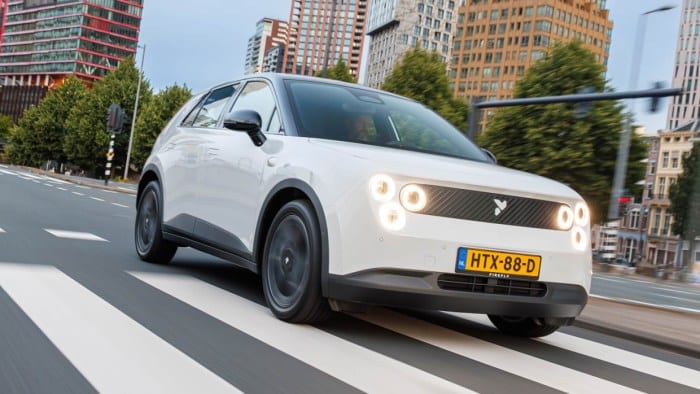
The sub-brand Firefly confirmed in March that battery swap integration would begin in May, coinciding with the pioneer station openings.
From August onward, Nio plans to deploy over 100 stations per month, rising to over 150 stations per month from October through December.
The monthly figures imply that roughly 450 stations are set to be deployed in the fourth quarter alone — nearly half the full-year target in a single quarter.
Gen-5 Stations
The fifth-generation stations represent a fundamental redesign of Nio‘s swap infrastructure.
The current fourth-generation system, deployed since June 2024, can store up to 23 batteries and complete a swap in under three minutes, but only supports the Nio and Onvo brands.
The new stations are being designed from the ground up to accommodate all three Nio Inc. brands — the namesake Nio brand, the family-oriented Onvo, and the compact Firefly — from a single piece of infrastructure.
That includes support for battery packs ranging from Firefly’s 42.1 kWh unit to Nio‘s 150 kWh pack, bridging a gap that the fourth generation could not handle.
On Thursday, Firefly began rolling out version 1.5.0 of its Aster OS in China, which includes the battery swap station parking assist function required for Firefly vehicles to use the fifth-generation stations.
The stations will also be the first ones compatible with EVs from external brands that have joined Nio‘s battery swap alliance, which now includes eight automakers — though none have yet launched a compatible vehicle more than two years after the first agreement was signed.
Nio‘s management has recently sidelined the alliance, however.
“In the short term, we will not treat whether third-party companies use our battery swap network as a priority — it is not our strategic focus,” CEO William Li said in late April.
Network Scale and Targets
Nio‘s swap network is the largest globally.
As of Thursday, the company operated 3,846 battery swap stations in China, having added 170 since the start of the year.
The EV maker has provided more than 110 million battery swaps since opening its first station in Shenzhen in 2018.
Li has guided to a year-end total of between 4,500 and 4,600 stations, a range that would imply between roughly 654 and 754 additional stations over the remainder of the year.
The CEO has also committed to adding approximately 1,000 stations annually through 2028.
Much of the 2026 deployment is expected to be heavily back-loaded, with the pace of construction set to accelerate sharply once fifth-generation mass deployment begins in the third quarter.
The company added only 681 stations in 2025 — well below its initial target of 1,800 to 2,000 — after Li acknowledged that deployment of fourth-generation stations had slowed because they could not be upgraded to support the range of battery sizes now used across the group.
Competitive Landscape
The deployment comes amid intensifying competition in China’s battery infrastructure space.
CATL, the world’s largest battery maker and Nio‘s primary cell supplier, launched its competing “Choco Swap” standard in December 2024.
The system was designed for cross-brand compatibility from the start and had 1,020 stations deployed by the end of 2025, with CATL raising its 2026 target to over 3,000.
BYD, meanwhile, has taken a different approach entirely.
The Chinese giant unveiled a 1,500-kilowatt charging system capable of refilling a battery from 10% to 97% in nine minutes, positioning ultra-fast charging as a direct alternative to battery swapping.
Li has doubled down on the technology, arguing that battery swapping is not just about speed but also about decoupling the car from its battery — addressing the issue of EVs having different lifespans for the vehicle and the pack.
He has described it as a systematic solution that also enables grid participation and vehicle-to-grid integration.