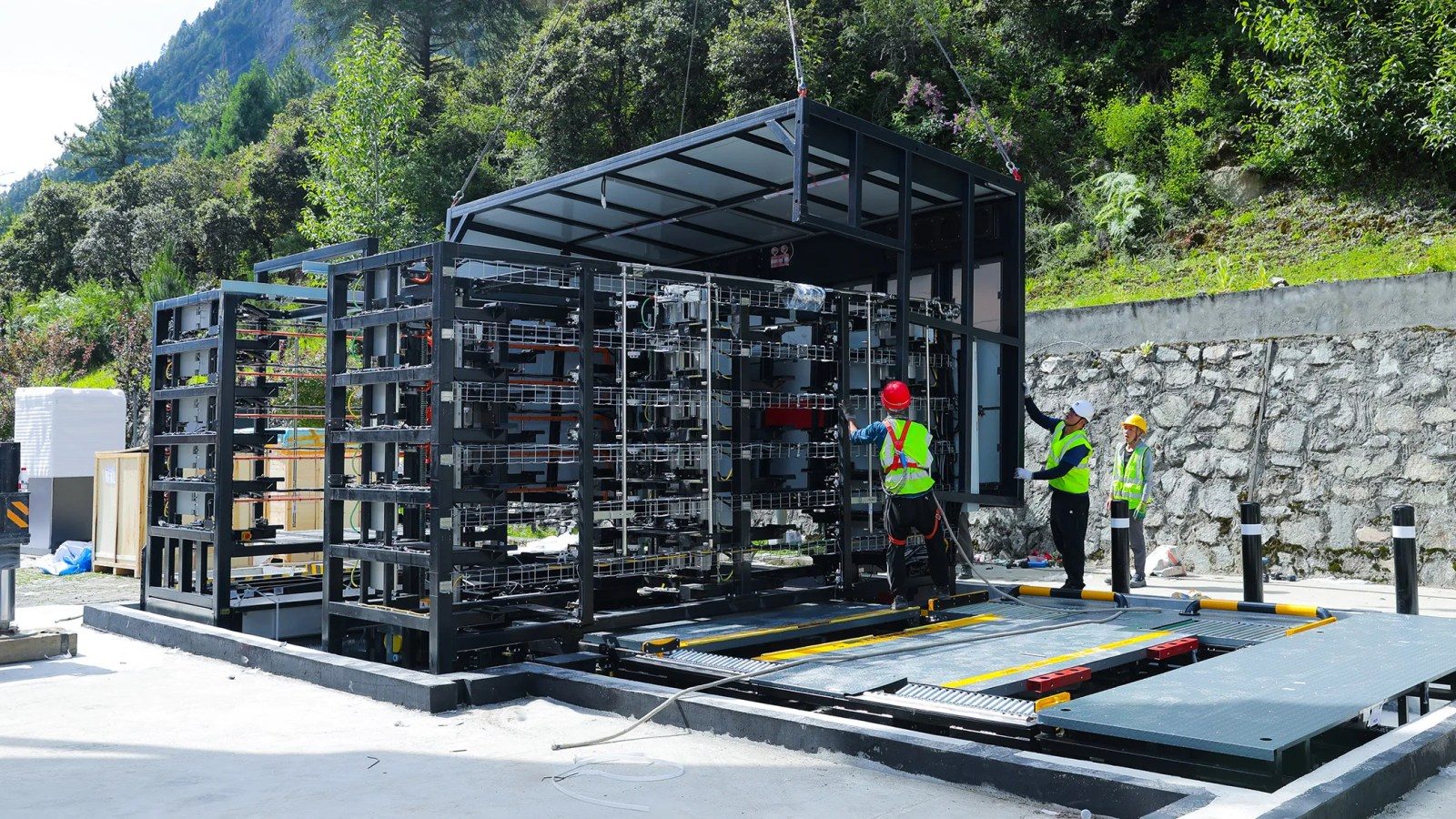

Chinese EV maker Nio is planning to deploy nearly half of its annual battery swap station target in the fourth quarter alone.
The information was revealed on a Wednesday update from auto blogger ‘轮上递归.’
The user shared a progress update on the rollout of the fifth-generation stations, noting that “the sites have already been secured — now just waiting for the 5th-gen stations.”
In a New Year’s Day letter to staff, CEO William Li wrote that “the full-year plan includes more than 1,000 new swap stations, with total stations exceeding 4,600 by year-end.”
Last December, Li had also said that “starting from Q2 next year, all the battery-swap stations we deploy will be fifth-generation stations.”
Earlier this year, however, Nio again delayed the mass deployment of the fifth-generation stations — to July or August.
It marked the third revision to a timeline that slipped repeatedly since the company first targeted a trial run before Christmas 2025.
Further details about the fifth-generation rollout are expected to be provided at the upcoming Beijing Auto Show.
First Stations
According to the blogger, Nio will deploy 10 pilot stations between June and early July.
This tracks with information previously confirmed by Nio’s sub-brand Firefly.
When announcing a facelift of its debut model last month, Firefly said “in May, we will launch the first batch of national pioneer stations, gradually opening them to users.”
Nio plans to build five to 10 pioneer stations between May and June, featuring a redesigned architecture to support the sub-brand, as the fifth-generation stations are tailored to Firefly‘s smaller battery pack.
Earlier this year, a Firefly vehicle was spotted testing at one in China — confirming brand chief Daniel Jin’s November statement that Firefly would adopt Nio‘s upcoming next-generation stations.
Wednesday’s post noted that “areas with more Firefly vehicles will be prioritized for 5th-gen station deployment.”
The nationwide rollout is then set to begin in August, with Nio deploying “over 100 stations per month” starting in September.
Q4 Rollout Plans
The auto blogger then revealed that, “from October to December,” Nio will “deploy over 150 stations per month.”
The monthly figures imply that 450 stations of the fifth generation are set to be deployed in the final three months of the year.
Li reiterated last month that the company’s target of adding more than 1,000 battery swap stations in China this year remains unchanged.
Taken together, the figures suggest Nio is back-loading its fifth-generation rollout to the fourth quarter — a single-quarter push that would account for nearly half of the full-year target.
Scale of Deployment
Since opening its first battery swap station in Shenzhen in 2018, the company has provided nearly 108 million battery swaps.
Nio completed its 100 millionth battery swap on February 6.
As of Thursday, the Shanghai-based EV maker operated 3,794 battery swap stations in China — up from 3,676 at the end of 2025.
The figures imply that the company has opened 118 new stations in the first three and a half months of 2026.
Since March 22, when the fifth-generation rollout was delayed, 33 stations were launched.
As of mid-April, progress stands at roughly 11.8% of the annual target.
Nio needs to deploy around 430 stations over the next six months to hit its goal, considering the 450 stations planned for the fourth quarter alone.
With 100 of those targeted to open in September, about 330 stations must be opened between mid-April and August — when the fifth-generation is scheduled to begin mass deployment.
2025 Target Missed
In 2021, Nio announced that it aimed to have over 4,000 battery swap stations worldwide by the end of 2025, including around 1,000 outside China.
However, these ambitious plans were later scaled back as deployment progressed more slowly than expected, namely overseas.
Nio had originally planned to install 2,000 new stations in 2025 across China — a goal that was later revised to between 1,800 and 2,000.
In early September, Nio founder and CEO William Li said the EV maker would fall short of its 2025 target as it reallocates resources toward the next-generation system
By the end of 2024, the company operated 2,995 battery swap stations in its domestic market.
Last year, 681 stations were added. The figures show that only 34.1% of the original guidance was met.
The company slowed station construction over the past two years to control capital expenditure, falling well short of its own targets.
Li acknowledged in September that deployment of fourth-generation stations had slowed specifically because they could not be upgraded to support the new battery sizes.
To reach its 2026 targets, Nio is increasingly relying on partnerships to share construction costs and revenue — an asset-light model it is also applying in overseas markets.
The company has also shifted its site selection strategy toward highway exits, a positioning it said can serve both highway transit and county-level markets simultaneously.
Competitive Pressure
Nio is facing intensifying competition in China’s battery swap and fast-charging infrastructure race.
CATL, the world’s largest EV battery maker and Nio’s primary cell supplier, launched its competing “Choco Swap” standard in December 2024.
The system — designed for cross-brand compatibility from day one — had 1,020 stations deployed across 45 cities by the end of 2025, and CATL has since raised its 2026 target to more than 3,000 stations.
Multiple automakers including GAC’s Aion and BAIC’s Arcfox have already announced Choco-compatible models.
Nio, by contrast, has signed battery swap alliance agreements with eight automakers since November 2023 but none have yet launched a compatible vehicle.
The fifth generation stations will be the first ones compatible with EVs from external brands.
BYD’s Fast Charge
BYD, meanwhile, recently unveiled a 1,500-kilowatt charging system capable of refilling a battery from 10% to 97% in nine minutes.
Chinese business outlet 36kr identified Nio as the primary target of BYD‘s new ultra-fast charging batteries, as the battery swap technology bets on the faster replenishment as one of its unique selling points.
At the unveiling event, BYD‘s General Manager of Branding and Public Relations Li Yunfei was asked whether the flash charging approach sparked a rivalry against battery swapping charging.
“I think both are actually quite good,” the manager stated, adding that “BYD has so many technologies, so many products, so many brands — all of it is ultimately about giving customers more choices.”
The company is targeting 20,000 FLASH Charging stations by year-end 2026 — more than five times Nio’s entire swap network built over eight years.
In an apparent indirect response to the comparisons between the two technologies, William Li stated on Weibo last month that battery swapping remains “the most convenient and efficient way to replenish energy.”
Additionally, he noted that the Shanghai EV maker has been “exploring how battery swap stations can participate in building a new electricity market and integrate vehicles with energy systems.”
Since 2022, several Nio battery swap stations have been included in grid regulation programs in China, focusing on reducing electricity demand during peak summer periods.
“Together with our industry partners, we will continue working hard to make this initiative — one that has long-term value for users, the industry, and society—more solid and reliable, so that people can buy cars with greater peace of mind and use them with greater confidence,” Li added.