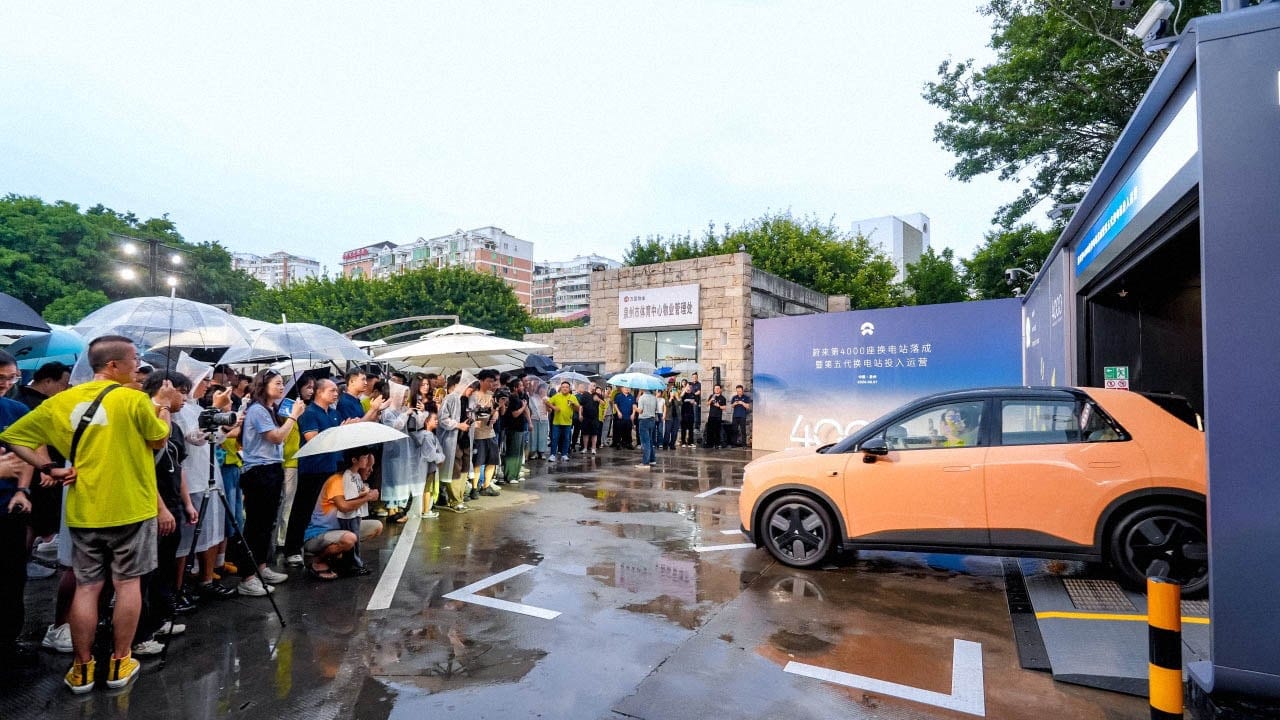

Nio opened its 4,000th battery swap station in China on Friday — the first of its fifth-generation stations — in Quanzhou, Fujian province, hours after the company said in a Weibo post that its cumulative swap count crossed 120 million.
The first batch of Gen-5 stations entered operation the same day across seven cities — Beijing, Shanghai, Guangzhou, Suzhou, Hefei, Chengdu and Quanzhou — and Firefly formally joined the swap system.
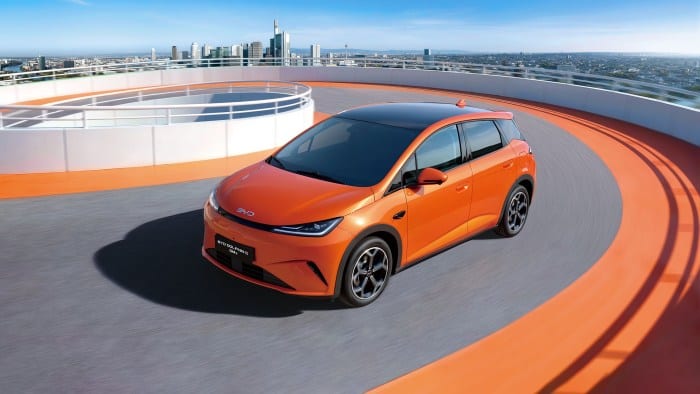
The new stations are the first to serve all three of the group’s brands alongside Nio and Onvo.
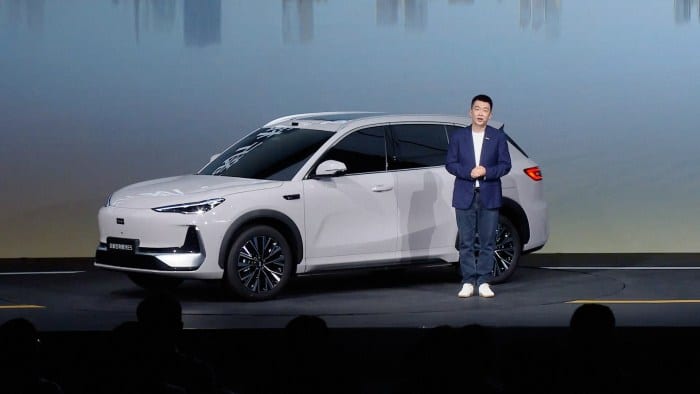
Speaking at the ceremony, founder and CEO William Li said the network has reached scale effects that make “recharging as convenient as refueling” and has become an important driver of the company’s vehicle sales growth.
Thursday’s mark arrives roughly 18 months after the network crossed 100 million swaps in February 2025, a pace of about 1.1 million swaps a month since.
What the Fifth Generation Changes
The new stations cut the fastest swap time to 1 minute and 48 seconds while keeping the three-minute full experience
Battery bays are flexibly configurable between 21 and 28 packs, single-station capacity rises to as many as 500 swaps a day, and each site integrates 500 kW ultra-fast charging piles alongside the swap line.
Underneath sits a newly self-developed swap platform that adapts to different chassis structures and battery-pack sizes, adjusting its own geometry in real time to locate each vehicle’s fastening bolts.
The platform supports wheelbases up to 3.5 meters and covers every model across the three brands, from the Firefly hatchback to the largest SUVs.
The company says the design also deepens two functions it has been building into the network for years: automated battery health checks on every swap, and grid-services capability that lets stations absorb renewable generation and shave demand peaks.
Development of the format stretches back well over a year: internal test stations opened at the end of March 2025, a handful of pioneer sites followed for user trials that summer, and Nio announced the large-scale rollout this month.
The Numbers Behind the Milestone
Alongside the swap count, Nio published cumulative figures for the network’s output.
Swapped energy totals 6.35 billion kWh, which the company equates to a full year of household electricity for more than 3.17 million homes.
Against conventional charging, Nio says swapping has saved users a combined 99.91 million hours of waiting — an average of 83 hours per user — and against refueling a combustion car, roughly 31.2 billion yuan ($4.6 billion), or about 26,000 yuan ($3,900) per user.
The broader energy network now spans 9,166 charging and swap stations combined — 4,006 swap stations, 5,160 charging stations and 29,801 charging piles, per the company — including 1,049 highway swap stations connecting 550 cities in what the company calls its nine-vertical, eleven-horizontal, sixteen-city-cluster expressway grid — with 80.1% of users living or working within three kilometers of at least one swap station, per the company.
A Target Still Out of Reach
The 4,000th station lands against a 2026 buildout target the current pace does not support.
Nio has added about 406 stations in China this year — 40% of the more than 1,000 it has targeted for 2026, a goal that would lift the domestic network above 4,600 by December.
At roughly 45 new stations a month, the run rate remains well below what the target requires, even as Li has repeatedly reaffirmed it and said the company now has the capacity to build between 1,000 and 1,500 stations annually.
CATL is closing in on Nio’s swap-station count with its own rapidly expanding network.
Europe Watches From a Standstill
None of Thursday’s momentum extends to Europe, where the swap network has been effectively frozen at fewer than 65 stations.
As EV exclusively reported, Nio closed its only Danish station last November — the first swap facility it had shut anywhere in Europe since arriving in 2021.
The continent’s 300,000th swap, completed in June, took 307 days to arrive, 38 days longer than the previous hundred thousand despite more vehicles on the road.
Management has said the decision to deploy swap stations in Nio’s new distributor-run European markets rests with each distributor.
None has announced one as of Friday.
The Norwegian team announced in June that a new one is set to open near the capital Oslo later this year, which would mark the first battery swap station to be installed in Europe in 2026.
With the Chinese network at 4,006 stations, the global count stands at 4,067, including the 60 in Europe and one in the United Arab Emirates.